


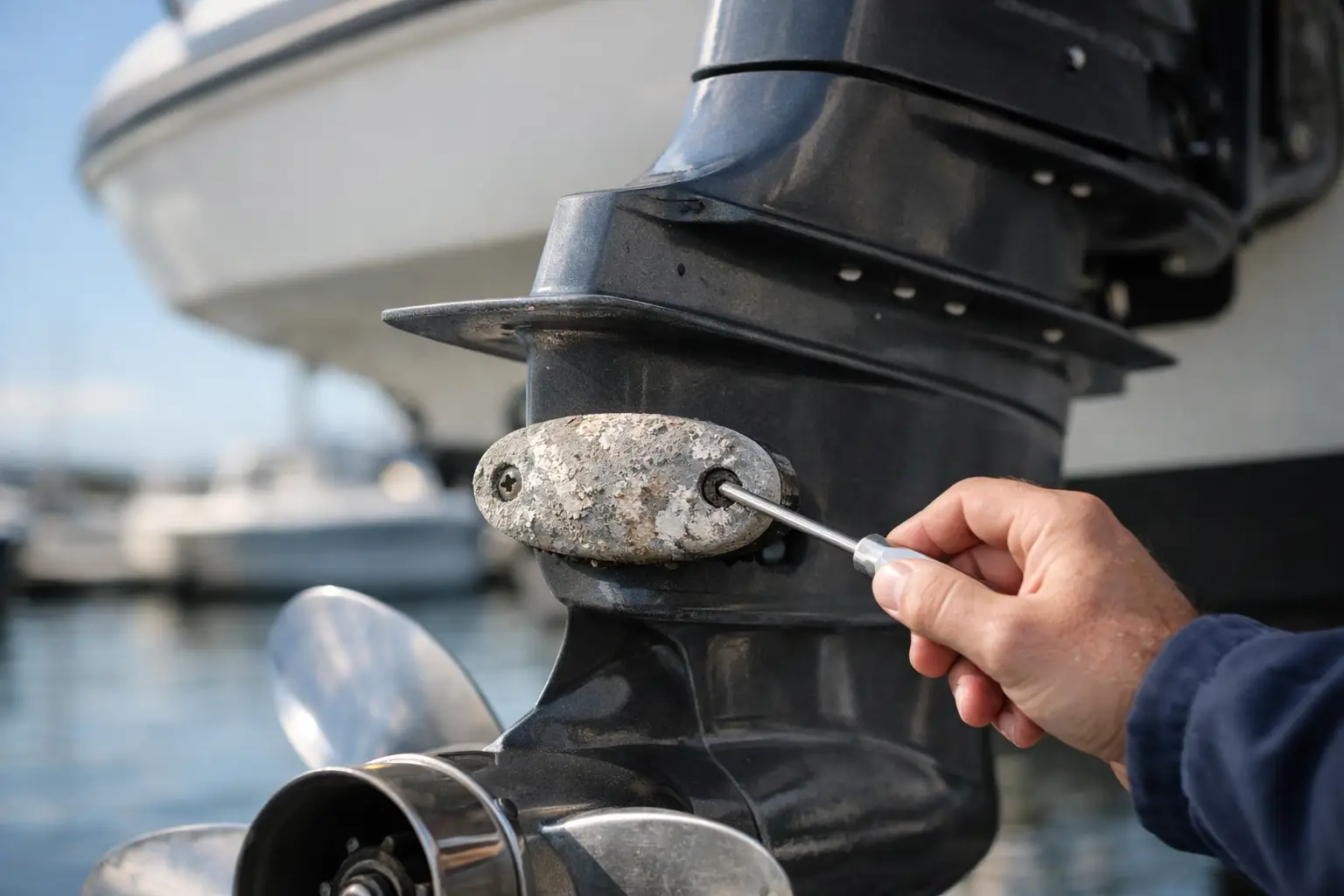
Anode consumption does not automatically indicate a problem—it means it is performing its protective function. Issues arise when it corrodes incorrectly, too quickly, or does not respond at all. Therefore, the question of how to check anode corrosion is not only part of regular hull maintenance but a crucial step in protecting the propeller, shaft, Z-drive, rudder, heat exchangers, and other metal components of your vessel.
On the Adriatic Sea, anode conditions may change within a single season, especially on vessels that remain in marinas for extended periods, frequently use shore power, or have complex electrical systems. A visual inspection provides an initial overview, but reliable diagnostics require understanding the anode type, its system location, and possible sources of stray currents.
What Anodes Protect and Why They Are Intentionally Consumed
Sacrificial anodes are made from metals that will electrochemically react before the protected metal does. Zinc or aluminum anodes are most commonly used in seawater, while magnesium is applied in freshwater. Their task is to absorb corrosion instead of bronze propellers, shafts, Z-drive housings, trim tabs, or other underwater metal components.
This is a controlled process. Moderate and uniform anode wear generally indicates that cathodic protection is effective. However, a fully consumed anode, deep uneven holes, wear confined to one side only, or a new anode appearing untouched for months require a more detailed inspection.
Anodes are not universal consumables. Incorrect material, wrong size, or poor electrical contact can leave metal parts unprotected. Likewise, oversized or unsuitable anodes can create conditions on certain components that are not intended by their design.
How to Check Anode Corrosion During Vessel Inspection
The most practical inspection is performed when hauling the vessel out of water, making all underwater parts accessible. If the vessel remains in water, diving inspection can be helpful, yet precise evaluation of shafts, screws, joints, and housings often requires dry inspection.
First, compare the current condition with photos or records from the last service. Without an initial reference, it is difficult to assess whether the anode is 20% or 60% consumed. For year-round used vessels, it is recommended to record the condition at least once before the main season and again at haul-out.
Visually check the following indicators:
- remaining anode mass and uniformity of its wear
- cracks, breaks, detachment from mounts, or missing parts
- hard white deposits, metal color, and surface texture
- condition of screws, clamps, bonding conductors, and contact surfaces
- signs of corrosion on the propeller, shaft, Z-drive, trim tabs, and through-hull valves.
It is common to replace an anode when approximately half of its original mass has been consumed. Waiting until it is completely gone is not economical maintenance. Once the protective material disappears, corrosion may spread to far more expensive components, with damage sometimes developing in areas not visible without disassembly.
Pay special attention to the contact between the anode and the metal it protects. Thick antifouling coatings, oxidation, grease, or poorly tightened screws can electrically isolate the anode. The anode may then appear nearly new while the propeller, shaft, or drive housing suffers corrosion. When replacing, contact surfaces must be clean and fasteners properly installed and tightened according to the manufacturer's specifications.
Recognizing Normal Wear, Electrolysis, and Galvanic Corrosion
Even matte wear and gradual volume reduction are usually expected signs of anode operation. However, wear rate depends on the material, water temperature and salinity, continuous or occasional shore power use, neighboring vessels, bonding system quality, and the type of underwater metals on the vessel.
Galvanic corrosion occurs when different metals are electrically connected and immersed in an electrolyte, i.e., seawater. The difference in their electrochemical potentials causes the less noble metal to corrode. Anodes are precisely intended to serve as sacrificial parts in this relation, but their protection has limits.
Electrolytic corrosion, often called electrolysis, is associated with direct current escaping undesirably into the water. It can result from DC installation faults, damaged devices, improper grounding, charger problems, inverters, shore power installations, or even neighboring vessels and marina infrastructure. In such cases, anodes may corrode very rapidly, and metal parts may show localized damage, pitting, or erosion.
Rapid anode loss within weeks is not a reason just to install larger anodes and keep sailing. It is a symptom requiring diagnosis. Replacing the anode without finding the cause may temporarily mask the problem but does not protect the installation or valuable underwater components.
Electrical Testing Provides Answers Visual Inspection Cannot
Visual inspection should be complemented by measurements. Technical checks analyze the potentials of underwater metals relative to a reference electrode, continuity of the bonding system, and potential presence of undesired DC voltage. Measurements are performed with appropriate instruments according to the propulsion type, vessel materials, and manufacturer's values.
It is important to evaluate the vessel under real operating conditions. If the problem is related to shore power, measuring only after disconnecting the cable may give a falsely reassuring result. The condition should be monitored with the shore-power connected, active chargers, inverter, generator, and major DC consumers active, while observing safety procedures.
A galvanic isolator or isolation transformer can be part of a properly designed solution for vessels connected to shore power. However, their installation is not a substitute for correct AC and DC wiring. Compatibility with the existing system, rated current, grounding method, protective devices, and overall vessel configuration must be checked.
Common Mistakes When Replacing Anodes
The most frequent mistake is choosing the material out of habit rather than based on usage conditions. Zinc, aluminum, and magnesium have different applications. A vessel operating between seawater, rivers, and lakes may require a different approach than one permanently moored in a saltwater marina.
Another mistake is replacing only the easily accessible anode. The shaft anode may be new while anodes on the Z-drive, trim cylinders, thrusters, heat exchangers, or other systems are neglected. On larger yachts and multi-engine vessels, the inspection must cover the entire underwater and electrical systems, not only the propeller.
The third mistake is coating anodes with antifouling or leaving a coating on their contact surfaces. The anode must have direct contact with seawater and an appropriate electrical connection to the component it protects. Also, commercial products with similar appearance are not necessarily of the same composition. Alloy quality is important for predictable anode performance.
When to Engage Professional System Diagnostics
A professional inspection is recommended when accelerated anode consumption, propeller or drive corrosion, recurring issues after replacement, unclear or improvised electrical modifications, or when the vessel remains connected to shore power for extended periods are observed. This is especially relevant for vessels with inverters, higher capacity chargers, LiFePO4 battery systems, generators, electric propulsion, and numerous DC consumers.
Such an inspection does not view the anode in isolation. It checks the condition of underwater metals, bonding and grounding, AC and DC distribution, battery charging, shore-power connection, and the mutual compatibility of installed components. Based on findings, it may be determined whether anodes should be replaced, connections repaired, electrical installations corrected, or appropriate protection against galvanic currents implemented.
UnLucky performs diagnostics of marine electrical and energy systems and technical inspection of existing installations before proposing measures. If your anode condition deviates from the expected, send an inquiry with vessel data, propulsion, connection points, and photos of underwater parts. Preventive inspection before corrosion affects an expensive component is always a better decision than relying on luck. Because Luck Has Nothing to Do With It.