


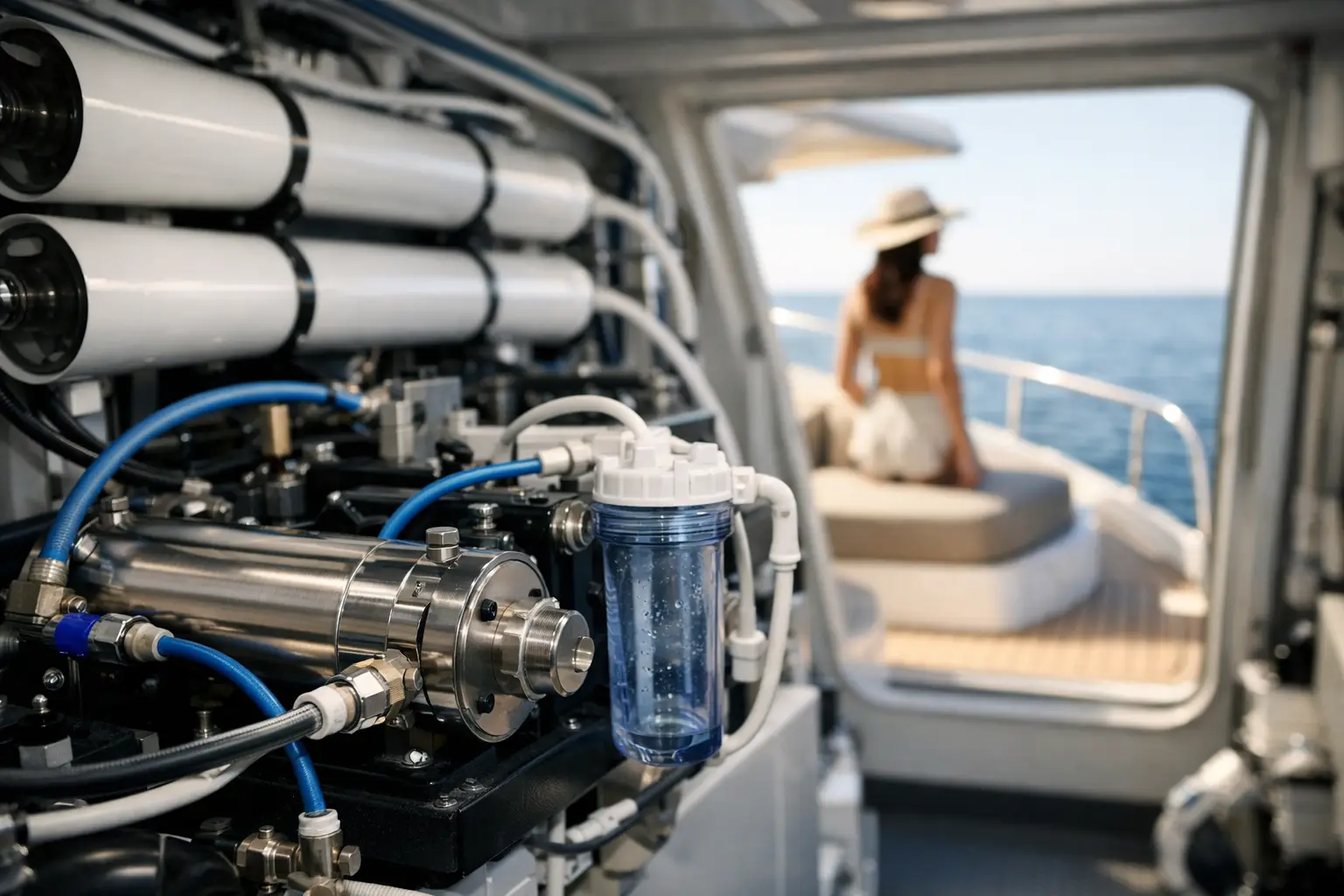
After several days at anchor, fresh water tanks often determine the pace of sailing more than fuel. Showering, food preparation, deck washing, and the daily needs of the crew quickly deplete the available supply, especially on yachts and catamarans with multiple people aboard. A watermaker for yacht allows production of drinking water from seawater, but its real value depends on correct sizing, input water quality, and integration with your vessel's systems.
A watermaker is not a device installed based on the daily production figure from a catalog. It must correspond to the vessel's usage pattern, battery and generator capacity, available space, existing plumbing installation, and maintenance plan. Incorrectly chosen or haphazardly installed systems can consume excessive energy, complicate servicing, and produce water of variable quality.
When a Watermaker for Yacht Makes Sense
A watermaker is most sensible on vessels that regularly stay outside marinas, sail longer routes, or have higher water consumption due to crew size, charter operation, or comfort equipment. During multi-day anchoring, it reduces the need for frequent trips ashore and dependence on the water quality available in individual ports.
However, autonomy is not the only criterion. The vessel owner must accept that the system demands electrical energy, periodic rinsing, filter replacement, and operational monitoring. For vessels mostly moored and sailing only occasionally for day trips, the added complexity may not be justified. Conversely, for yachts with continuous crew or frequent guests during the season, a properly executed water supply system can significantly ease operational management.
How a Watermaker Produces Fresh Water
Most marine watermakers operate on the principle of reverse osmosis. A low-pressure pump draws seawater through pre-filters, then a high-pressure pump pushes the water towards the membrane. The membrane allows water molecules to pass through while salts and most impurities are discharged in concentrate back to the sea. The produced fresh water then undergoes quality control before being routed to the tank.
That is why a watermaker is not just a single unit in the engine room or storage area. Its operation depends on the intake water, valves, filtration, high-pressure piping, concentrate discharge, electrical power supply, and connection to the potable water tank. Advanced versions also feature automatic flushing, salinity measurement, remote control, and integration with vessel monitoring systems.
The quality of intake water directly affects reliability. Harbor water, areas near discharges, turbid waters after storms, and zones with a high concentration of algae are poor locations for production. Pre-filters can clog quickly, and the membrane may be unnecessarily stressed. The system should be used according to marine conditions, not as a substitute for basic assessment of where and when it is safe to take seawater.
Capacity Is More Than Just Liters per Hour
A common mistake is selecting a device based on maximum declared production. Actual daily consumption must be assessed first. A two-person crew on a sailing yacht has significantly different needs compared to an eight-person charter crew on a catamaran, or a motor yacht with a washing machine, ice maker, and multiple bathrooms.
When choosing, four related data points are analyzed:
- Number of persons onboard and expected daily consumption
- Duration outside the marina and water tank capacity
- Available electrical power during watermaker operation
- Installation location, service access, and piping design
A larger capacity system can operate for a shorter time to produce the required quantity, but typically demands more power, space, and higher upfront investment. An undersized system may run too long, burden the battery system, and reduce water availability precisely when it’s needed most. Proper sizing is based on daily usage profiles, not the assumption that a larger unit is always better.
Electrical Power and Integration with the Rest of the Vessel
A watermaker may be powered by AC or DC current depending on design and intended operation mode. On vessels with a generator, it is often logical to plan water production while the generator runs for other consumers. On vessels with well-designed battery systems, solar panels, and chargers, a DC watermaker can enable quieter operation without starting the generator.
Such a decision must not be made in isolation. Battery capacity, allowed continuous inverter load, wire gauges, circuit protection, and priorities of other consumers must be verified. The LiFePO4 battery system can handle higher loads well but only if the entire installation is properly designed, including BMS, fuses, busbars, and charging.
Automatic start and unattended operation require particular attention. Automation can be helpful but must not circumvent system safety conditions. Water tank level, pre-filter status, produced water quality, and power availability must be part of control logic. For more complex vessels, we recommend linking key alarms to existing vessel monitoring systems.
Installation Location Determines Service Ease
A watermaker should be installed in a dry, ventilated, and accessible space protected from direct splashing, mechanical damage, and unnecessary heat. A compact unit tucked behind tanks or under difficult-to-access paneling may fit during installation, but filter changes, joint inspection, or membrane preservation later will take excessive time.
Intake sea water location is also important. The intake must not draw air, has to be equipped with appropriate valves and filters, and be separated from contamination sources. Concentrate discharge must be correctly connected without risk of water backflow or overloading other systems. High-pressure lines require suitable components, proper mounting, and inspection after commissioning.
Connecting produced water to an existing tank must also be carefully managed. Water from the watermaker should not mix uncontrolled contents in the tank if the water there is of questionable quality. Depending on vessel design, a separate supply, valve diversion, additional disinfection, or changing tank filling methods may be necessary.
Maintenance Starts Before First Operation
The membrane is a critical and sensitive system component. Regular flushing with fresh water reduces salt deposits, while timely pre-filter replacement protects pump and membrane from impurities. If the watermaker will be inactive for an extended period, it must be preserved according to prescribed procedures. Leaving the system unflushed after the season can lead to microbial growth and reduced membrane performance.
Preventive maintenance usually includes inspection of pre-filters, pumps, pressures, joints, valves, and electrical connections, plus checking salinity of produced water. Production drops or quality deviations are not always caused by the membrane itself. The problem may be a clogged filter, suction leak, incorrect pressure setting, worn pump, or control error.
Diagnostics therefore must follow the full path of water and energy through the system. Replacing parts without measurement and checks can increase cost without resolving the root cause of failure.
Equipment Selection and Professional Commissioning
Before selecting a watermaker, actual vessel condition must be reviewed: available space, sea intake, tanks, existing electrical system, generator operation mode, piping possibilities, and service access. Only then can the appropriate device category, production capacity, and automation level be defined.
UnLucky provides technical consulting, compatibility verification, design, installation, and integration of watermakers with water and electrical systems onboard. After installation, configuration, pressure and flow verification, produced water quality testing, and commissioning follow, along with clear instructions for regular use and maintenance.
If you plan installation or have an existing system with performance drop, send an inquiry with vessel data, number of persons onboard, sailing mode, and existing electrical system. Precise watermaker planning is not a matter of luck. Because Luck Has Nothing to Do With It.