


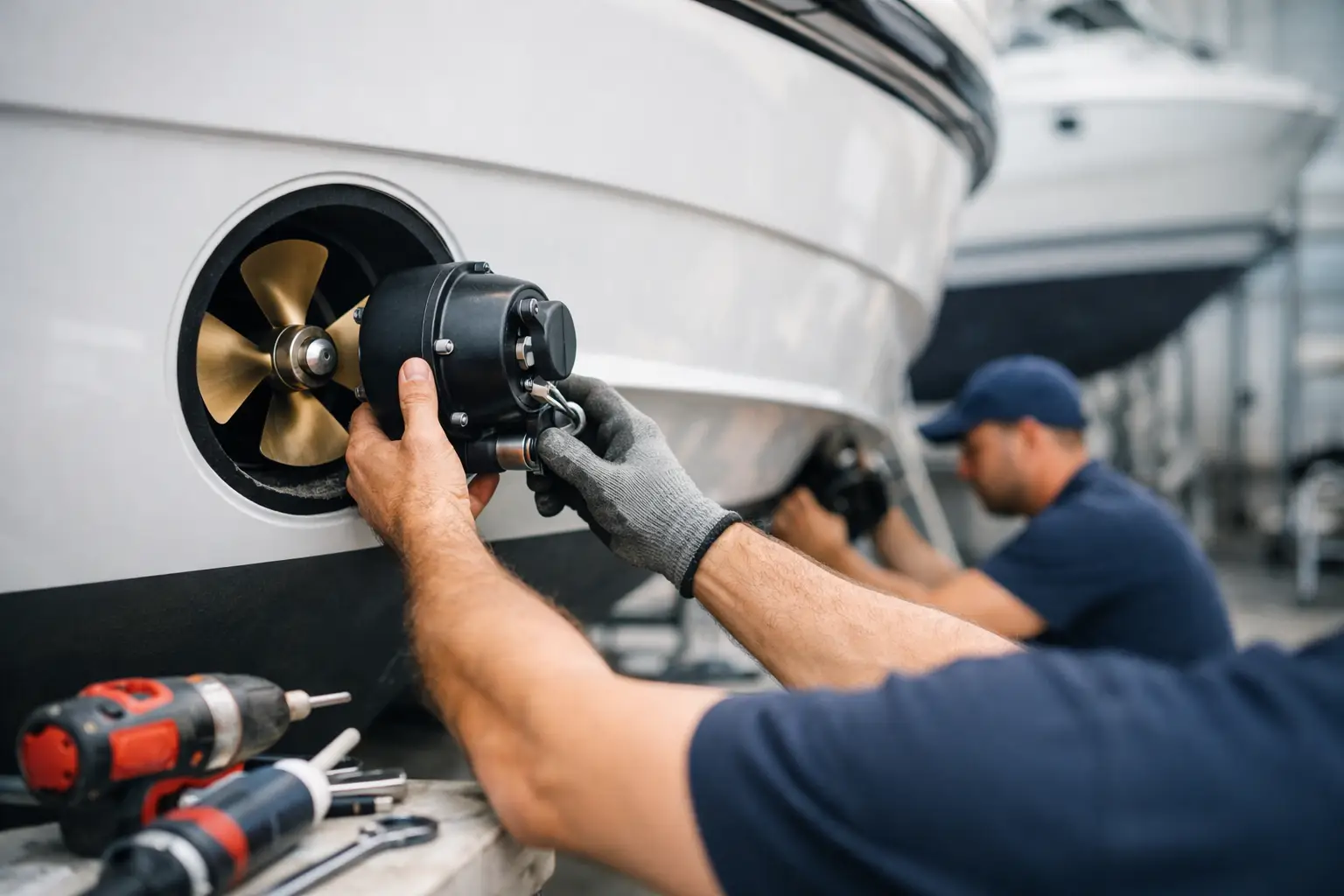
Side docking in crosswinds, turning in tight marinas, or controlling the bow while the stern is not yet fully under engine control—these are precisely the situations where the true value of a well-executed system becomes evident. Installing a bow thruster can significantly improve maneuverability, but only if the thruster is properly dimensioned, integrated into the structure, and connected to your vessel's electrical system.
A bow thruster is not a substitute for good judgment, rudder operation, and safe maneuvering. It is an auxiliary propulsion that gives you or your crew additional control during short, demanding moments. An inappropriate model, undersized cables, or a poorly positioned tunnel can reduce its effectiveness, increase battery load, and create technical problems that often appear only mid-season.
When Installing a Bow Thruster Makes Sense
On a sailboat with high freeboard, a motor yacht with a large lateral surface area, or a catamaran frequently docking in tight berths, a bow thruster can substantially ease daily vessel handling. It is also useful when the vessel is handled by a small crew, often docked without shore assistance, or operated in marinas exposed to crosswinds and currents.
However, the decision does not depend solely on vessel length. Weight, hull shape, draft, superstructure height, ballast distribution, propulsion type, and expected usage play equally important roles. A thruster that fits the vessel length on paper may be underpowered for a yacht with significant wind resistance. Conversely, an unnecessarily powerful system increases cost, battery demands, and installation load without proportional practical benefit.
Therefore, the first step is not choosing a catalog model but conducting a technical assessment of your vessel and existing systems.
Choosing Power: Thrust Is More Important than Nominal Rating
Bow thrusters are typically compared by thrust expressed in kilograms-force. This figure indicates how much lateral force the system can exert on the bow but is not the sole criterion. Real efficiency depends on thruster position, tunnel depth, thruster condition, voltage under load, and hydrodynamic conditions around the hull.
When selecting, we estimate the required thrust relative to displacement and lateral surface area. Special attention is needed for vessels with high bows, superstructures, or flybridges, as wind affects them more intensely than the vessel's mass alone suggests. For charter vessels, frequency of use and ease of operation for different users are also important.
Additionally, it must be decided whether a classic tunnel thruster, vertical model, external retractable system, or a special installation solution suits your vessel. Tunnel thrusters are often a rational choice when the bow structure allows proper tunnel positioning. Retractable versions may be preferable to reduce hydrodynamic resistance while underway but require more space, complex mechanics, and disciplined maintenance.
Tunnel Position Determines Actual Performance
The tunnel must be positioned as close to the bow as possible while sufficiently deep below the waterline. If too close to the surface, the thruster may draw in air during operation, losing thrust. If too far from the bow, the lever arm acting on the vessel is reduced, requiring more power for the same effect.
The geometry of the tunnel's inlet and outlet openings also affects performance, noise, and resistance during navigation. Poorly shaped openings can create turbulence, and inadequate lamination or sealing pose risks to the hull's structure and watertightness. For GRP vessels, work includes precise cutting, surface preparation, laminating, finishing, and appropriate underwater protection.
For aluminum, steel, or wooden hulls, the procedure differs and requires material-compatible solutions. No universal installation method exists. Hull structure, available space, frames, tanks, and existing installations must be reviewed before defining the scope of work.
The Thruster Must Operate in Clean Water
Tunnel position must not be determined solely by accessibility from inside the vessel. The effect of the keel, bow lines, sea intake, sensors, existing hull passages, and structural elements must be checked. The goal is to ensure the thruster has sufficiently clean water for operation with minimal negative impact on navigation characteristics.
On vessels moored long-term in the sea, anti-fouling protection is important. Deposits on the tunnel and thruster can noticeably reduce thrust and increase power consumption. Regular underwater inspections should be part of maintenance planning, especially before the main season.
Electrical Installation Is Not a Secondary Project Part
The bow thruster draws high current during operation over short periods. Therefore, service and starting battery condition, battery system capacity, cable cross-sections, wiring length, main fuses, circuit breakers, and connections must all be compatible with the selected device. A system that works properly at idle may lose power under real load due to voltage drop.
Sometimes the installation of a dedicated bow thruster battery near the thruster, with the appropriate charging system, is justified. In other cases, it is better to use the existing battery system but upgrade cables and protection. The choice depends on vessel layout, battery types, existing chargers, alternators, solar production, and expected operating regime.
Particular care must be taken when integrating with LiFePO4 batteries. They can deliver high current, but the BMS, protective elements, and charging configuration must be designed for such loads. Improper integration may cause BMS protection activation precisely when thruster assistance is most needed during maneuvering.
Installation includes properly dimensioned conductors, quality cable terminations, mechanical protection against abrasion, moisture protection, and clearly marked fuses. Every connection must be accessible for inspection and constructed to withstand vibrations and the marine environment.
Control, Safety, and Commissioning
The control panel, joystick, or remote control should be positioned for natural access from the vessel's operating position. On larger yachts, integration with additional control stations is possible, but each integration requires priority command verification, safety locks, and system behavior checks in case of voltage drops or communication loss.
The job does not end after physical installation. Commissioning includes verifying rotation direction, measuring voltage under load, checking connections, testing control functions, and inspecting for any unusual noise, vibrations, or overheating. If an additional battery is installed, its charging from all relevant sources must be checked.
Users must be clearly informed about system limitations. The bow thruster is intended for short operation cycles, not continuous holding alongside in strong wind. Prolonged use can trigger thermal protection or unnecessarily strain the electrical installation.
Preventive Maintenance Preserves System Availability
Regular service reduces the risk of thruster failure after wintering or during the busiest part of the season. Inspections cover thruster and tunnel condition, corrosion signs, anodes where applicable, seals, electrical connections, fuses, and control system operation. Symptoms such as reduced thrust, slower response, voltage drops, or unusual sounds require diagnostics before the problem escalates into a failure.
UnLucky approaches such projects as system integration rather than standalone device installation. We assess structural possibilities, electrical infrastructure, and vessel usage, then define a compatible solution, perform installation and integration, and conduct commissioning and technical checks.
If you are considering installation or replacement of an existing bow thruster, please send an inquiry with basic vessel data, existing battery installation, and usage patterns. A properly prepared system provides control when maneuvers are most demanding - Because Luck Has Nothing to Do With It.