


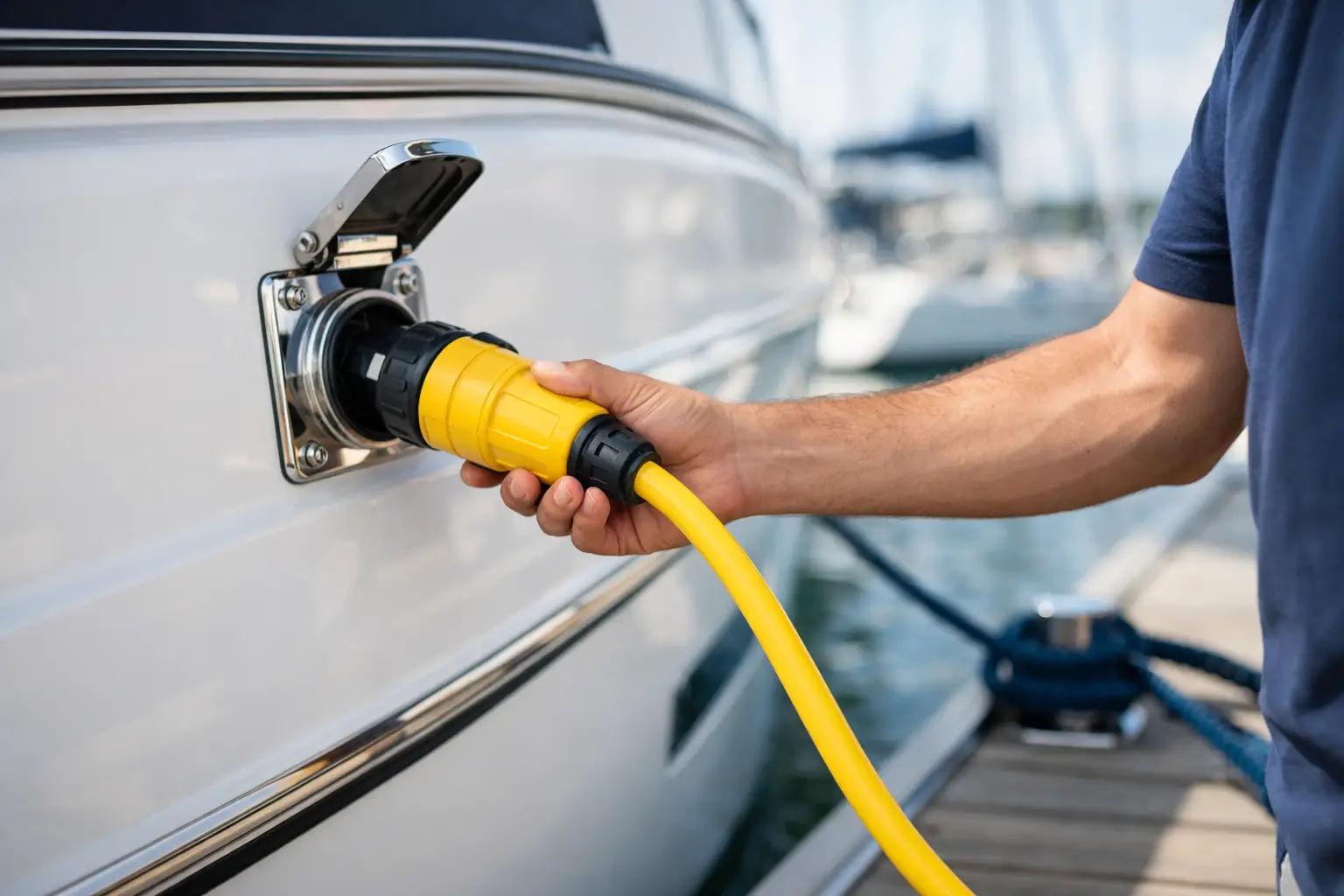
The connection cable between the shore and the vessel is often regarded as a simple accessory until circuit breakers trip, the charger fails to charge batteries, or metallic parts in the water begin to corrode rapidly. The question of how to connect shore power is not merely about plugging the connector into the socket. It involves linking the external grid to your vessel's electrical system, and this transition must be properly designed, protected, and verified.
Shore power enables charging service and starter batteries, operation of chargers, boilers, air conditioners, sockets, household appliances, and other AC consumers while the vessel is in the marina. At the same time, the wrong cable, inadequate protection, or poorly executed grounding can cause electrical faults, equipment damage, fire, or increased galvanic corrosion. For higher-value vessels, charter fleets, and professional systems, improvisation has no place.
Check What Your Vessel Accepts Before Connecting
The first check is not on the pontoon but at the vessel's main panel and installation documentation. It is necessary to know whether the system is designed for single-phase 230 V power, three-phase 400 V power, or a combination of multiple independent inputs. You should also verify the rated current of the connection—most commonly 16 A or 32 A, and higher on larger yachts.
The voltage, number of phases, and rated current of the shore socket must match the vessel's installation. Connecting a single-phase vessel to a three-phase outlet using an unverified adapter may lead to incorrect load distribution or serious equipment damage. An adapter is not a technical substitute for a properly dimensioned and protected installation.
Inspect the shore cable condition as well. The cable must be marine-grade, sufficiently flexible for outdoor conditions, of appropriate conductor cross-section, and free from cracks, deformation, signs of overheating, or contact oxidation. A 16 A cable is not intended for 32 A loads, even if a physical connection can be made with an adapter. Length also affects voltage drop, especially when chargers, boilers, or air conditioning operate simultaneously.
The Socket on the Vessel Is Not a Common Household Socket
The shore connection should be executed as a dedicated inlet with a cover, mechanical strain relief for the cable, and protection against moisture ingress. Behind the inlet follow the main switch, overcurrent protection, residual-current device where specified by the design, and systems for monitoring polarity, voltage, and frequency when the vessel configuration requires.
A household extension cord run across the deck is not a substitute for a shore power cable. It is not intended for the wet marina environment, mechanical loads, UV exposure, or specific connection standards. Furthermore, weak connections in adapters and extension cords create transition resistance, which under load converts into heat.
Step-by-Step Procedure for Connecting Shore Power
Safe connection begins when the shore outlet is switched off. If the marina has its own connection procedure, it takes precedence, especially with locked cabinets, smart meters, and systems with remote control.
First, check that there is no visible damage to the vessel's inlet, that the cable is dry, and contacts are neither tarnished nor loose. Then, on the vessel's AC distribution panel, switch off larger consumers. Leave the main AC switch in the position documented in your installation procedure but do not switch on consumers before verifying power quality.
Typically, the cable is first connected to the vessel's inlet, then to the switched-off marina socket. After mechanically verifying the connection, activate the shore outlet. This order reduces the possibility that the free cable end remains live on deck or pontoon. When disconnecting, reverse the procedure: turn off the shore outlet, disconnect the cable from shore, then from the vessel, and store it properly without sharp bends and without leaving connectors in the water.
After powering up, verify that the vessel panel shows correct voltage and, where an indicator exists, proper polarity. Only then gradually switch on consumers. If the circuit breaker trips, if a smell of heated plastic is detected, if the charger signals a fault, or the connection heats up, immediately cut power. Do not repeatedly switch the breaker without diagnosing the cause.
The Charger, Inverter, and Battery System Must Operate as a Unit
On many vessels, shore power primarily serves to operate battery chargers. This does not mean every charger is suitable for every battery system. AGM, GEL, classical lead-acid, LiFePO4, and sodium-ion batteries have different requirements for charging profiles, voltage thresholds, and temperature compensation.
If the vessel has been upgraded to LiFePO4 batteries, communication between the BMS, charger, alternator, solar regulator, and inverter must be verified. A charger that has operated correctly for years with lead-acid batteries may be unsuitable without configuration changes or additional protective elements. The BMS can disconnect the battery at low temperature, overvoltage, or other protective conditions, and the system must remain predictable for both the user and sensitive DC consumers.
Combined inverter-chargers additionally require operation mode verification. It is necessary to clearly define when shore power is used, when energy from batteries is converted to 230 V, and how it behaves during power loss from the marina. Improperly executed source transfer can create back-feed, unwanted battery discharge, or damage to sensitive electronics.
How Many Consumers May You Connect?
The answer depends on the available current at the connection and the actual load. A single-phase 16 A connection at 230 V theoretically provides about 3.7 kW, but this is not an invitation to operate the system continuously at the limit. Chargers, boilers, heaters, air conditioners, and power tools can quickly exceed the available power.
A practical approach is to stagger large consumers. If you are charging a large battery bank and heating the boiler, it may not be the time for simultaneous operation of the air conditioner or refit tools. Vessels with higher energy needs often require upgrades to 32 A, separate connections, or three-phase solutions, but only after assessing the existing distribution, charger, inverter, and loads.
Grounding and Galvanic Corrosion Are Not Details to Skip
Shore power connects the vessel's protective conductor to the land electrical network. This connection has a safety function but can open paths for small DC potentials between vessels in the marina. The consequence can be accelerated galvanic corrosion of underwater metal parts, anodes, shafts, propellers, and other elements.
The solution depends on vessel construction and the entire electrical system. A galvanic isolator can block low-voltage galvanic currents while maintaining the grounding protective function, whereas an isolation transformer fully galvanically separates the vessel network from shore. Isolation transformers are often technically more demanding and costly, but for certain vessels and long-term marina stays provide a higher level of separation.
Neither solution should be installed blindly. Incorrectly executed protective conductor or improperly connected neutral point can compromise protection device operation. An inspection of the existing installation, measurements, and confirmation of operation after commissioning are necessary.
When Professional Installation Inspection Is Required
If fuses or residual-current devices occasionally trip, the connection heats up, batteries do not charge at expected rates, or anodes wear unusually fast, the problem should not be dismissed as "bad electricity in the marina." The cause might be the cable, charger, insulation of an individual AC device, neutral and protective conductor connection, inverter, or installation at the mooring itself.
Professional shore power inspection includes technical compatibility verification of the connection, cable and connector inspection, distribution panel control, measurement of voltages and protective conductors, and operation check of charger, inverter, and battery systems under load. When upgrades are required, solutions should be designed based on actual consumption and vessel usage, not only the rated power of a single device.
UnLucky carries out diagnostics, design, installation, and integration of shore power with chargers, inverters, battery systems, and galvanic corrosion protection. Send an inquiry with data about your vessel, existing connection, batteries, and consumers you wish to use at the berth. Reliable shore power does not start at the end of the cable but with a verified system behind it. Because Luck Has Nothing to Do With It.