
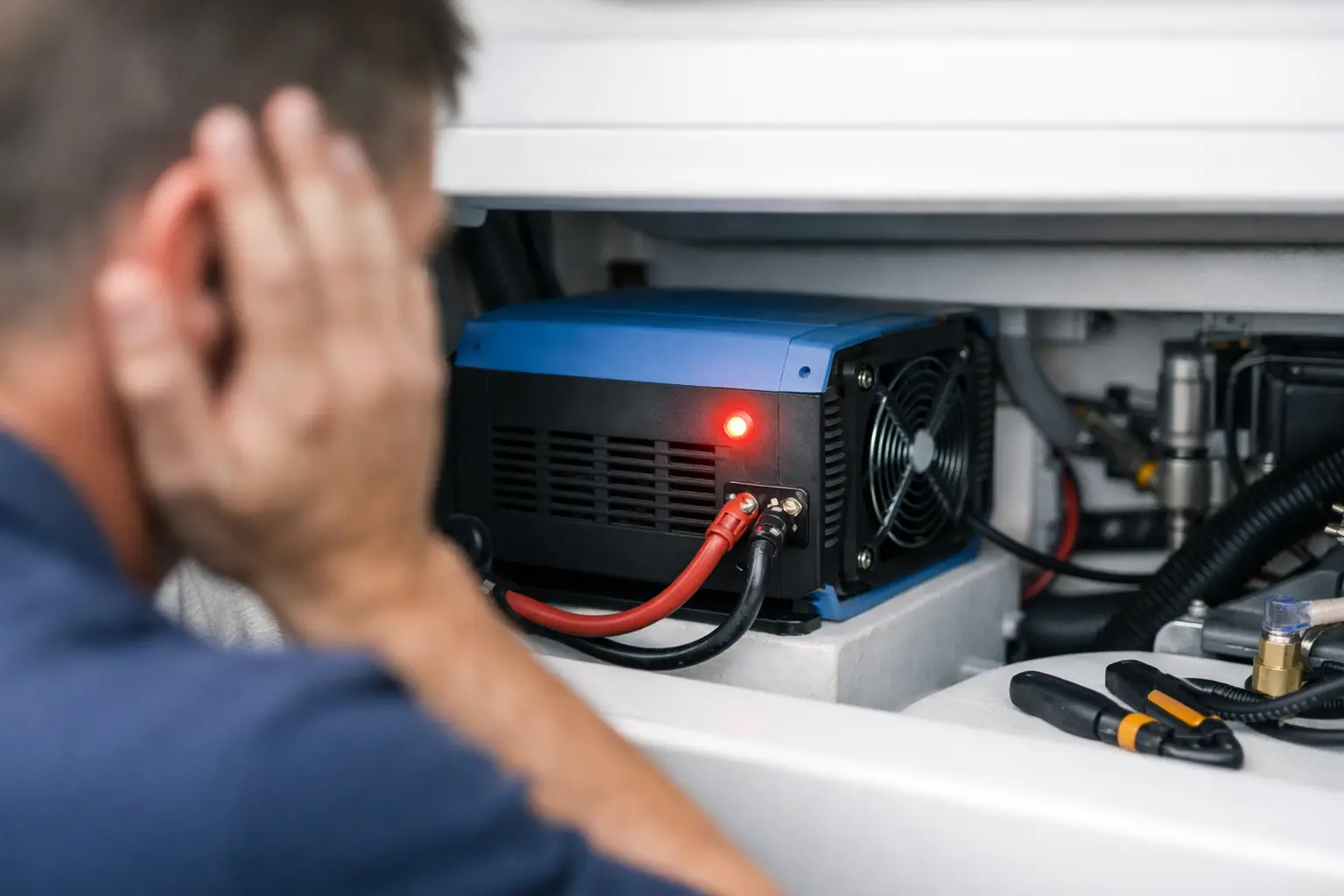
A marine inverter sounding an alarm during the night at anchor, when starting the coffee maker, or during navigation equipment operation is not merely an annoying sound notification. The question of why a marine inverter beeps should be understood as a warning that the system has detected a condition potentially jeopardizing the availability of 230 V power, the battery, or the equipment itself. The audible alarm often prevents a more serious malfunction, but only if its cause is correctly identified.
An inverter converts the DC voltage of the battery system, typically 12 V, 24 V, or 48 V, into AC voltage for 230 V consumers. Many models simultaneously function as battery chargers and manage switching between shore power, generators, and battery operation. Therefore, beeping does not necessarily indicate inverter failure. It may indicate a problem with the battery bank, cabling, charging, connected load, ventilation, or the configuration of the entire power system.
Why marine inverters beep: common causes
The first rule is simple: an audible signal without reading status LEDs, display, or service application is not a complete diagnosis. Alarm patterns vary by manufacturer and model. One short beep can indicate low voltage, while the same pattern on another device may warn of temperature or overload. Always consult the manual for the specific model before resetting the system.
Low battery voltage under load
Low DC voltage is the most common cause of alarms. A battery may show acceptable voltage at rest, but when a larger load is switched on, the voltage suddenly drops below the safe threshold defined by the inverter. The device then beeps, limits output power, or shuts down completely to protect the batteries and electronics.
This typically occurs when batteries are partially discharged, aged, or undersized for the actual load on the vessel. For example, a 3,000 W inverter at 12 V can draw over 250 A at full load, plus additional losses. Such current is determined not only by battery capacity in Ah but also discharge current limits, cell condition, temperature, cable length and cross-section, and the quality of all connections.
With LiFePO4 batteries, the alarm may precede intervention by the BMS. If the BMS cuts off discharge due to low cell voltage, high current, or low temperature, the inverter loses DC supply and reports an error. Repeated restarting without determining the cause can complicate diagnostics and leave the vessel without critical consumers.
Overload or excessive inrush current of loads
An inverter dimensioned according to the nominal power of the load may still shut down at startup. The reason is the inrush, or starting current. Refrigeration compressors, pumps, power tools, air conditioners, and certain kitchen appliances may initially demand several times their rated power.
If the inverter beeps immediately when you turn on a particular device, switch off that load and check if the system resumes normal operation. Do not assume only a larger inverter is needed. Sometimes the cause is a faulty load, low battery voltage, insufficient DC cable, or wrongly set maximum output current limit.
Overload can also develop gradually. At anchor, it is easy to simultaneously operate the boiler, tool charger, coffee maker, and induction cooktop. The total power may exceed the inverter’s capacity, though each device individually operates without issues. Load management and clear prioritization of consumers are part of system design, not improvisation during navigation.
Voltage drop in cables and bad connections
Batteries are not the sole source of voltage drop. At high DC currents, even small additional resistance becomes significant. Oxidized terminals, insufficiently tightened screws, damaged fuse, undersized cable, or faulty main switch can create voltage drop between the battery and inverter.
In such cases, voltage measured directly at the battery terminals may be acceptable, but the inverter detects low voltage at its terminals and triggers an alarm. A bad connection can heat up, increasing resistance and risk of thermal damage. Inspection should not end with visual checks; voltage measurements under load, voltage drop checks on positive and negative conductors, and inspection of fuses, busbars, and main connections are necessary.
Excessive temperature and inadequate ventilation
Inverters generate heat under high load. If installed in enclosed spaces without sufficient airflow, near heat sources, or in areas with high ambient temperatures, the internal protection may trigger an alarm. It is common for the device to work properly in spring and begin shutting down in summer when technical space temperatures rise considerably.
Fans, intake openings, and cooling fins must remain clean and unblocked. Problems may also arise if the fan fails to operate under load. It is not recommended to cover the inverter with equipment or place objects near its ventilation channels. For larger systems, ensure space dimensions, ventilation, and clearances comply with manufacturer specifications.
AC-side error, charging or source switching issue
For combined inverter-chargers, beeping may occur when connecting to shore power or starting a generator. Potential causes include low or high input voltage, incorrect frequency, input current limit, unstable generator, polarity error, or source switching issues.
Particular attention is needed for modifications to the AC installation. Neutral conductor, protective grounding, RCD protection, galvanic isolation, and switching between grid and inverter must be designed as a whole. Randomly adding an outlet or rearranging consumers may cause conditions recognized by the inverter as faults. Such interventions should not be attempted on active installations.
What to check before calling service
If there are no signs of burning smell, smoke, unusual heating, or visibly damaged conductors, first reduce the load. Turn off higher power AC consumers and note when the alarm started: at inverter startup, device startup, during battery operation, or after connection to shore power.
Then read error messages on the device and measure battery voltage. Measurements should be taken at rest and under load. Confirm batteries are charged and that solar regulator, alternator charging, shore charger, or generator are operating as expected.
Do not repeatedly reset the inverter if the alarm returns. Protection is not an error to bypass but information to interpret. Also, do not replace fuses with higher rated ones to prevent blowing. The fuse protects cables and equipment, and its rating must correspond to conductor cross-section, current load, and manufacturer specifications.
When professional system diagnostics are needed
Professional inspection is recommended if the inverter shuts down without clear cause, if battery voltage significantly drops under moderate loads, if connections heat up, or if lithium batteries, solar systems, new generators, or large AC consumers have recently been installed on the vessel. These are situations where individual components may be functional, but the system as a whole is not properly coordinated.
Diagnostics should include battery bank condition and capacity, DC voltage and voltage drop measurements under load, cable and protection inspection, error log reading, charger and charging source operation, and inverter configuration. For LiFePO4 systems, communication with the BMS, charge and discharge current limits, and voltage settings adapted to battery chemistry are verified.
UnLucky performs technical compatibility checks, system diagnostics, installation, and integration of inverters, chargers, batteries, and energy monitoring. The goal is not just to silence the alarm but to determine why it was activated and ensure your vessel can reliably use available energy under real operating conditions.
If you cannot clearly link the alarm to a specific load or battery status, send an inquiry with the inverter model, battery type, error message, and a description of the moment when the problem occurs. Timely diagnostics preserve vessel autonomy, battery system health, and peace at anchor. Because Luck Has Nothing to Do With It.