
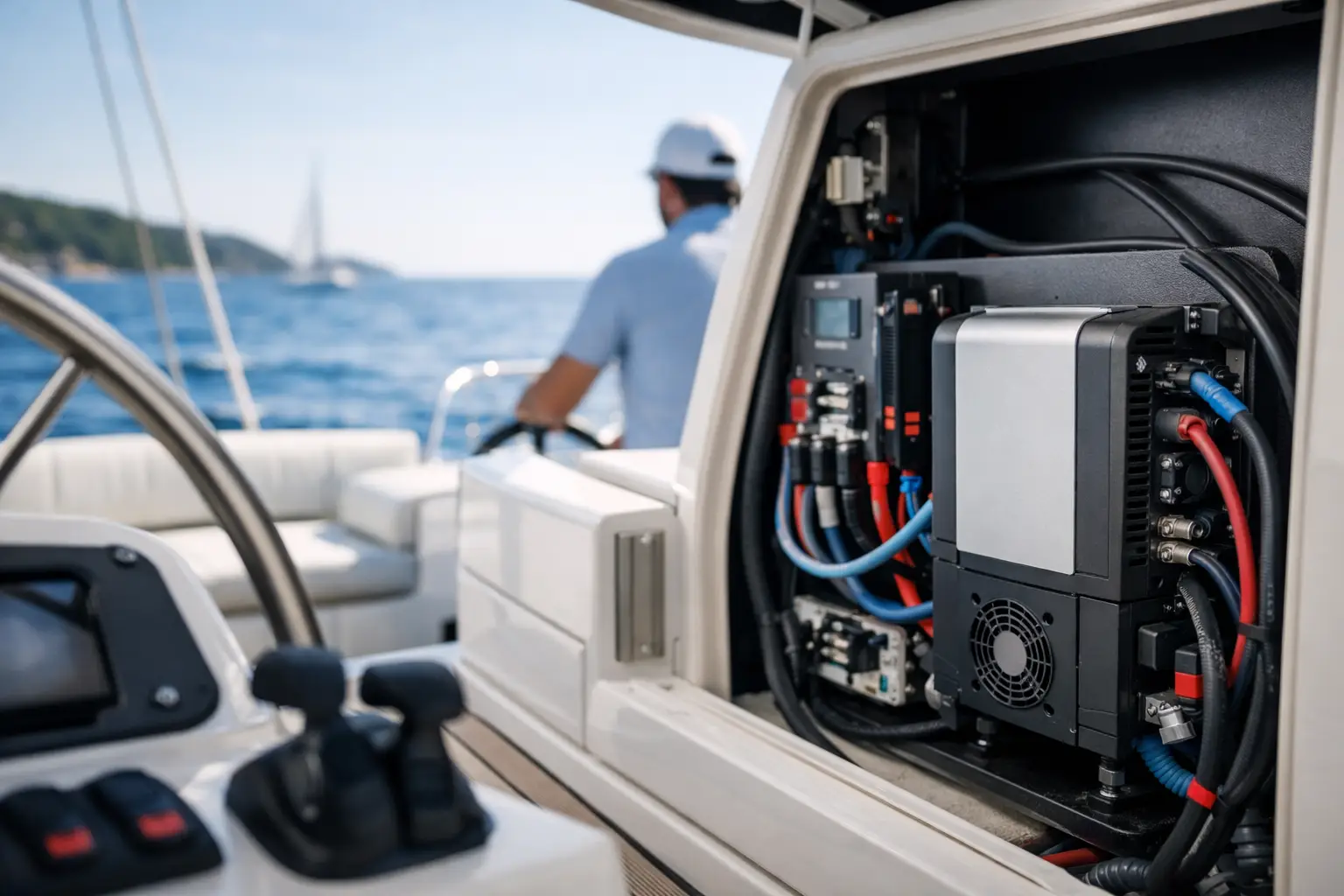
When your coffee maker, computer, or tool work properly at the marina but stop functioning once disconnected from the shore power, the problem often isn't with the device itself. The Guide to Marine Inverters begins with understanding the entire power system: batteries, cables, fuses, charging, source overlapping, and actual consumption. An inverter can significantly increase a vessel's autonomy, but only if properly selected and integrated into the existing installation.
Onboard, assumptions based on device name or the power rating on the front label have no place. An improperly sized inverter can overload the battery system, cause voltage drops, trigger protective shutdowns, or create issues in 230 V distribution. On larger vessels, charter fleets, and professional crews, consequences extend beyond comfort to system availability and safe operation at sea.
What a Marine Inverter Actually Does
An inverter converts direct current voltage from batteries, typically 12 V, 24 V, or 48 V, into alternating current voltage of 230 V / 50 Hz. This enables operation of devices normally intended for shore power or generators: chargers, laptops, kitchen appliances, tools, specific pumps, and AV equipment.
It is important to distinguish a standalone inverter from a combined inverter-charger. A combined unit charges batteries and manages the transition between power sources when the vessel is connected to shore power or a generator. When the external source disappears, the system can switch selected circuits to battery power. This is a practical solution but requires precise AC and DC system design.
An inverter is not a replacement for a generator in every scenario. For short-term operation of moderate consumers, it can be more efficient, quieter, and simpler. However, air conditioning, electric water heaters, large induction hobs, higher capacity desalinators, or simultaneous operation of multiple powerful consumers quickly exceed realistic battery capacity limits. The appropriate solution depends on your vessel’s operational profile.
Guide to Marine Inverters: Power Is Not the Only Criterion
The rated power of an inverter is given in watts or volt-amperes, but proper selection requires analyzing continuous consumption, peak starting loads, and runtime of each device. Compressor refrigerators, electric tools, or pumps can draw multiple times their normal running power upon startup. An inverter that seems powerful enough on paper may shut down when such a consumer starts.
For example, a 2,000 W inverter at 12 V under full load can draw approximately 180 A or more from the battery system, depending on actual voltage and losses. This demands substantial capacity from the battery, BMS, main fuses, busbars, and cable cross-sections. At 24 V the current is roughly halved, and at 48 V it decreases further, offering advantages in efficiency and installation performance for larger systems.
When sizing, check the following:
- Continuous and peak power of loads powered by the inverter
- Daily energy consumption expressed in Wh or kWh
- Voltage and available capacity of the battery system
- Permissible continuous and short-term current of battery and BMS
- Charging capability from alternator, solar, generator, and shore connection
- Existing AC circuits, protection, and source overlapping methods.
It is not always justified to supply the entire onboard 230 V network via the inverter. Often, it is better to separate critical or frequently used circuits, such as salon sockets, communication equipment, refrigerator, or certain service outlets. This reduces the risk of unnecessarily draining batteries by accidental activation of large consumers.
Pure Sine Wave and Output Voltage Quality
For modern vessels, an inverter with a pure sine wave output is recommended. Such output closely matches shore power quality and is suitable for sensitive electronics, chargers, audio equipment, variable-speed motors, and devices with electronic control.
Inverters with modified sine wave outputs may be acceptable for simple resistive loads or tools but often create more limitations and issues onboard than savings. They can cause increased heating, transformer buzzing, unstable charger operation, or device incompatibility. For higher value systems, compromising on output voltage quality rarely has a technical justification.
Equally important are frequency stability and inverter capability to handle short-term startup currents. These specifications should be considered together with the type of loads served, not in isolation from equipment catalogs.
Batteries Determine How Long the System Can Operate
Inverter power dictates what you can power on; battery capacity determines how long you can use it. A 400 Ah battery system at 12 V nominal contains about 4.8 kWh of energy, but available energy depends on battery chemistry, allowable depth of discharge, temperature, battery condition, and conversion losses.
LiFePO4 batteries can offer significantly higher usable capacity and better current delivery than traditional lead-acid batteries, but only with properly designed BMS, charging, and protection. The BMS must support the current demanded by the inverter, including short peak values. Otherwise, under heavier loads, the system will disconnect the battery despite a possibly high state of charge indication.
When integrated with alternators, charging strategy must be verified. Large lithium batteries may require currents that standard alternators cannot continuously provide without overheating. DC-DC chargers, external regulators, temperature monitoring, and appropriate current limiting are part of the technical assembly, not optional extras selected afterward.
The solar system can extend autonomy but should not be viewed as an immediate source for large AC loads. Solar primarily replenishes battery energy during daytime. If the inverter powers a large load simultaneously, realistic energy balance assessment is necessary, especially during prolonged anchoring.
DC Installation: Cables, Fuses, and Voltage Drop
The highest currents in the inverter system flow on the DC side, between the battery and the inverter. Poor installation there rapidly becomes a risk. Undersized cable cross-section causes voltage drop and heating, while poor connections increase electrical resistance and may cause localized connector overheating.
The inverter must have properly sized protection close to the power source, a suitable main switch, and cables adapted to current, length, and installation method. Terminals must be professionally crimped, corrosion-protected, and mechanically relieved. Batteries, busbars, fuses, and inverter should be accessible for inspection but protected against moisture, splashing, and accidental contact.
Installing thicker cables alone is insufficient without verifying other components. Weak links might be a fuse, switch, busbar, battery terminal, or BMS. Technical verification must cover the entire current path.
AC Distribution and Source Overlapping
The most sensitive part of integration occurs when shore power, generator, and inverter meet in the same network. The system must prevent unauthorized simultaneous connection of different sources, properly manage the neutral conductor, and ensure correct protective device function. This includes suitable circuit breakers, residual current protection where applicable, and clearly separated circuits.
Installing an inverter into an existing network without reviewing single-line diagrams and actual installation condition may produce unpredictable outcomes. Some vessels may have prior modifications, unmarked wiring, inappropriate cable sizes, or mixed-generation equipment. Before intervention, the actual system execution must be established, not assumed to match drawings or panel labels.
Inverter-charger configuration also impacts system operation. Limits for input current must be set according to marina capability, generator, and shore connection cable, source priorities defined, and charging profiles coordinated with battery chemistry. Post-installation testing includes load measurements, source transition checks, and protection circuit tests.
When Professional System Inspection Is Needed
If you plan a higher power inverter, transition to LiFePO4 or sodium-ion batteries, integrate solar charging, or power existing 230 V circuits, the starting point should be a system inspection. The same applies if the inverter occasionally shuts down, batteries unexpectedly discharge, charging is unstable, or terminals heat up.
At UnLucky, technical compatibility checks cover the existing installation, actual loads, battery capacity, charging options, and AC/DC safety components. Based on this, a solution can be developed including equipment selection, design, installation and integration, configuration, commissioning, as well as subsequent diagnostics and preventive maintenance.
Reliable 230 V onboard power supply is not achieved by purchasing a stronger inverter alone. Send an inquiry with data about your vessel, batteries, charging sources, and devices to be powered. Good preparation and professionally executed system keep luck out of electrical installations. Because Luck Has Nothing to Do With It.