


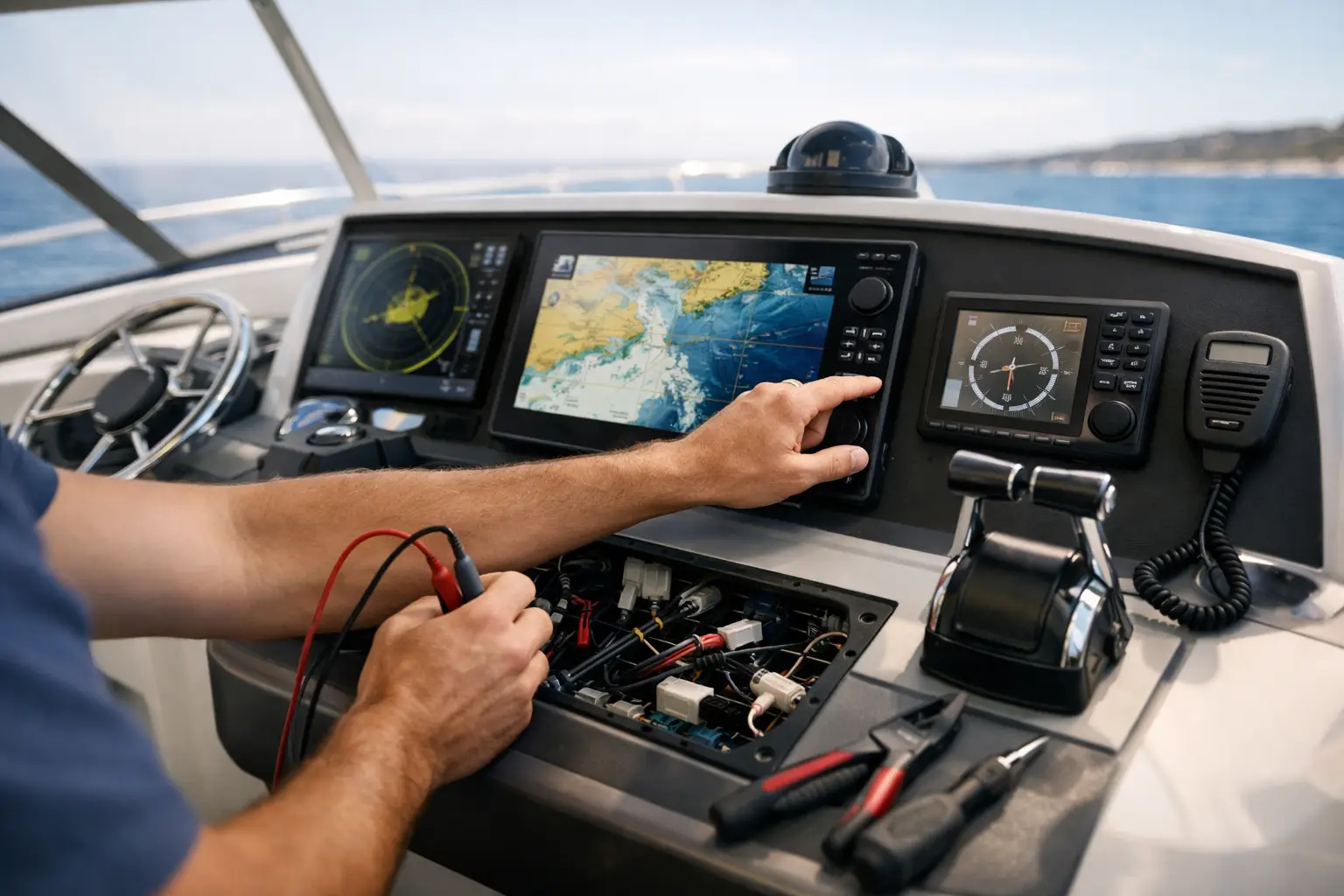
A navigation display that intermittently turns off, unreliable overlay of radar imagery on the navigation chart, or an autopilot that does not hold the set course are not merely inconveniences. At sea, such symptoms may indicate problems with power supply, return wiring, potential equalization, network communication, sensors, or system configuration.
Therefore, installing marine electronics is not simply replacing one device with another. It is a technical procedure that integrates navigation, power, data networks, sensors, and crew requirements into a reliable and functional whole.
For newer vessels, the challenge is usually integrating additional equipment into the existing network. In refits, especially on vessels with multiple generations of devices, it is first necessary to determine what is actually installed, how it is connected, and which components still make technical sense to keep. A correct decision at the outset reduces the risk of rework, unnecessary costs, and failures during the season.
What Marine Electronics Installation Includes
Marine electronics encompass far more than just a chart plotter. The system may include a GPS receiver, VHF radio station, AIS, radar, depth sounder, autopilot, wind instruments, cameras, engine monitoring, alarm systems, and communication with energy management systems.
Each device must have stable and properly protected power, receive appropriate data, and communicate with other components without conflicts.
For example, autopilot installation depends on the type of steering system, vessel size and displacement, characteristics of hydraulic or mechanical transmission, position of the rudder angle sensor, and quality of heading data. Selection based solely on the declared power of the drive unit is insufficient.
The same applies to radar. It is necessary to verify antenna position, visibility, influence of the mast or superstructure, cable routing, available power supply, heading data source, and compatibility with the navigation display.
On smaller sailboats, emphasis may be on autonomy, energy consumption, and instrument reliability during extended voyages. On motorboats and yachts, integration often involves multiple control stations, radars, cameras, engine monitoring, and alarm systems.
Charter vessels have additional requirements. The system must be intuitive for various users, protected from incorrect settings, and sufficiently clear to enable rapid service diagnostics.
Technical Inspection of Existing Condition
The most costly mistake is not necessarily purchasing the wrong device. Often a bigger problem is installing new equipment without inspecting existing installations.
Corroded connections, undersized conductors, unmarked fuses, unstable voltage, poorly executed return wiring, or improvised network branches can limit the performance even of quality new systems.
A technical inspection should cover the state of DC and AC installations, battery system capacity, energy distribution, circuit protection, and charging from alternators, shore chargers, solar panels, and other sources.
Marine electronics are sensitive to voltage drops and electrical interference. If navigation equipment is powered from inadequately designed distribution, voltage drops may occur when a heavy consumer such as a bow thruster, anchor winch, or pump is activated.
Therefore, it is not enough to measure battery voltage at rest. It is essential to check power behavior under load, voltage drops on positive and return conductors, connection conditions, and the integrity of fuses, switches, and busbars.
Data Networks and Device Communication
It is necessary to inspect the data infrastructure as well. NMEA 2000, NMEA 0183, Ethernet, and proprietary networks can only be connected if compatible interfaces, appropriate converters, and clearly defined data architecture exist.
For the NMEA 2000 network, topology of the backbone, termination, network power supply, T-connector positions, and total load must be checked. For NMEA 0183 systems, the communication direction, transmission speed, and method of connecting inputs and outputs are important.
Unplanned network connections can lead to duplicated GPS sources, loss of AIS data, incorrect readings, or situations where the autopilot uses data from an inappropriate sensor.
In complex systems, it is necessary to define which device is the primary source of position, heading, speed, depth, and wind data. Without properly set sources, the system may operate in a degraded mode but become unreliable during navigation.
Compatibility Is Not Just a Connector Issue
Devices with physically compatible connectors are not necessarily functionally compatible. It is essential to verify which NMEA 0183 sentences, NMEA 2000 PGN messages, and other data each device transmits, can receive, and can properly utilize.
A plotter may be able to display wind data, but that does not mean the autopilot can use it for control according to apparent or true wind. Similarly, the presence of GPS position in the network does not guarantee that heading data are fast and accurate enough to overlay radar display onto the chart.
Special attention is required for combinations of older and newer equipment. Sometimes it is possible to retain a quality radar, sonar transducer, or existing instruments and connect them to a new display through a suitable interface.
In other cases, an adapter only temporarily conceals system limitations. Then it is more rational to plan a gradual but complete modernization rather than invest in a series of compromises that hinder future upgrades and servicing.
Aligning Electronics with the Energy System
Compatibility must also be considered from an energy perspective. New multifunction displays, radars, cameras, and network modules increase continuous energy consumption.
If the vessel often spends nights at anchor, the electronic package must be aligned with battery system capacity, charging profile, and available energy sources. It is important to calculate expected daily consumption and verify whether the system can replenish consumed energy under actual conditions.
LiFePO4 battery systems can increase usable capacity and vessel autonomy but require properly designed protection, appropriate BMS, and charging sources configured according to battery manufacturer requirements.
Sodium-ion batteries may also be an interesting solution for certain applications, but their characteristics, voltage range, charging methods, and compatibility with existing equipment must be checked separately. Different battery chemistries should not be treated as directly interchangeable without technical system analysis.
Installation Planning to Facilitate Future Servicing
Professional installation begins before drilling the first hole. It is necessary to define device positions, access to rear panels, ventilation, splash protection, daytime screen visibility, and ergonomics of the control station.
A device mounted too low, at an unfavorable angle, or without access to connectors can complicate daily operations and extend future service interventions.
Cable routes must be protected from mechanical damage, moisture, heat sources, and electromagnetic interference. Power conductors, communication cables, and antenna lines must not be randomly bundled together.
For radar, VHF, and AIS, the quality of antenna cable, connectors, connector protection, and cable route implementation directly affect the range and signal stability. For sensors and data networks, a poor connection can cause intermittent errors that are difficult to diagnose.
Documentation is equally important. Clearly labeled fuses, conductors, network modules, connectors, and service loops are not just aesthetic details. They enable faster diagnostics, safer maintenance, and easier system understanding for a new captain, crew, or future vessel owner.
On higher-value vessels, neat technical documentation is part of responsible asset management.
Configuration and Commissioning
After physical installation, the phase follows in which individual devices become a functional system.
It is necessary to configure GPS position sources, depth, speed, heading, and wind, set data priorities, check alarms, and update device software when required.
Radar system checks include antenna position, bowline alignment, heading data source, and target display. Autopilot requires drive unit configuration, compass calibration, rudder angle sensor check if installed, and sea trial.
Commissioning should include checks of basic scenarios: system operation on batteries and during charging, AIS data transmission, GPS position transmission to the VHF device, correct DSC function configuration, radar overlay over chart, shallow water alarms, and system behavior when individual devices are turned off.
If the system includes monitoring of batteries, generators, tanks, or engines, it is necessary to confirm that displayed data correspond to actual conditions.
This phase clearly differentiates installed equipment from realized integration. A device may be powered and display data while the system is not yet ready for reliable navigation. Especially for autopilots, radars, and navigation networks, sea calibration and verification are not optional.
When Is It Time to Modernize the System
Modernization is not necessarily driven by total failure. Reasons may include unavailability of spare parts, inability to update cartography, lack of AIS or radar, excessive consumption of an old system, or the need for reliable remote vessel monitoring.
In refits, it is often cost-effective to align electronic renewal with refurbishment of distribution panels, batteries, chargers, solar systems, or propulsion. This way, cable routing, protection, and energy distribution can be addressed without repeating the same work.
However, full replacement is not always justified. If existing devices are reliable, the network is properly implemented, spare parts are available, and user needs are clearly defined, targeted upgrades may be a reasonable choice.
The decision depends on vessel condition, usage, planned routes, service availability, and long-term maintenance plans.
Marine Electronics Installation Starts with Vessel Inspection
Quality marine electronics installation begins with inspecting the vessel, not selecting devices from a catalog.
Send us basic vessel data, a list of existing equipment, installation photos, and a description of usage. Based on this, we can prepare a realistic technical recommendation, verify equipment compatibility, and define the required scope of work.
Because Luck Has Nothing to Do With It.