


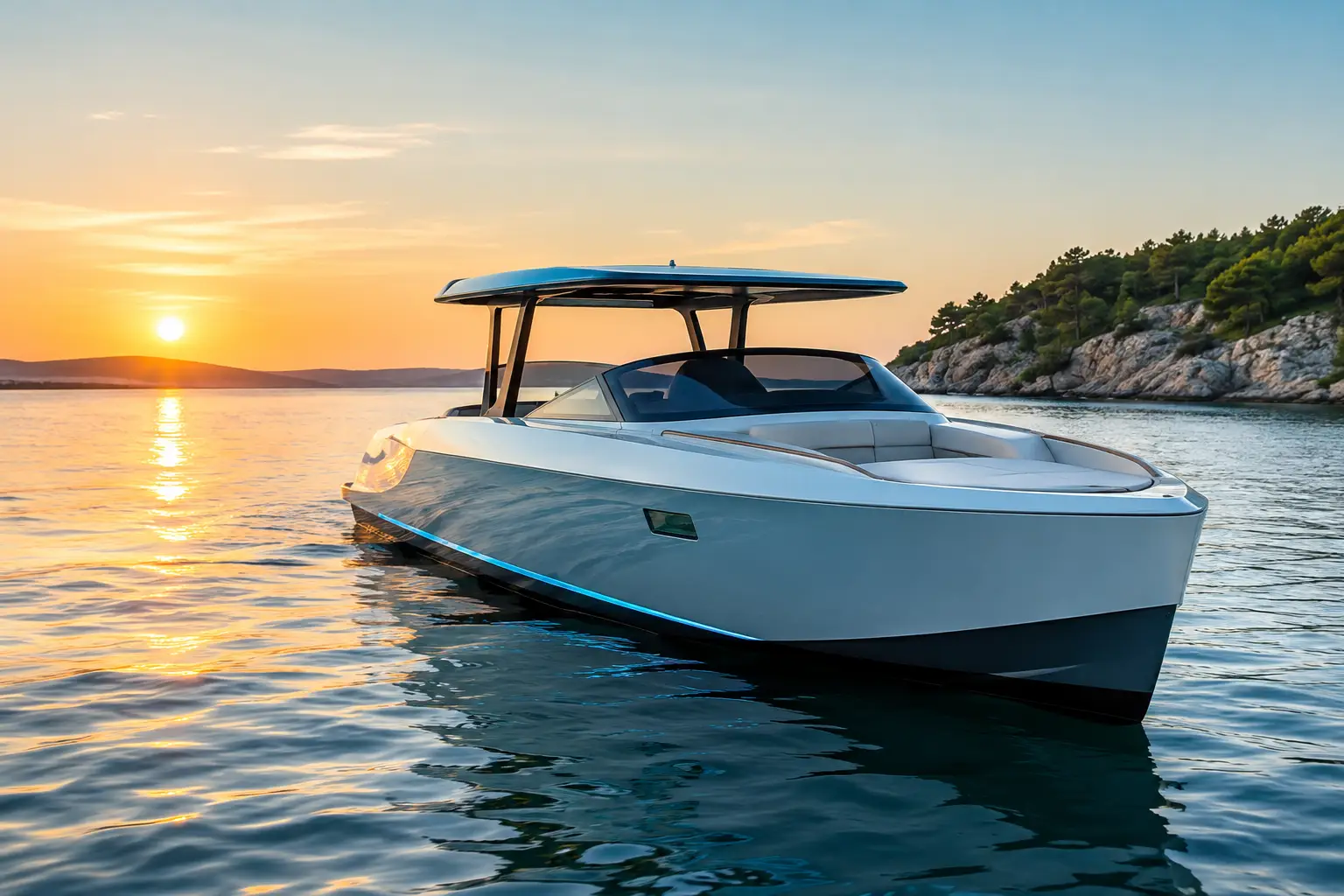
Electrification of vessels is no longer a topic reserved for prototypes and short rides within enclosed marinas. Trends in electric vessels are already influencing decisions made by owners of sailboats, motorboats, catamarans, and workboats on the Adriatic – from choosing auxiliary propulsion and battery systems to methods of charging in the home port. However, an electric drive is not just a component to be installed instead of a diesel engine. It is a system that must be designed according to actual consumption, available space, vessel mass, sailing profile, and existing electrical installation.
For vessels operating daily on short routes, electrification can bring quieter operation, reduced local emissions, and simpler propulsion maintenance. For yachts intended for long passages, priorities differ: battery capacity, fast charging capability, safety reserves, and availability of alternative energy sources become more important than motor power alone. Technically correct solutions begin with assessing how you actually use your vessel.
Trends in Electric Vessels: A System, Not Just a Motor
The biggest change is not only in the development of electric motors but in the approach to the entire vessel energy architecture. Propulsion battery, service battery bank, chargers, inverters, solar system, alternators, generator, and consumption monitoring must operate as a coordinated whole. Unsynchronized components can shorten battery life, limit available power, or create serious problems during charging and diagnostics.
LiFePO4 batteries have become a common choice due to greater usable depth of discharge, stable voltage, and a lower number of replacement cycles compared to traditional lead-acid versions. However, the designation LiFePO4 alone does not indicate if the battery system is suitable. It is necessary to check BMS, communication capability with chargers and monitoring systems, charging limitations at low temperatures, overcurrent protection, and separation of critical consumers.
Sodium-ion batteries also attract attention, especially as a potential option for certain service and energy applications. Their development should be monitored without premature conclusions. For each project, the actual available capacity, operating characteristics, certification, equipment compatibility, and availability of technical support must be verified. New technology makes sense only when supported by proven project solutions.
Electric propulsion makes sense when the cruising profile is clear
Electric propulsion is particularly logical for day trips, tenders, workboats in harbors, vessels on short routes, and sailboats where the engine mainly serves for maneuvering and reaching anchorages. Under these conditions, energy consumption can be estimated with enough precision, and charging can be planned during stays in marinas or moorings.
For larger motorboats regularly covering long distances at higher speeds, fully electric propulsion imposes significantly greater demands. Hull resistance increases with speed, so the required energy does not rise linearly. A few additional knots can substantially increase consumption and reduce range. Hence, in some cases, hybrid architecture is considered, where electric propulsion operates in certain modes, while another energy source retains function for longer passages or safety redundancy.
Such a choice is not a compromise to be concealed but a technical decision that must correspond to the vessel's purpose. The goal is not to achieve an “electric” label but to ensure that the vessel remains available, manageable, and safe in actual sailing conditions.
Batteries, Charging, and Monitoring Define Autonomy
Battery capacity expressed in kilowatt-hours is an important data point but insufficient for planning autonomy. It is necessary to know the continuous and peak propulsion power, energy consumption of navigation, refrigerators, pumps, air conditioning, winches, and other consumers, as well as the allowable battery reserve. A propulsion battery that covers the planned route on paper may not have enough reserve for wind, waves, stronger current, or unexpected maneuver delays.
Charging is the next point where many projects become limited. If a vessel has a large battery bank but the marina has a limited connection, charging time can be impractically long. Conversely, increasing charger power without verifying the connection, cables, protective devices, and thermal load of the installation is not an acceptable solution.
Solar panels can significantly assist service consumption, especially during anchoring or extended stays without shore connection. Their contribution to propulsion energy depends on available surface area, panel orientation, shading, and actual consumption. On most vessels, solar systems will not replace shore charging for strong electric propulsion but can extend autonomy and reduce generator operation.
Reliable system monitoring is not a comfort addition. Measuring voltage, current, state of charge, temperature, and charger status allows the crew to detect deviations before they escalate into failure. Integrating data onto an appropriate display or vessel monitoring system facilitates energy management, but only if measurements are properly configured and verified during commissioning.
What to Check Before Electrifying Your Vessel
Before selecting equipment, a technical inspection of the existing state is required. For refits, cable sections and conditions, fuse arrangement, connection quality, available battery space, ventilation, structural load capacity, and water protection are particularly important. A higher mass battery system may affect vessel trim, and changing the position of heavy components may alter vessel behavior underway.
Existing charging sources must also be verified. Alternator on the main engine, generator, shore connection, and solar regulators must have clearly defined roles. Installing a lithium battery with a charger not adapted to its charging profile can lead to operational limitations or unnecessary system load. The same applies to DC-DC chargers, inverters, and protective switches.
Safety is addressed with a concrete project, not by assuming factory protections will cover all situations. This includes proper conductor sizing, short-circuit protection, circuit separation, emergency shutoff, appropriate battery enclosures, mechanical damage protection, and clear access to service and diagnostics components. For vessels operating in charter or with professional crews, clear documentation, system labels, and procedures for regular inspection are also important.
Integration Is More Important Than Individual Specifications
Many quality components exist on the market, but a quality component does not guarantee a quality system. Electric motor, battery, BMS, charger, and control electronics must be electrically and communicatively compatible. Special attention is required for existing navigation systems, engine monitoring, alarms, bow thrusters, winches, and other consumers with high peak loads.
Professional installation and integration include design, compatible equipment selection, installation, configuration, load measurements, and commissioning. Afterwards, the system should be monitored through preventive maintenance. Inspection of connections, diagnostic readings, charging verification, and analysis of actual consumption provide data necessary for timely corrections before the main season.
At UnLucky, we do not view electrification as replacing a single component but as a technical process that must fit your vessel and usage. If you are considering electric or hybrid propulsion, battery system upgrades, or charging integration, send an inquiry with basic data about your vessel, existing equipment, and planned sailing. A good decision starts with verifying the actual state – Because Luck Has Nothing to Do With It.