


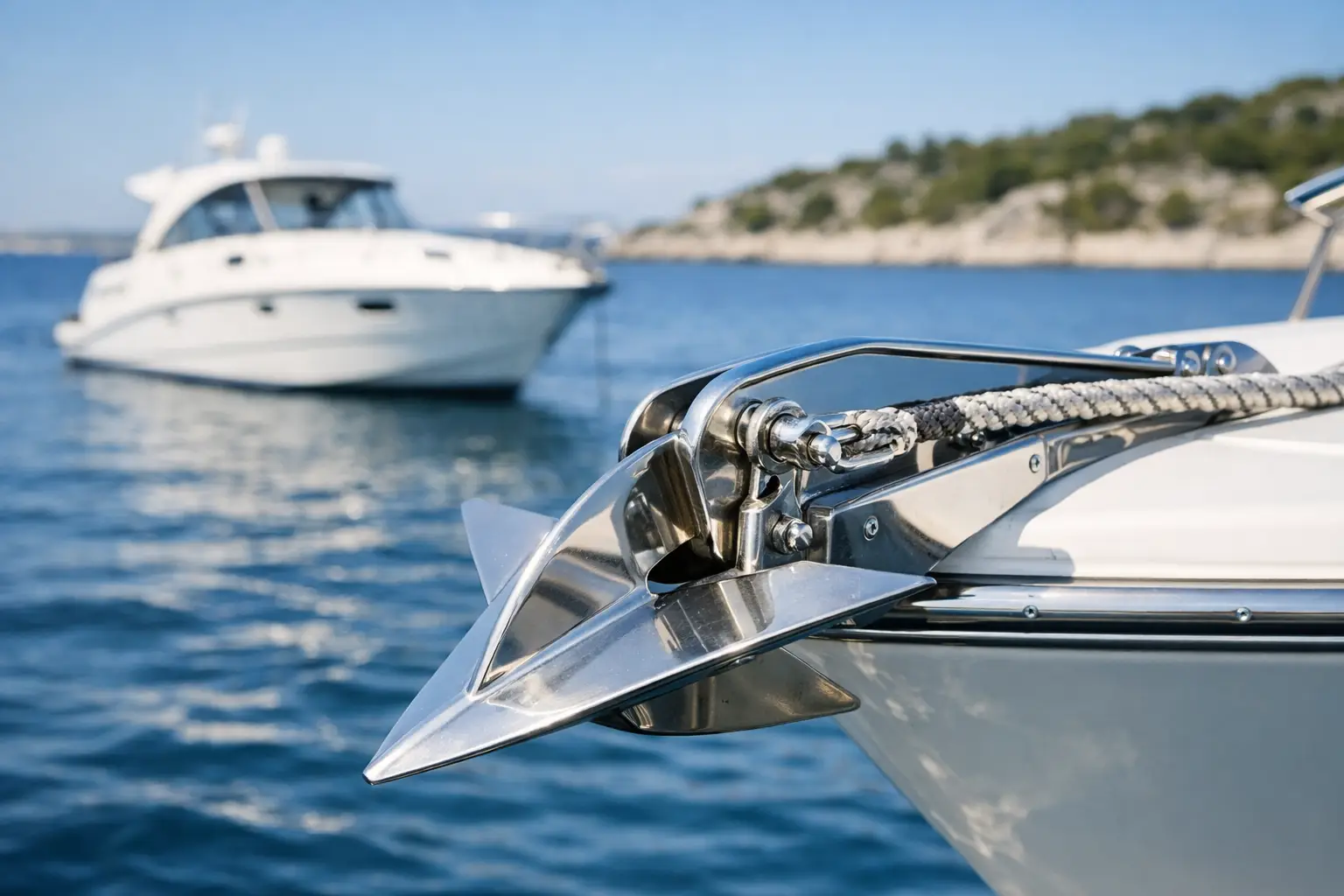
An anchor is often assessed when it is already too late - at night, during wind shifts, in a crowded bay, or when the vessel starts drifting towards another boat. Stainless Anchors can be a quality part of the anchoring system, but a brilliant finish alone does not guarantee better holding power, greater safety, or compatibility with your bow and windlass.
When selecting an anchor, the entire system must be considered: shape and weight of the anchor, type of seabed, length and diameter of the chain, windlass power, battery capacity, bow roller, chain guide, and how you actually use the vessel. Criteria for weekend cruising with occasional anchoring differ from those for yachts that spend the entire season at anchor or charter boats with frequent crew changes.
Why Anchor Material Is Not the Only Criterion
Stainless steel has a clear advantage on board: with proper fabrication and maintenance, it maintains a neat appearance and is more resistant to surface corrosion than ordinary galvanized steel. This is especially relevant at the bow, where the anchor is constantly exposed to seawater, salt, wave impacts, and mechanical wear during lifting and lowering.
However, the term "stainless" does not mean the material is completely corrosion-proof. The quality of the alloy, welding method, finishing, and presence of cracks or salt deposits directly affect durability. In closed joints, beneath deposits, and in oxygen-deficient zones, pitting or crevice corrosion can occur. Particular attention is required for welds, swivel shaft in folding designs, and the anchor connection with chain or swivel.
For marine applications, alloys such as AISI 316 are most common, while more resistant materials are used for certain heavily loaded components. Nevertheless, material designation does not replace construction verification. The anchor must have known and verifiable working load, properly shaped critical parts, and execution suitable for your vessel's dimensions.
Stainless Anchors and Actual Holding Power
Holding power depends not only on weight. A modern anchor with appropriate geometry can quickly set and develop significant resistance to pull, while a too-light or unsuitable anchor, regardless of material, may drag on the bottom. Crucial factors are the shape of the flukes, surface area engaging the substrate, center of gravity distribution, pulling angle, and the ability to reset after wind or current direction changes.
On the Adriatic, sand, mud, posidonia, gravel, and rocky slabs often alternate. An anchor that performs excellently in compact sand may not be equally reliable on growing or very hard bottoms. Thus, universal recommendations based solely on vessel length are not precise enough. Consider displacement, superstructure, wind-exposed surface area, usual cruising areas, and tolerance for trade-offs between weight, volume, and performance.
It is important to distinguish initial setting from long-term holding. The crew may feel the anchor has "set" once the chain tightens, but only controlled backward pull at appropriate RPM confirms the anchor is truly embedded. Upon load direction changes, the anchor must maintain position or reset without uncontrolled slipping.
The Anchor is Part of a System, Not a Standalone Item
Even a properly sized stainless anchor will not perform as expected if the rest of the system is not harmonized. The chain must have the appropriate diameter, strength grade, and weight. An undersized chain can limit allowable load, and an unsuitable profile will not pass correctly through the windlass sprocket. Oversized chain may cause fitting problems in the chain locker and stress the drive system.
The length of the deployed chain is as important as the anchor choice. Greater chain length reduces the pulling angle towards the bottom, facilitating anchor setting and reducing the risk of pulling out. Required length depends on depth, weather conditions, bay space, and vessel characteristics. In tight anchorages, ideal chain-to-depth ratios may not be feasible, so safety reserves should be planned throughout the configuration rather than on a single component.
The bow roller must accommodate the geometry of the chosen anchor without jamming, striking the hull, or resting on sensitive parts of the pulpit structure. The anchor must be able to be safely retracted, properly seated, and mechanically secured for transit. The windlass is not a transport lock: after retrieval, the anchor must be secured by an appropriate mechanical device or lashing to prevent shock loads to the motor, gearbox, and sprocket.
Swivels and connectors also require assessment. Their role is useful in preventing chain twisting and facilitating proper anchor stowage, but not all designs equally resist side loads. A connection effective under straight pull may be unfavorable when the anchor approaches the roller at an angle. Selection should be based on the specific geometry of the anchor, chain, and bow equipment.
What to Check Before Replacing an Anchor
Before purchasing or installing a new anchor, a technical inspection of the existing anchoring assembly is recommended. Measuring the old anchor and selecting one of similar weight is insufficient. It is necessary to check actual bow space, clearances from hull and bow fitting, condition of rollers, guides, brackets, and deck fittings.
Windlass checks include model, power, motor and transmission condition, sprocket, electrical wiring, fuses, contactors, and voltage drop under load. Anchoring windlasses can draw significant current when lifting anchor, especially from great depth. Weak connections, undersized cables, or insufficient battery capacity can cause slow retrieval, overheating, and premature system failure.
The chain locker should also be inspected. The chain must have sufficient room for free stacking without forming a cone that could block lowering or require manual clearing. The chain entry position, locker depth, and compartment layout are more important than usually assumed, especially in refits of older vessels.
If the vessel has remote control, foot switches, helm station control, or monitoring systems, the safety logic and system behavior should be checked. The lowering command must be predictable, protected from unintended activation, and accessible to the crew when bow visibility is limited.
Selection Based on Vessel Usage
The owner of a sailing yacht often staying overnight out of the marina will prioritize secure setting, holding reserve, and reliable re-lifting. On a motor yacht with a larger bow volume, integration with existing roller, neat stowage, and electrical system capacity for a larger windlass are often important. Charter operators require configurations that are clear for different crews to use, resistant to intensive use, and easy for preventive inspections between guest turnovers.
For vessels navigating areas with marked tide ranges or stronger currents, additional evaluation of loads during direction changes is important. For larger vessels, it may be justified to design main and auxiliary anchoring as separate but functionally coordinated systems. The goal is not just to meet minimum formal requirements but to ensure the crew can use the system quickly and correctly when conditions worsen.
Professional Installation and Preventive Maintenance
Installing a new anchor often involves more than delivery. Sometimes adjustments to the bow roller, sprocket replacement, chain guide correction, new mechanical securing installation, or windlass servicing are necessary. Electrical interventions require checking conductor cross-section, circuit protection, connections, control components, and the battery system condition.
After installation, functional testing at berth and, when conditions permit, at sea trial follow. Tests verify free lowering, pulling load lifting, proper anchor seating, all controls operation, and chain behavior in the locker. Only then can the system be handed over as a technically verified entity.
Preventive maintenance includes freshwater rinsing when possible, salt deposits removal, weld and joint inspection, chain wear control, roller inspections, and windlass servicing. If stains, corrosion spots, cracks, or deformation of critical parts are observed on stainless surfaces, an inspection before the next major voyage is necessary. Aesthetic issues on an anchor can sometimes be the first sign of a mechanical or material problem that should not be ignored.
UnLucky can inspect the existing anchoring system, verify component compatibility, and recommend anchor, chain, windlass, and bow equipment according to your vessel's actual demands. Submit an inquiry with vessel data, existing configuration, and usage mode to ensure recommendation, installation, and commissioning are performed without relying on assumptions. Because Luck Has Nothing to Do With It.