


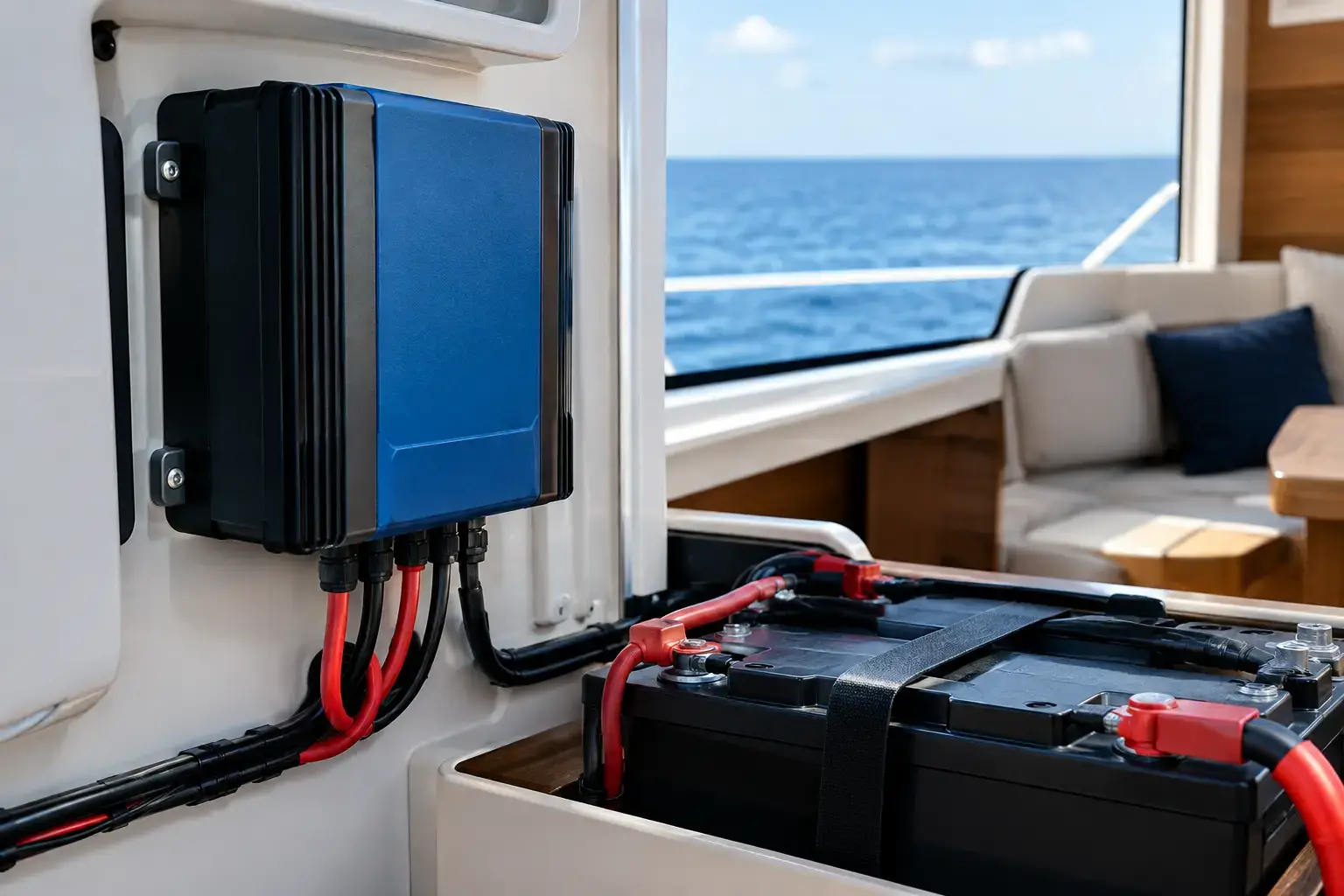
The vessel is moored in the marina for months, shore power is connected, and the charger continuously maintains the batteries. The question whether a charger is allowed to operate continuously has no universal answer. In a properly designed and configured system, continuous charging can be a correct way to maintain batteries. With an outdated charger, wrong charging profile, or improper installation, the same practice can accelerate battery degradation and increase failure risk.
On a boat, the charger is not an independent device. Its operation depends on battery chemistry and condition, consumer load distribution, quality of the shore power connection, protections on AC and DC sides, and the ventilation of the battery compartment. Therefore, the answer always starts with a technical check of the entire system, not just the charger label.
Is it permissible for a charger to operate continuously? It depends on four conditions
A modern marine charger from a reputable manufacturer is generally designed for long-term operation when connected to an appropriate battery bank. After the main charging phase, it must switch to maintenance mode, often marked as float or storage. In that phase, the voltage is reduced, and the charger only compensates for the battery's natural self-discharge and the consumption of permanent consumers.
This, however, only applies if four conditions are met: the charger must have a profile for the actual battery type, the batteries must be technically sound, the charger must be properly sized and installed, and the shore power connection must be safe and protected. If any of these elements are incorrect, a continuously connected charger may mask a problem instead of solving it.
It is especially important to distinguish maintaining charged batteries from charging batteries that are continuously discharged. If the charger operates for days under heavy load because of refrigeration, bilge pumps, alarms, routers, monitoring systems, or unrecognized parasitic consumers, it is not in maintenance mode. Then it is necessary to determine where the energy is going and whether the marina’s shore power supply is sufficient for the vessel's actual load.
Battery type determines charging profile
The most common mistake on vessels is not that the charger runs continuously, but that it operates with incorrect parameters. Lead-acid, AGM, gel, LiFePO4, and sodium-ion batteries have different voltage, temperature, and charging cycle completion requirements.
Lead-acid, AGM, and gel batteries
Classic lead-acid batteries tolerate maintenance mode if voltage is set correctly. Excessively high voltage over extended periods can cause over-gassing, electrolyte loss in flooded batteries, heating, and accelerated plate corrosion. In AGM and gel batteries, the consequences of overcharging often cannot be simply remedied since the user cannot replenish lost water.
Temperature compensation is not a luxury extra for high-end vessels. Voltage acceptable at moderate temperature can be too high in an enclosed space during summer heat. A battery temperature sensor enables the charger to adjust charging to actual conditions rather than an assumed temperature under which the system was designed.
LiFePO4 batteries
LiFePO4 systems require even more precise integration. The battery must have an appropriate BMS, and the charger must support a profile aligned with the battery manufacturer's recommendations and the overall system architecture. Continuous high voltage, i.e., keeping the battery at 100% charge permanently, is not necessarily desirable even if the BMS formally allows charging.
For vessels that stay long in marinas, a better strategy is often maintaining the battery at the level prescribed by the manufacturer with periodic system checks. Also, communication between the BMS, charger, alternator, solar regulators, and inverter-chargers must be resolved. If the BMS interrupts charging, other power sources must respond in a controlled manner. Otherwise, overvoltage, device errors, or unwanted shutdown of critical consumers may occur.
Sodium-ion batteries
Sodium-ion batteries may be interesting for some marine applications but must not be treated as a substitute for LiFePO4 without verifying compatibility. Their voltage ranges, BMS logic, and storage recommendations may differ. A charger with only a general lithium profile is not automatically suitable for every sodium-ion battery.
A charger can operate continuously but must not operate blindly
Check on the charger's display or battery monitor if the system switches to maintenance mode after charging. If the charger stays continuously in bulk or absorption phase, if batteries are warm, if electrolyte smell is detected, or if the device casing warms unusually, the system requires diagnostics.
It is equally important to monitor voltage and current on each battery bank. Starter battery, service bank, bow thruster, generator, and emergency systems are often connected via relays, DC-DC chargers, or distributors. Poorly executed charging distribution can leave one bank chronically undercharged while another receives excessively high voltage.
In long-term installations, connections might also be an issue. Corrosion, inadequately sized conductors, faulty fuses, incorrect wire gauges, or unclearly marked circuits cause voltage drops and local heating. The charger then tries to compensate for voltage not properly reaching the battery, leading the user to erroneously blame the battery itself.
Shore power is part of the safety chain
A continuously connected charger means a constantly active shore power connection. Therefore, the condition of cables, plugs, connection boxes, residual current devices, galvanic isolation or isolation transformers, and vessel grounding must be checked. Darkening contacts, heating plugs, and occasional power interruptions are not trivial issues to postpone until the next service.
Voltage drops, errors on pedestals, and varying installation quality in marinas are possible. A quality marine system must have appropriate protections, but protection does not eliminate the need for inspection. Special attention is required for vessels left unattended for long periods as faults may remain unnoticed for days.
If the vessel lacks reliable remote monitoring, we recommend not relying only on the fact that the charger is on. A monitoring system can promptly warn about shore power loss, low battery voltage, excessive charging current, high battery compartment temperature, or bilge pump activation. This is a concrete preventive measure, particularly off-season.
When should the charger be turned off?
The charger should not remain continuously connected if it is not designed for battery maintenance, if the charging profile is unknown, if batteries heat up or show damage signs, or if the shore power connection and installation have not been inspected. The same applies when the vessel is left unattended without reliable protection and monitoring.
Some lithium systems may recommend storage at partial state of charge and disconnecting the charging source after the target voltage is reached. This is not a system flaw but a prescribed mode that should be included in the vessel's maintenance plan. The actual recommendation depends on the battery model, BMS, charger, and loads remaining active during inactivity.
What does a professional charging system check include?
Before a long stay in the marina, it makes sense to check battery capacity and condition, charger parameters, charging circuits, fuses, connections, temperature, and actual resting consumption. In more complex systems, coordination between shore charger, inverter-charger, solar controllers, alternator, and BMS is also verified.
UnLucky, through system diagnostics, technical compatibility checks, and configuration, can determine if your charger operates in the proper mode and whether settings need correction, an incompatible component replacement, or system redesign. After each modification, measurement, protection checks, and commissioning under actual load are essential.
Do not leave battery system reliability to chance. Send a request for charging system inspection before the season or a long marina stay. Because Luck Has Nothing to Do With It.