


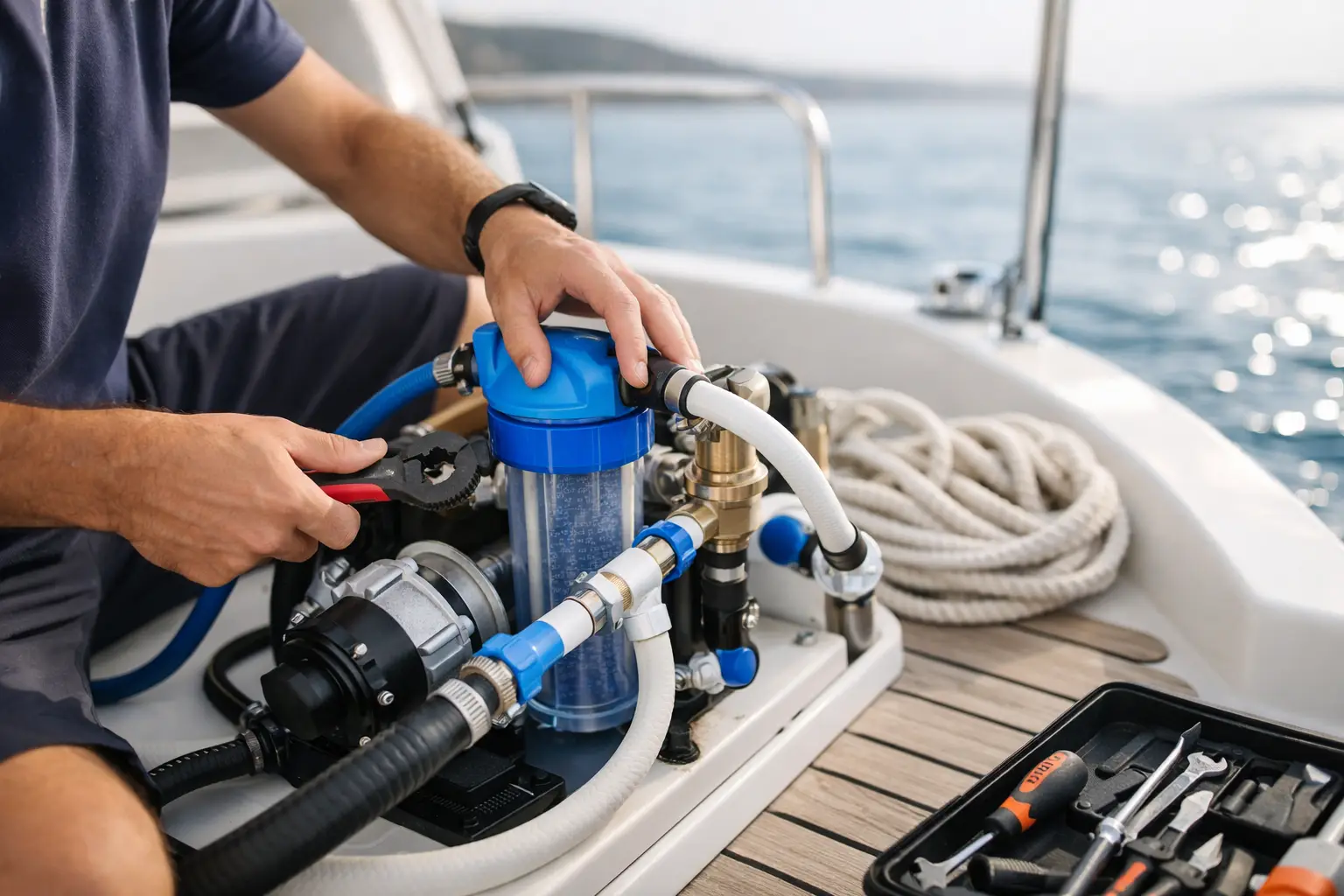
Low shower pressure, a pump activating without opening a faucet, or unpleasant water odor are not trivial issues to postpone until the next docking. Servicing the vessel's water system should be viewed as a technical inspection of the entire chain—from tank filling and ventilation to pumps, pipelines, filters, boilers, fittings, and the watermaker. A fault often appears in one location while the actual cause is hidden in another system component.
Why the Water System Requires Regular Servicing
The fresh water system directly impacts onboard comfort and vessel availability. On a yacht, catamaran, or charter vessel, several days without a functional toilet, shower, or galley faucet quickly becomes an operational problem. For longer voyages and vessels frequently anchored, reliable watermaker operation further determines true autonomy.
The marine environment is harsh on installations. Vibrations, temperature changes, salt, extended vessel inactivity, and occasional tank emptying create conditions where seals lose elasticity, joints loosen, filters clog, and biofilm can develop within tanks and piping. Water that looks clean at entry is not necessarily clean through to the outlet fitting.
Preventative inspection is thus not merely a matter of comfort. Leakage on the pressure side can cause unnecessary pump operation, battery drainage, damage to cabinets and decks, and moisture in spaces where faults are difficult to detect. If the pump draws air on the suction side, flow interruptions and accelerated wear of membranes or mechanical parts may occur.
Scope of Vessel Water System Servicing
Quality servicing is not limited to replacing filter cartridges. First, it must be determined how your vessel’s water system is actually designed and whether used as originally intended. A system for weekend cruising requires a different maintenance regime than a charter catamaran with high guest turnover or a yacht cruising for weeks without frequent docking.
Technical inspection typically begins with examination of tanks, filling caps, vents, and accessible piping. Condition of flexible hoses, joints, non-return valves, clamps, and shut-off valves on individual branches is checked. Special attention is given to components hidden behind panels, under decks, or in the engine room, where small water losses can remain unnoticed for a long time.
Operational pressure, pressure pump cycling, and pressure vessel condition are then checked. A pump that intermittently activates without water consumption may indicate pressure drop, leakage, a faulty check valve, or incorrect pressure setting in the expansion tank. Replacing the pump without diagnostics sometimes only temporarily masks the issue.
Servicing may include cleaning and disinfection of tanks and installation, system flushing, and replacement of consumables as per actual condition. Cleaning agents must be compatible with tank materials, piping, seals, and purification equipment. Overly aggressive chemicals can shorten component lifespan, while superficial rinsing without proper procedures will not remove system deposits.
Boiler inspections check connections, safety valves, electrical parts, heater condition, and signs of corrosion or leakage. The hot water system is often neglected until leakage or poor heating occurs. If the boiler operates via shore power, a generator, or inverter, inspection must also cover electrical protection and existing energy system capacity.
Watermaker Requires a Separate Approach
A watermaker is not an ordinary addition to the fresh water system. It is an assembly where intake must be clean and airtight, prefiltration correct, high-pressure pump in good condition, and membrane properly flushed and preserved during inactivity. Incorrect procedures post-season or during extended downtime can significantly reduce membrane performance.
Diagnostics monitor inlet pressures, flow, produced water quality, prefilter condition, and pump behavior. It is important to verify where the produced water is directed. Incorrect connections to the tank, inappropriate valves, or lack of quality control can negate the advantage of a quality device.
When upgrading systems, watermaker capacity is not determined solely by declared daily output. Real crew consumption, tank capacity, available electrical energy, generator or solar production, and maintenance possibilities during the season must be considered. A higher capacity is not automatically a better choice if the vessel lacks conditions for proper and regular use.
Signs That Should Not Be Ignored
Some issues can wait for scheduled service, but others require prompt intervention. If the pump continuously activates, there is water on the floor, pressure drops noticeably, or unusual odors are present, the system needs inspection before the next significant voyage. The same applies to cloudy water, particles on faucets, unstable boiler operation, and poor watermaker output.
Pay particular attention to these situations:
- The pump runs even when all faucets are closed
- Water has altered odor, taste, or visible particles
- Pressure varies between individual consumers
- Signs of moisture appear under cabinets, decks, or in the engine room
- The watermaker produces insufficient water or shows deviations in produced water quality
For charter vessels, it is useful to record reported symptoms by cabins and zones. Such data often indicates whether the issue is a localized fitting problem, blockage in one branch, or a broader pressure drop in the system. Captains and crew thus provide the technical team with concrete initial information rather than reducing intervention to guesswork.
When Redesign Is Needed, Not Just Repair
On older vessels, the problem is sometimes not a single component failure but the way the system has been upgraded over the years. An additional faucet, a new boiler, watermaker, or another tank can increase load on existing pumps and electrical installations. Pipes of varying diameter, improvised joints, and lack of shut-off valves complicate servicing and increase damage risks.
In such cases, we recommend technical compatibility verification prior to equipment purchase. Designing may include proper dimensioning of pumps and pressure accumulators, filter arrangement, accessibility of service points, valve labeling, and integration of tank level and pump operation monitoring. Good system layout allows fault isolation without shutting down the entire water system.
Electrical aspects must also be assessed. Pressure pumps, bilge pumps connected to other circuits, boilers, and watermakers depend on proper power supply, protection, conductor cross-section, and battery system condition. Mechanical and electrical diagnostics thus need to be coordinated, especially on vessels having undergone refit or equipped with new energy sources.
Maintenance Plan According to Vessel Use
There is no universal interval suitable for every vessel. A vessel cruising all year on the Adriatic has different requirements than one mostly stored closed in a marina. Frequency of inspections depends on tank fill water quality, usage intensity, system age, number of users, and presence of a watermaker.
Pre-season, it makes sense to conduct inspections for tightness, pump and valve checks, filtration servicing, and tank cleanliness assessment. After prolonged inactivity, controlled flushing and disinfection according to system condition are recommended. During the season, the crew can monitor pressure, pump running time, tank levels, and filter state, with deviations requiring professional diagnostics.
At UnLucky, water system servicing is considered together with vessel energy, electrical, and monitoring systems. After inspection, we can define scope of work, suggest compatible components, perform installation and integration, and carry out commissioning. If you want to verify the actual system condition or prepare the vessel before the season, send an inquiry describing the vessel, equipment, and symptoms noticed. Because Luck Has Nothing to Do With It.