


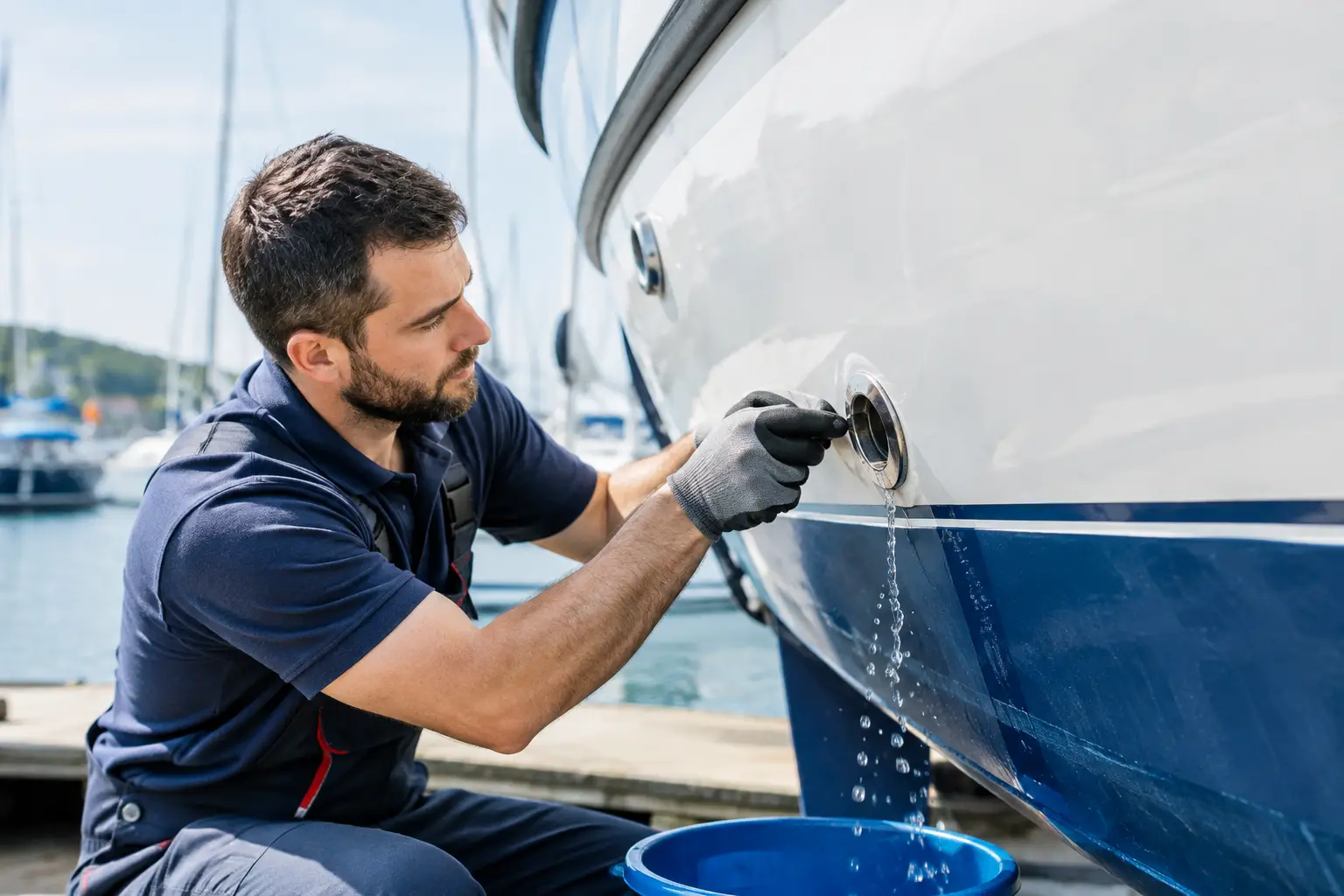
A drop of water in the bilge is not always cause for alarm, but changes in water quantity, its salinity, or appearance after rain, sailing, or system operation require inspection. Water intrusion repair does not start by applying sealant to the first suspect spot. It begins with determining the path through which water enters, as the spot where water is visible often differs from the actual intrusion point.
On a vessel, water can enter through deck joints, openings, windows, cable glands, pipe passages, valves below the waterline, or freshwater system connections. It may then move through bulkheads, installation channels, and linings before appearing in the cabin or bilge. Surface repairs without diagnostics often only delay a larger problem.
Why Water Intrusion Is a Technical and Safety Issue
Consequences depend on the volume of water, its source, and the affected part of the vessel. Seawater in electrical compartments can accelerate corrosion of contacts, fuses, busbars, and connectors. Moisture in enclosed structures can damage insulation, linings, wooden structures, and sandwich laminate cores. Intrusion below the waterline poses a direct risk: a valve, pipe, or joint failure can compromise the vessel's buoyancy.
Availability of the vessel is equally important. An owner who empties the bilge several times per season, dries mattresses, or resets devices due to moisture has not solved the cause but instead handles a repeating operational problem. For charter vessels, this may mean reservation cancellations; for professional crews, increased monitoring and uncertainty during navigation.
Water in the bilge also does not automatically prove seawater intrusion. Air conditioning condensate, coolant discharge, watermaker leaks, tank leaks, siphoning through drains, or freshwater pipe bursts can leave very similar traces. Therefore, the first task is to distinguish external intrusion from internal system failure.
Water Intrusion Repair Begins with Source Identification
Reliable diagnostics rely on the circumstances in which water appears. If the problem arises only after heavy rain or deck washing, inspection focuses on the superstructure, windows, hatches, deck equipment, and installation penetrations. If the amount increases during sailing, especially at certain heel angles or wave impacts, inspect the hull, deck-to-hull joints, cockpit, drains, and all openings exposed to the sea.
When water appears while stationary, check valves below the waterline, pipes, joints, shaft seals, engine cooling systems, generators, and tanks. Odor, taste, and salt residue can assist but are not sufficient as sole evidence. Water may mix with bilge residue, and slight seawater intrusion can be diluted by condensate or freshwater.
Inspection should also include the time of problem onset. Photos before and after sailing, marked bilge water levels, and pump operation logs are often more useful than assuming the problem arose at the first visible spot. More complex cases involve controlled water testing section by section. Decks are not flooded randomly. One person controls water input externally while another watches inside the vessel and records findings.
Points Requiring Systematic Inspection
The most common causes are not necessarily large or immediately visible. Old sealant, slightly loosened screws, or improperly executed cable passages can allow enough water over months to cause serious damage. Particular attention must be given to these assemblies:
- hatches, windows, cockpit doors and their frames
- deck fittings, winches, cleats, railings, solar panel and antenna mounts
- deck-to-hull joints and tank covers and service openings
- cable glands, pipe passages, and penetrations for mast or navigation equipment
- valves, intakes, drains, pipes, and clamps below the waterline
- shaft seals, transom area, rudder passages, and all propulsion system penetrations.
In electronic equipment, problems often arise at the mechanical-to-installation joint. Antennas, radars, solar panels, or deck connectors may be well chosen but represent a weak point if the deck penetration is not properly designed and sealed. The cable must have an appropriate gland, strain relief, and a path that prevents water ingress inside. Simply adding sealing compound around the cable rarely provides a lasting solution.
Repairs Must Correspond to Material and Cause
After locating the source, the extent of repairs is determined. With worn hatch seals, servicing the frame, cleaning the seating surface, and replacing the seal may suffice. For deck fittings, components must be removed, substrates inspected, old sealant removed, moisture or laminate damage checked, and parts reinstalled with appropriate sealing and correctly tightened fasteners.
If moisture in a sandwich core, laminate cracks, or hull damage is found, the procedure differs. Such tasks may require drying, opening the damaged area, core restoration, and laminating according to the actual structure condition. Quick surface closure without moisture assessment can trap problems inside the structure. The scope depends on vessel material, damage location, internal access, and intended use.
For valves and pipe joints below the waterline, safety is the priority. Corroded valves, cracked pipes, or inappropriate clamps are not places for temporary repairs that remain in use all season. Compatibility of materials, hull attachment condition, accessibility for shutoff, and regular inspection capability must be confirmed. Each valve must be accessible, clearly marked, and the crew must understand its function.
Protect Electrical and Power Systems Before Major Failures
If water has reached batteries, chargers, inverters, distribution panels, navigation devices, or connectors, drying the surface is insufficient. Inspection of connections, conductor insulation, corrosion traces, and protective device function is necessary. Salt moisture can cause failure weeks later when contacts lose conductivity or contact resistance increases.
Special caution is required with LiFePO4 battery systems and high-current DC cables. Water, corrosion, and poor contacts can cause connection heating and unpredictable system behavior. Post-intrusion technical checks should cover not only the visibly wet device but also wiring, fuses, busbars, housings, and communication connections in the affected zone.
UnLucky offers diagnostics of water intrusion impacts on marine electrical, electronic, and power systems, installation renewal, proper deck penetration execution, and functional checks after interventions. When findings suggest structural hull or laminate repair, scope should be coordinated with an appropriate shipyard or qualified contractor. Clear responsibility allocation is more critical than ad hoc field solutions.
Preventive Maintenance Reduces Recurrence Risk
The best time to inspect sealants, deck fittings, and underwater penetrations is not the day before departure. Regular checks before the season, after severe weather, impacts, or new equipment installation allow small defects to be rectified before water reaches installations and interiors.
After each intervention, verify results under the conditions that revealed the issue: controlled water spraying, test sailing, bilge monitoring, or pump and electrical circuit operation checks. Commissioning is not a formality. It confirms that the water path is interrupted and that the repair did not cause new problems to adjacent systems.
If you notice unusual moisture, rising bilge water levels, salt traces, or occasional electrical disturbances, send an inquiry with vessel description, problem location, and circumstances of occurrence. The more precise the findings, the more reliably the repair can be planned. Because Luck Has Nothing to Do With It.