


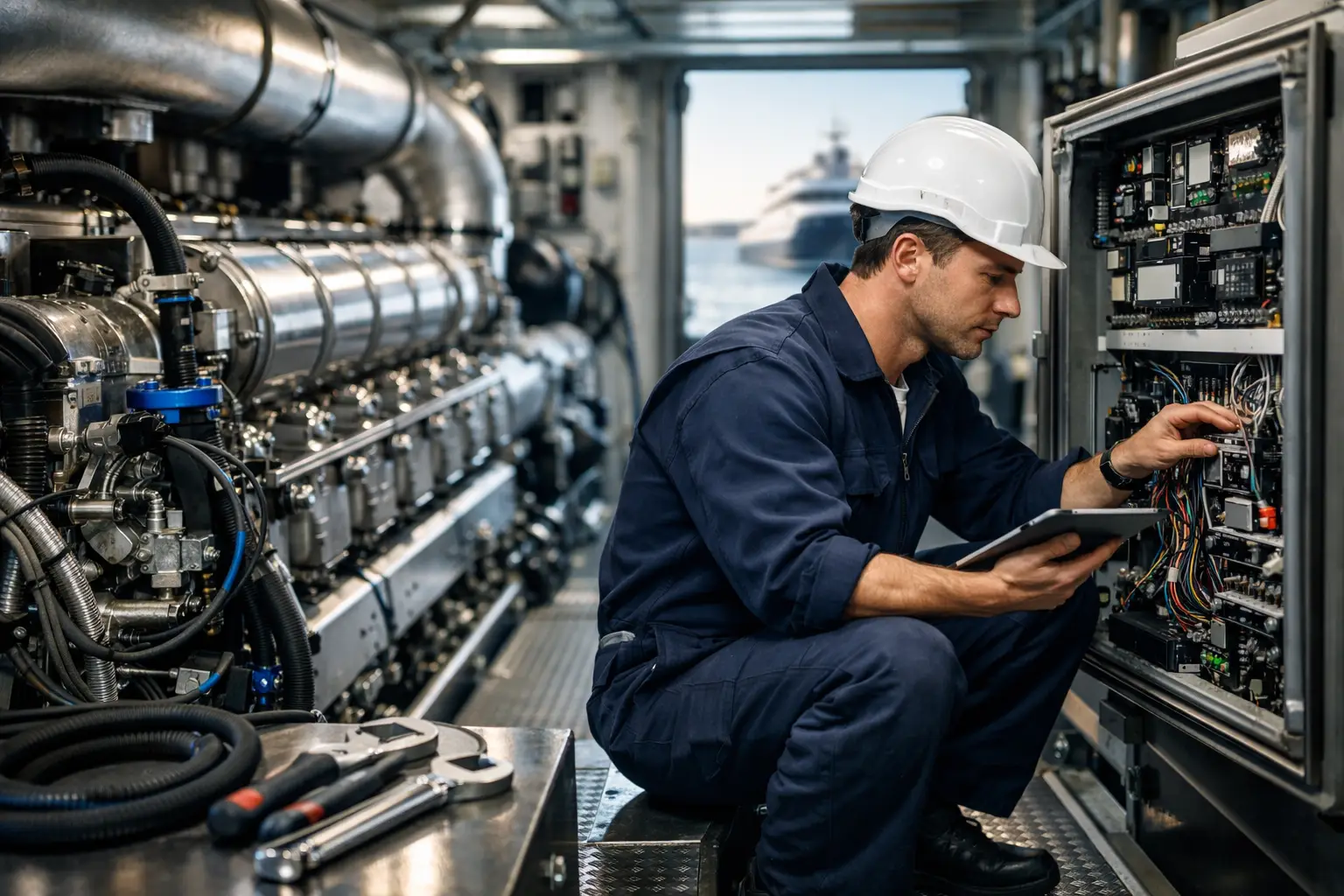
The refit of ship systems is not merely the replacement of several worn-out devices nor just an aesthetic refresh of the control console. It is a technical intervention where existing installations, power sources, control, and equipment are brought to a status that corresponds to the actual way your vessel is used. When performed without a comprehensive inspection, a new device may only reveal an old problem—undersized wiring, inadequate protection, improperly executed charging, or communication protocols that do not understand each other.
The owner who desires greater autonomy at anchor, the captain who requires reliable navigation, or the charter operator aiming to reduce unplanned downtime do not share the same project. Their common demand is: the system must operate predictably, be user-friendly, and enable clear diagnostics when deviations from normal operation occur.
When Ship System Refit Is Justified
The need for a refit rarely occurs instantly. It is usually recognized through a series of symptoms: batteries discharge faster than expected, the charger operates without clear monitoring, navigation devices occasionally lose data, the bow thruster lacks expected power, or switches appear on the panel without clear labels and functions.
In older vessels, a frequent problem is that systems have been incrementally upgraded over the years, often by different contractors. The result can be a functional vessel with an installation difficult to service, even harder to expand, and risky to diagnose under load. Such a condition does not automatically mean a complete replacement of everything. Sometimes it suffices to repair critical parts, reorganize distribution, introduce supervision, and properly integrate existing equipment.
A complete refit makes sense when the system’s foundation is outdated, unsafe, or cannot support the vessel’s intended use. An example is transitioning to a larger capacity house battery bank, installing an inverter, solar panels, and a new charging system. In that case, not only battery capacity but alternators, cables, fuses, busbars, ventilation, consumer management, and shore and generator charging are evaluated.
Inspection Before Equipment Selection
A quality project begins with an inspection of the actual condition, not a product catalog. It is necessary to determine how the electrical installation is executed, where losses or corrosion exist, whether wiring and protective elements are correctly dimensioned, and if proper system documentation exists. On many vessels, documentation is incomplete or no longer corresponds to the actual state after previous interventions.
Equally important is understanding the usage profile. A sailboat spending several days at anchor has different energy priorities than a motor yacht with a generator and permanent crew. A charter catamaran requires simple operation and resistance to intensive use, while an owner planning longer voyages outside the home marina may prioritize redundancy, monitoring, and greater energy autonomy.
During the technical inspection, several related areas need to be covered:
- Condition of DC and AC distribution, battery switches, fuses, connections, busbars, and grounding
- Battery capacity, actual consumption, charging sources, and system behavior under load
- Communication between navigation, instruments, autopilot, VHF, AIS, and monitoring systems
- Status of propulsion and auxiliary systems such as bow thrusters, winches, pumps, watermakers, and deck equipment
Such an inspection reveals priorities. Not every irregularity is equally urgent, but it is necessary to distinguish aesthetic defects from faults that could cause power loss, overheating of wiring, pump malfunction, or inability to start the engine.
Energy System: More Than New Batteries
LiFePO4 batteries are often the centerpiece of modernization because they offer useful capacity, lower weight, and a high number of cycles compared to traditional lead-acid types. However, their installation is not a "one for one" replacement. Compatibility of chargers, solar charge controllers, alternators, BMS, and existing monitoring systems must be verified.
Special attention must be given to alternator charging. A battery bank capable of accepting high current can simultaneously overload the alternator if the system is not properly designed and protected. Solutions may include DC-DC chargers, external regulators, current limiting, or changes in charging methods. This depends on the engine, alternator, battery capacity, and expected operating mode.
The solar system should also be sized according to available surface area, shading, daily consumption, and onboard priorities. Solar panels can significantly extend anchoring time but will not solve the problem alone if large consumers, such as air conditioning, boilers, or watermakers, exceed the realistic capabilities of the battery and production system. Properly set expectations are part of the project as much as component selection.
Sodium-ion batteries may be a relevant option in certain applications, but the choice should always be based on available space, required capacity, temperature conditions, charging methods, and overall vessel architecture. Battery technology is not the goal itself. The goal is a stable system with clear operating limits and reliable maintenance possibilities.
Navigation, Monitoring, and Data Integration
An outdated plotter is not the sole reason for navigation modernization. A major value of the refit is often in data integration: position, depth, wind, engine data, tank levels, energy consumption, and alarms should be accessible where the crew actually uses them. Simply connecting devices by cable is insufficient. It is necessary to verify protocols, network topology, data sources, and how the information is displayed.
Duplicated or incorrectly configured sources may cause inaccurate readings. For instance, an autopilot might receive an inappropriate course input, whereas the plotter might show incomplete engine data. In complex systems, future expansions should be planned: additional displays, remote monitoring, tank sensors, or energy management integration.
Monitoring ship systems has concrete operational value. Timely warnings of low voltage, high temperature, bilge pump operation, or consumption deviations enable reaction before a problem develops into a voyage interruption. However, alarms must be sensibly configured. A system that constantly sends irrelevant notifications will be ignored just when a critical warning appears.
Mechanical and Comfort Systems in the Same Project
A refit often includes equipment that at first glance seems unrelated to the electrical system: bow thrusters, winches, watermakers, pumps, heating, or electric propulsion. In practice, all these systems are interconnected through energy consumption, circuit protection, control, and available installation space.
A bow thruster may have sufficient declared thrust but poor connections, inappropriate cables, or a drained battery at the moment of maneuvering. A watermaker may be well selected but cause problems if not properly integrated with water supply, filtration, drainage, and power supply. Planning electric propulsion is even more demanding because propulsion power, battery capacity, charging, cooling, and safety components must be considered as a single entity.
To protect the hull from fouling, BPS Marine Ultrasonic Antifouling can be considered after assessing vessel type, compartment layout, hull materials, and usage conditions. As with every technical upgrade, the installation must be justified by the vessel's real needs, not just the promise of new technology.
Installation, Commissioning, and Documentation
The selection of compatible equipment is valuable only to the extent that execution is reliable. Professional installation includes proper cable routing and labeling, appropriate conductor cross-sections, protection against vibration and moisture, correctly placed fuses, neat connections, and service access. In a marine environment, an improvised connection that works today can tomorrow cause voltage drops, corrosion, or overheating.
After installation, configuration, functional testing, and commissioning follow. The system behavior is tested under real conditions: shore charging, inverter operation, heavy consumer load, data transfer, alarm function, and energy source priorities. The crew or owner must be clearly informed about normal operation, limitations, and basic checking procedures.
Documentation is not an administrative addition. Updated schematics, equipment lists, settings, and circuit labels accelerate any future diagnostics and service intervention. This is especially important when the vessel is operated by multiple crew members or serviced outside the home marina.
UnLucky approaches the project through inspection, technical compatibility testing, design, installation, and integration, and then through commissioning, diagnostics, and continuous technical support. The scope of work, equipment availability, deadlines, and price can be responsibly confirmed only after reviewing the vessel's condition and your requirements.
If your vessel shows signs of unreliable power supply, unclear installations, or disconnected systems, send an inquiry with basic data about the vessel and existing equipment. A good refit starts with precise questions, a clear plan, and verification of every key detail - Because Luck Has Nothing to Do With It.