


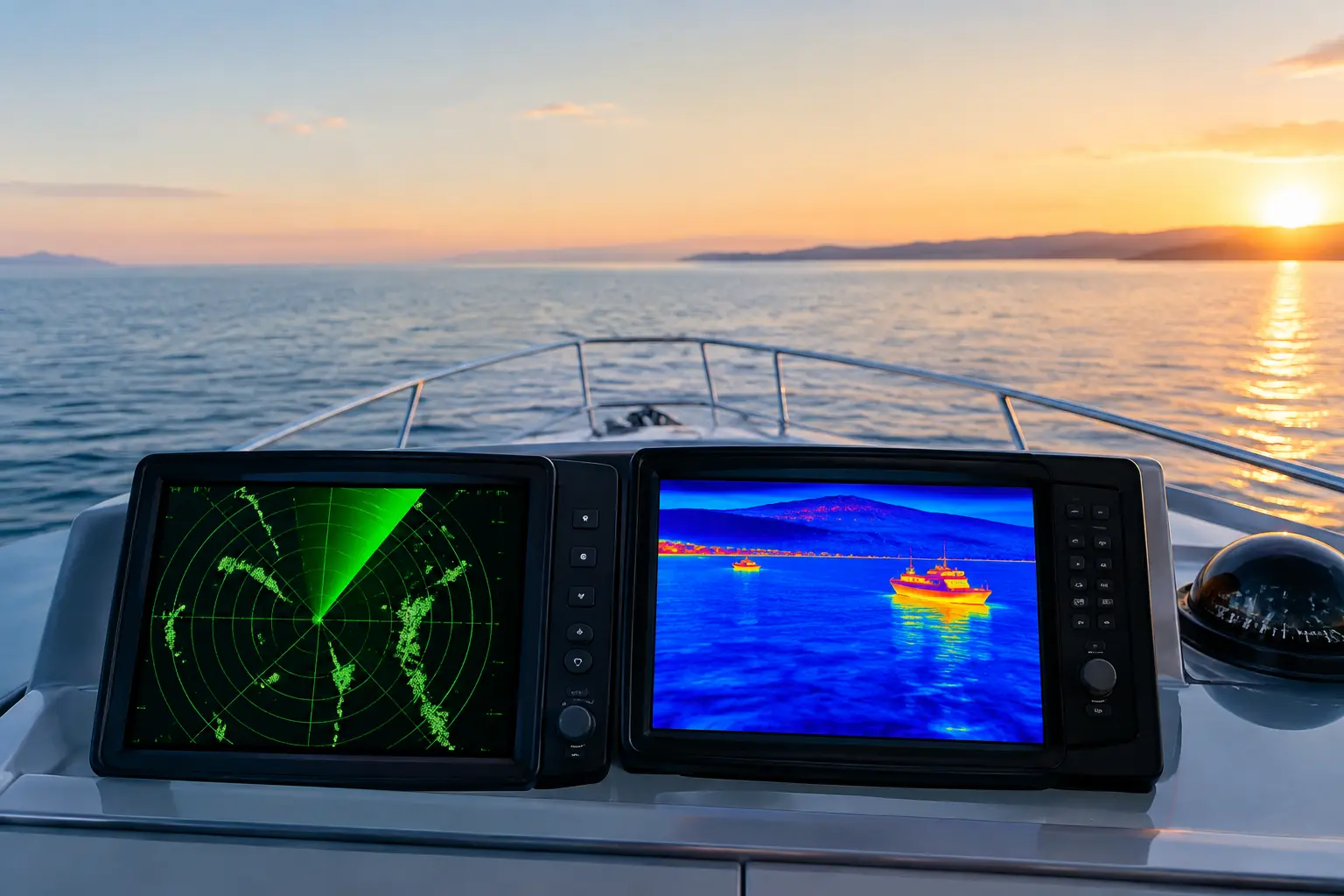
Returning to port at night, navigating along busy coasts, or sailing in reduced visibility quickly reveals the limitations of relying solely on plotter, AIS, and the human eye. The question of radar or thermal camera is therefore not a matter of prestige or additional equipment, but an assessment of real risks on your vessel. These two systems provide different information about the environment and often complement each other within a properly designed navigation suite.
Radar detects radio wave reflections, while the thermal camera displays temperature differences. Radar can show you the shoreline, a buoy, a rain zone, or another vessel at a greater distance. A thermal camera can detect a person, a smaller boat, or an obstacle without its own light when the radar image is unclear or when the object has a weak radar signature. Neither system replaces mandatory lookout, good situational assessment, and a crew capable of interpreting the displayed data.
Radar or Thermal Camera: Key Difference
Radar emits an electromagnetic signal and measures the reflected echo. On the display, it provides a representation of the position and distance of targets relative to the vessel. Experienced users find radar especially valuable for monitoring course and approaching vessels, comparing coastline outlines with charts, and assessing precipitation development.
Its advantage is not only night operation. Radar can be very useful in fog, poor visibility, and rain, although intense precipitation generates rain clutter, and waves and foam cause sea clutter. Proper adjustment of sensitivity, sea and rain clutter suppression, range, and display mode is necessary. Automatic modes may assist but cannot always accurately assess sea conditions, vessel speed, and target type.
The thermal camera does not emit a signal. It receives infrared radiation and converts temperature differences into an image. A person in the water, the warm engine of a small inflatable boat, or a vessel with crew can stand out from the cooler sea background, especially in complete darkness. For maneuvering into a dimly lit cove, bow area monitoring, or man-overboard search, such an image can provide information the radar does not clearly show.
However, a thermal camera cannot see through coastlines, waves, or solid obstacles, and its effectiveness depends on weather, humidity, sea and air temperature, and the thermal contrast of the target. Fog, heavy rain, sea spray on the lens, and uniform ambient temperature can significantly reduce image usefulness. The camera also does not provide reliable distance to the target without additional references or integration with other systems.
When Radar Holds the Advantage
For longer passages, night navigation offshore, and vessels regularly sailing in varying weather conditions, radar is commonly the fundamental navigational tool. It can display targets at greater ranges and assist early detection of traffic situations. With a properly configured automatic target tracking system, the captain can monitor CPA and TCPA — the closest point of approach and the time to reach it.
This, however, is no reason to assign the same significance to every echo on the screen without verification. A small plastic boat, a low buoy, a wooden object, or a person in the water may have a very weak radar return, especially among waves. Conversely, a metal vessel, coastal structure, or large wave can produce a strong echo which must be correctly interpreted.
Radar installation must consider antenna height and position, clear horizon, influence of masts, superstructures, and other equipment. Safe clearance from crew areas is important. An antenna installed too low has a limited horizon, and a poorly chosen location may create shadow sectors where the radar does not provide a reliable image.
When a Thermal Camera Justifies Investment
A thermal camera is especially advantageous on motor yachts, larger sailing vessels, workboats, and vessels frequently entering port at night. Its greatest contribution is visual confirmation of what radar, AIS, or lookout suggest. For example, radar may show an echo ahead of the bow, while the thermal image can help judge whether it is a vessel, a coastal rock, or an object with a thermal signature.
In safety scenarios, the ability to quickly detect heat sources is critical. A person in the water may be very difficult to see by lights, particularly when the sea is rough and coastal lighting reflections impair night vision. A thermal camera is not a guarantee of finding a person but can provide a very valuable additional layer of safety if operated correctly and if the crew regularly drills search procedures.
For vessels mostly operating during daytime, on short routes and in good visibility, a thermal camera may not be the first priority. In such cases, a quality radar, well-installed AIS, reliable VHF communication, or navigation display upgrade can be more beneficial. The choice depends on the mode of operation, not on what is currently more commonly installed on other vessels.
The Best Results from an Integrated System
On vessels regularly sailing at night or on the open sea, radar and thermal camera are not opponents. Radar provides measurable situational awareness and extended range, while the thermal camera offers intuitive visual information in the immediate navigation zone. AIS additionally provides identity, course, and speed of vessels transmitting data but will not show non-AIS vessels, buoys, debris, or persons in the water.
Integration into a compatible multifunction display allows radar, chart, AIS, and thermal views to be logically accessible. This does not mean everything must be permanently shown on one screen. Cockpit and command station layouts should suit actual crew operation, visibility conditions, and quick switching capabilities between views.
For professional vessels and larger yachts, a separate thermal camera display, multi-position camera control, and connection to alarm or video systems where justified should be considered. On smaller vessels, simpler solutions often better suit crews for safe use without unnecessary complexity.
Installation Determines Equipment's Real Value
Purchasing equipment is just the beginning. Radar requires properly dimensioned power supply, appropriate circuit protection, quality cable routing, and carefully chosen antenna position. Thermal cameras require a solid mount with minimal vibration, protected wiring, and an unobstructed viewing area. Salt, UV radiation, and continuous marine vibrations quickly reveal compromises in execution.
Before selection, verify compatibility with existing navigation displays, vessel networks, heading sensors, GPS sources, and AIS systems. For radar, accurate heading data is especially important for target tracking and overlay functions on charts. For thermal cameras, determine whether a fixed view, manually operated PTZ camera, or a camera with tracking functions and a defined field of view is needed.
After installation, configuration, display verification, basic parameter adjustment, and commissioning at sea follow. The crew must know how to recognize sea clutter, when to reduce range, how to verify targets with other data sources, and what to do if navigation display or network behaves unusually. Preventative maintenance includes checking connectors, mounts, housings, cables, and image quality before the system is needed under reduced visibility conditions.
Selection Based on Your Navigation, Not a Catalog
If you sail long routes, radar is usually the primary navigation priority. If you frequently sail at night, dock in unlit areas, or want to enhance visual detection capabilities during search and maneuvering, a thermal camera can be a justified upgrade. For higher value vessels and professional operations, a combination of both systems often makes the most sense, provided it is properly designed and the crew trained in its use.
UnLucky can review your existing navigation installation, check equipment compatibility, and suggest solutions suited to your routes, command station layout, and vessel power system. Send an inquiry with basic vessel data and usage to receive a technically grounded recommendation. Because Luck Has Nothing to Do With It.