


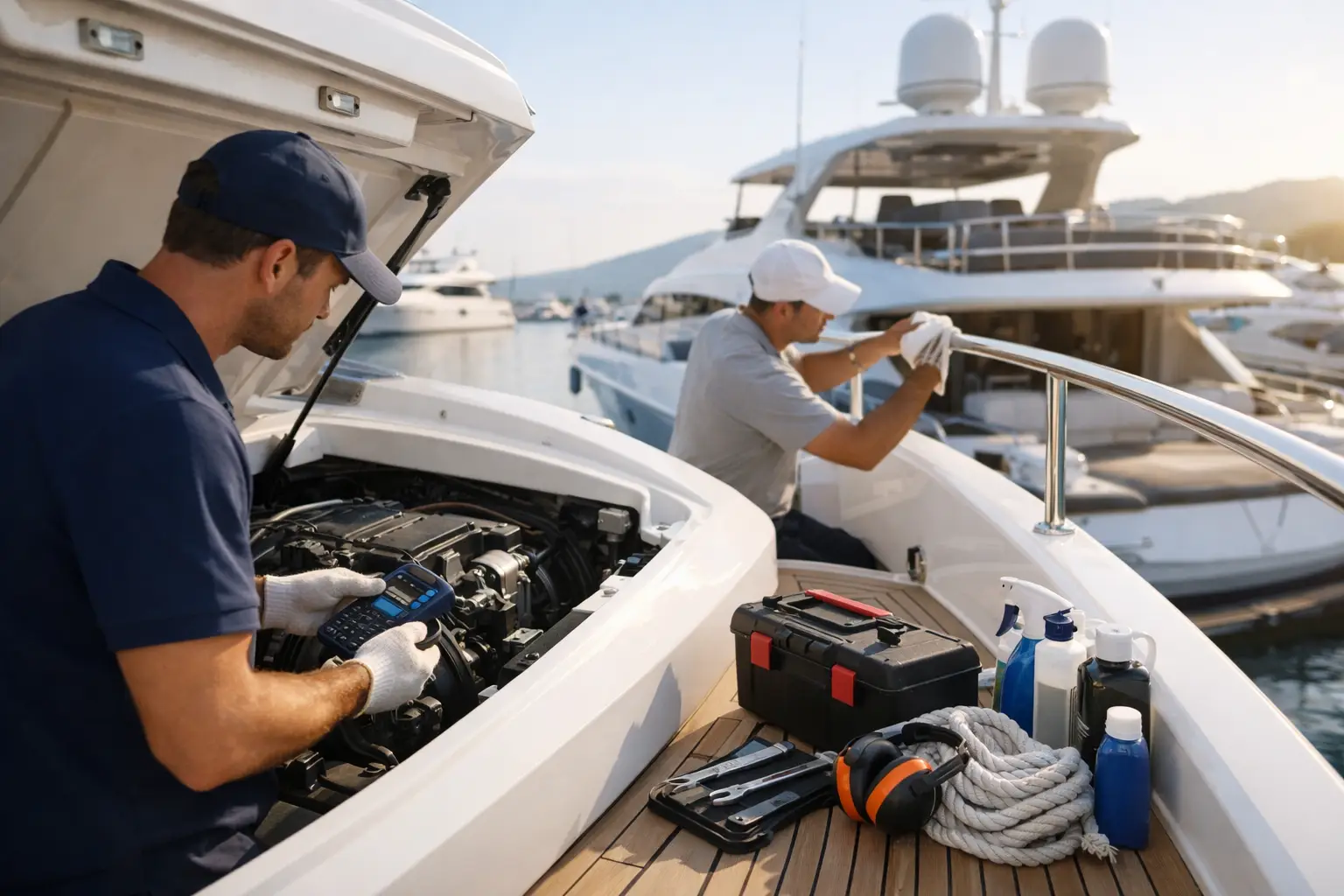
Malfunction of the bow thruster during docking, loss of battery charge while underway, or a faulty bilge pump rarely occur without warning. Preventive yacht maintenance serves precisely to detect signs of wear, corrosion, loose connections, and improper function before they become safety or operational issues.
For the owner, captain, or charter operator, maintenance is not just a cost between seasons. It is managing vessel availability, protecting valuable equipment, and reducing the risk of emergency interventions when service, spare parts, or a berth are not readily accessible.
Why yacht failures are often detected too late
Marine systems operate in conditions that accelerate wear: salt, humidity, vibrations, thermal loads, and occasional long periods of disuse. The problem may not be visible. A seemingly intact connection can have elevated contact resistance, a battery can lose capacity without clear warning, and a water system hose can weaken before leakage occurs.
Additional complexity arises from later installations. Many vessels acquire new electrical branches, extra consumers, chargers, solar panels, navigation equipment, or autonomous systems over the years. If each modification is not integrated into the existing installation with proper protection, appropriate conductor cross-section, and compatibility verification, the likelihood of intermittent and hard-to-diagnose failures increases.
Therefore, preventive inspections are not a quick walkthrough. Their purpose is to establish the actual technical condition, identify priorities, and determine which interventions should be done immediately and which are reasonably planned outside the main season.
Preventive yacht maintenance starts with an inspection of the actual condition
A good maintenance plan is not based solely on manufacturer’s service interval lists. It must consider vessel age, engine and generator operating hours, usage patterns, season length, number of persons aboard, and existing electrical and power system loads.
A vessel cruising near the home marina on weekends has different requirements from a yacht spending weeks at anchor, using a watermaker, air conditioning, a larger bank of house batteries, and numerous navigation devices. A charter vessel faces additional strain from more intensive use and shorter turnaround times between guest rotations.
The technical inspection should yield a clear finding: what was checked, what irregularities were found, their priority, and the recommended next steps. This provides the owner with a basis for work planning instead of decisions under the pressure of unexpected failure.
Electrical system: Small connections, big consequences
Electrical installations deserve special attention because failures often start in places not constantly visible. Moisture and salt enter connectors, vibrations strain connections, and inappropriate fuses or conductors can endanger equipment operation and vessel safety.
Preventive checks assess battery terminals, main switches, fuses, busbars, chargers, inverters, and distribution panels. Signs of overheating, oxidation, mechanical cable stress, improper labeling, and prior improvised interventions are examined.
It is particularly important to review the relationship between power sources and consumers. Installing a larger inverter, additional coolers, electric winches, or new navigation devices can significantly change consumption profiles. A system previously operating satisfactorily may then suffer from insufficient charging, voltage drops, or overloaded lines.
For LiFePO4 and sodium-ion batteries, preventive maintenance includes reviewing BMS configurations, communication with chargers and monitoring systems, charging parameters, and protection against excessively low or high temperatures. Simply replacing lead-acid batteries with newer technology is insufficient. The entire charging system, alternator, DC-DC chargers, solar regulators, and protection logic must be checked.
Navigation, communication, and system monitoring
Navigation electronics are often tested only when needed. This is not an ideal time to discover a GPS antenna intermittently losing signal, an improperly calibrated radar, or communication interruptions in instrument networks.
Preventive checks include operation of plotters, AIS, radar, VHF devices, depth sounders, autopilots, wind sensors, and other onboard equipment. For integrated systems, data exchange between devices must be verified. This is especially important after firmware upgrades, component replacements, or adding new data sources to the network.
System monitoring can detect voltage, temperature, tank level, or pump operation deviations early. However, monitoring is effective only if sensors are properly installed, configured, and someone understands which values require action. An alarm repeated without verification eventually becomes one that is ignored.
Propulsion, deck equipment, and systems under load
Bow thrusters, anchor windlasses, electric winches, and deck equipment operate briefly but under high electrical and mechanical load. For this reason, cables, contactors, fuses, control switches, mechanical transmissions, and water ingress protection are crucial for reliable operation.
Anchor systems require inspection of the anchor chain, connections, guides, windlass, and remote controls. Corrosion, faulty brakes, or electrical contact issues may manifest at the worst moments — during weather changes or departure from anchorage.
If the vessel uses electric propulsion, the preventive approach must cover the battery system, control electronics, cooling, communication between components, and charging infrastructure. There is no universal interval for all systems. Recommended maintenance frequency depends on the manufacturer, usage pattern, and data recorded via system monitoring.
Water supply, bilge, and underwater hull protection
Water supply systems, pumps, filters, valves, and watermakers often operate without full crew attention until failure occurs. Preventive service includes leak checks, connection inspections, filter and pressure evaluations, pump operation, and hose conditions. Watermakers require a maintenance plan aligned with usage and water quality, including proper flushing and preservation for prolonged inactivity.
Bilge pumps and high-water alarms require functional testing, not just visual checks. Floats can be blocked by debris, automatic pumps may have loose connections, and discharge hoses may be partially clogged.
The underwater hull section also affects efficiency and operating costs. Ultrasonic antifouling can reduce fouling under certain conditions but requires correct transducer positioning, proper installation, and realistic expectations. Effectiveness depends on the hull, sailing area, water temperature, time spent in the berth, and system condition.
When to schedule work
The best time for a thorough inspection is before the season starts, allowing sufficient time for diagnostics, procurement of compatible components, and quality work execution. Post-season inspections are equally valuable to reveal intensive use impacts and enable proper winterization.
During the season, shorter control checks are recommended, especially before extended voyages, after severe weather, impacts with floating objects, or any changes in electrical, propulsion, or water system operation.
A practical annual plan typically includes four groups of checks:
- electrical installations, charging, batteries, and protective elements
- navigation and communication equipment and device network integration
- pumps, valves, watermakers, bilge systems, and water supply systems
- deck equipment, bow thruster, windlasses, anchoring system, and propulsion systems
Professional installation prevents recurring issues
Replacing a component without determining the root cause may temporarily restore function but does not always solve the problem. A charger overheating may not be faulty but operating in a system with incorrect cable sizing, poor ventilation, or wrongly set battery parameters. A navigation device losing data may not be defective but have network topology or power supply issues.
Thus, technical compatibility assessment, design, installation, and integration are interconnected processes. After works, configuration, functional testing, and commissioning in real conditions should be performed when possible. Documenting the performed condition further facilitates future service and reduces diagnostic time.
If you wish to determine what work your vessel truly requires before the season or during operation, send a request for a technical inspection and preventive maintenance plan. UnLucky approaches the system holistically – because reliability of the vessel is no accident. Because Luck Has Nothing to Do With It.