


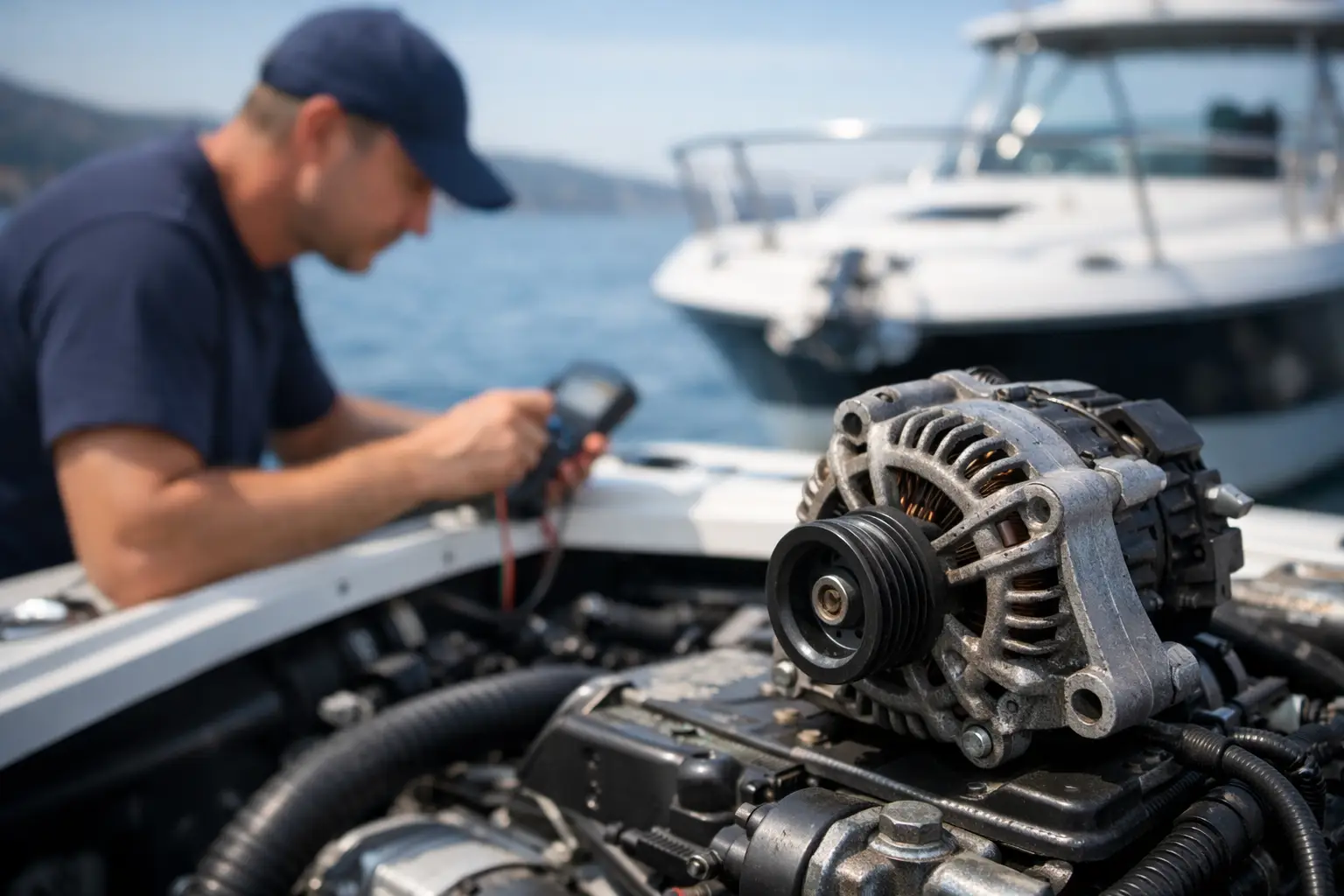
An alternator rarely fails without warning, but warnings on a vessel are often attributed to an old battery, increased consumption, or short engine operation. Five signs of alternator failure can help you distinguish a transient irregularity from a problem that threatens charging the service battery bank, navigation operation, communication equipment, and the ability to continue sailing safely.
On a vessel, the alternator is not just a component for starting the engine. Depending on the electrical system design, it can charge both the starter and service batteries, support the operation of the refrigerator, autopilot, radar, navigation instruments, winches, and other consumers while the engine runs. In vessels with a large LiFePO4 bank, DC-DC charger, or external charging regulator, its integration must be specifically well-engineered. An inappropriate charging regime can overload the alternator even when instruments show no apparent problems.
Why alternator failure requires swift response
When the alternator stops charging, the vessel can continue operating for some time on the energy stored in the batteries. How long depends on the capacity of the battery bank, actual state of charge, consumption, and how circuits are connected. On a sailing yacht during daytime sailing, consequences may not be immediate, whereas on a motorboat with active navigation, communications, and electronic control, the situation can quickly become operationally critical.
Not every voltage drop indicates alternator failure. Causes may include belt slip, faulty regulator, poor ground connection, corroded cable, fuse, battery isolator, relay, DC-DC charger, or the battery itself. For this reason, replacing the alternator without measurement is often not the correct first step.
Five signs of alternator failure you should not ignore
1. Charging indicator light remains on or lights up intermittently
The battery indicator light on the engine panel should go off after the engine starts. If it stays on, blinks, or appears at higher RPM, the alternator may not be generating sufficient voltage or the excitation circuit is malfunctioning.
Intermittent illumination of the indicator light is often a more valuable diagnostic clue than a constantly lit light. It can indicate a loose connection, circuit interruption, worn brushes, regulator problem, or belt slipping only under higher load. Do not assume the problem is solved if the light goes off after changing engine speed.
2. Battery voltage does not rise while the engine is running
The most reliable basic indicator is voltage measurement at appropriate points in the system. In a classic 12-volt lead-acid system, the alternator typically raises voltage above the battery's resting voltage during charging. The exact value depends on battery chemistry, temperature, charging phase, regulator, and installation losses.
If you measure approximately the same voltage on the battery with the engine off and running, the charging may not be reaching the battery bank. However, measuring only at the panel is insufficient. On a vessel, significant differences may exist between the alternator output, the input to the distribution system, and the voltage at the battery due to poor connections or undersized cables.
In LiFePO4 systems, assessing based on voltage alone is even less reliable because the voltage curve is not as straightforward as in lead-acid batteries. It is necessary to check charging current, BMS settings, DC-DC chargers or external regulators, and allowable alternator load.
3. Batteries discharge faster than usual during sailing
If you are accustomed to having charged batteries after several hours of engine operation, but now the state of charge does not recover, the cause may be insufficient alternator charging. Typical symptoms include dimmer lights, slower operation of bow thrusters or winches, warnings on multifunction displays, and more frequent generator starts or shore power connections.
However, increased consumption does not prove alternator failure. Refrigerator, autopilot, inverter, watermaker, or electric kitchen appliances can significantly alter the energy balance. Technical verification must compare supplied current with actual consumption on the vessel, not just observe charge percentage on the display.
4. You hear squealing, scraping, or detect overheating smell
Squealing at engine start or when larger consumers engage often indicates the alternator belt is slipping. A loose, worn, or contaminated belt does not transmit sufficient power to the alternator, and friction may further heat pulleys and surrounding components. An overly tight belt is also not a solution as it unnecessarily burdens the alternator and engine bearings.
Scraping, buzzing, or metallic sounds can indicate worn bearings. The smell of burnt insulation, hot cables, or discoloration of connectors demands immediate load reduction and inspection. Such signs are not only about current availability but also a potential risk to the electrical installation.
5. Charging is unstable or the alternator becomes unusually hot
Voltage that fluctuates significantly, occasionally charges too high, or suddenly drops may indicate issues with the regulator, connections, or internal alternator components. Excessively high voltage may damage sensitive electronics and shorten battery life, while low voltage leaves the battery bank chronically undercharged.
High alternator temperature during operation is not unusual itself. Problems arise when the alternator is continuously loaded near its limit, especially when charging large lithium battery banks. Standard engine alternators are often not designed for prolonged maximum output. Solutions in such systems may include an external regulator with a temperature sensor, current limiting via DC-DC chargers, a higher capacity alternator, or different energy source management.
What to check before replacing the alternator
The first step is a visual inspection: condition of the belt, pulleys, connectors, fuses, ground, and cables at the alternator output. Corrosion in cable terminals, poorly executed ground connections, or thermally damaged fuses can cause voltage drops resembling alternator failure.
Next, measure voltage and current at different engine speeds and loads. It is necessary to compare voltage at the alternator itself with voltage at the battery, check the activation of isolators or chargers, and read any errors on the BMS and battery monitor. If the vessel has multiple charging sources, such as solar systems, generators, and shore chargers, diagnostics must clearly separate each source's contribution.
Replacing with an appropriate new alternator only makes sense after confirming the existing unit is the problem and verifying compatibility with the engine, existing cables, battery chemistry, and vessel usage patterns. A stronger alternator without adaptation of cable cross-section, protection, ventilation, and regulation can create a new set of problems.
Preventive maintenance of the charging system
Alterator inspection should be included in regular engine and electrical system maintenance, especially before the season and longer voyages. Check belt tension and condition, cleanliness of ventilation openings, contact connections, voltage drops in main wiring, and actual charging current under load.
For vessels refitted with LiFePO4 or sodium-ion batteries, a comprehensive review of the charging architecture is required. Confirming the battery receives energy is not sufficient. It is essential to ensure the alternator operates within permitted thermal limits, protection devices respond predictably, and the BMS does not interrupt charging in a way that may overload the engine's electrical system.
If you notice one or more of these signs, reduce unnecessary consumption, monitor voltage, and do not delay system diagnostics. UnLucky can perform measurements, technical compatibility verification, and charging system servicing based on the actual state of your vessel. Submit an inquiry before your next cruise - reliable power supply is not a matter of luck but of proper inspection and professional implementation.