


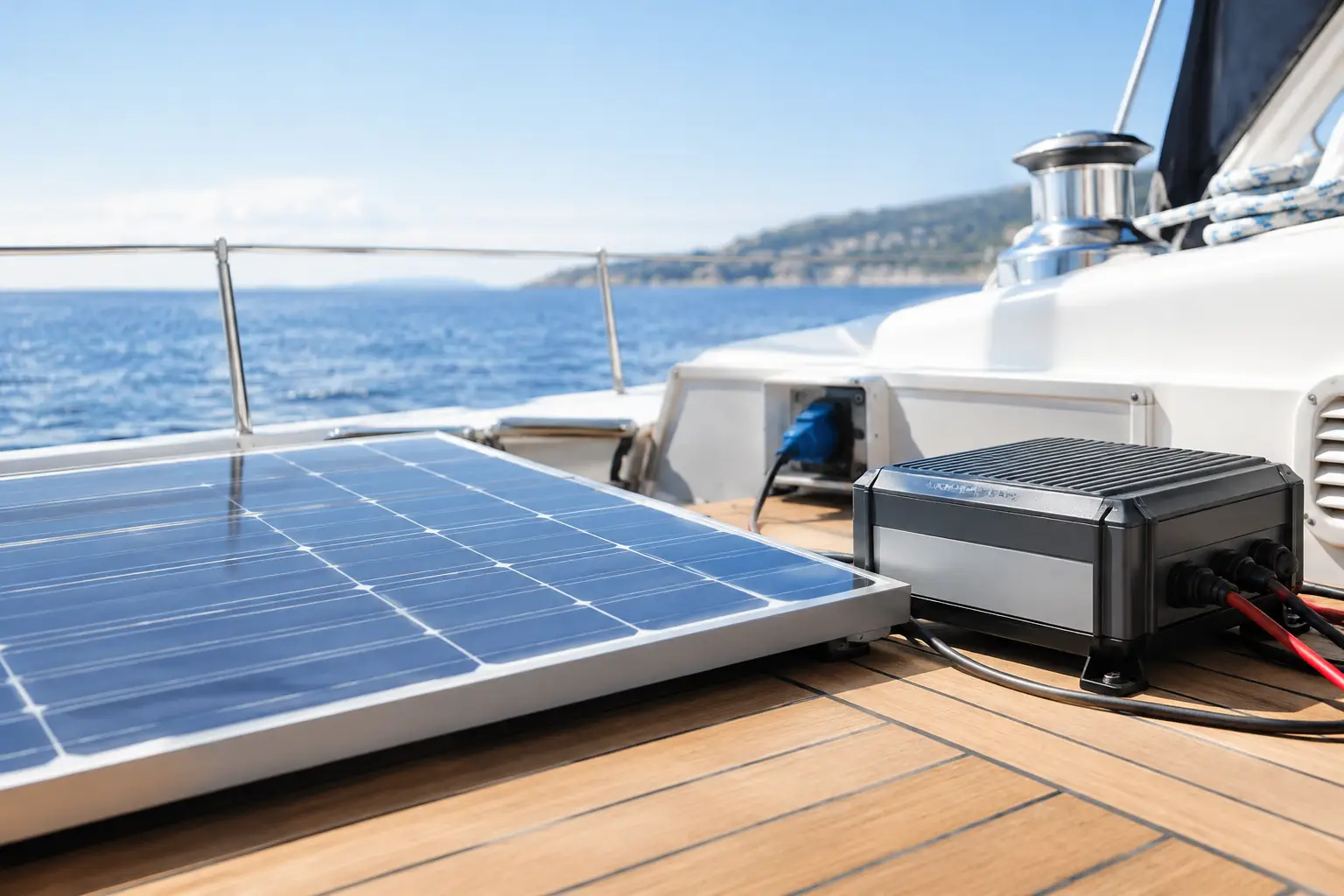
The battery system on a vessel rarely fails due to a single reason. Problems often start with under-dimensioned charging, improperly set battery profiles, or the expectation that a single source will cover all usage modes. The question grid or solar charger is therefore not about choosing one device, but about designing a system that ensures energy supply to your vessel in the marina, at anchor, and during navigation.
Grid chargers and solar systems do not exclude each other. On most well-designed vessels, they have distinct but interconnected roles. The grid charger takes over charging when the vessel is connected to shore power, while solar panels reduce dependence on the generator, alternator, and marina when staying off the berth. The correct decision depends on the batteries, daily consumption, vessel usage profile, and existing electrical installation.
Grid or Solar Charger: First Define the Navigation Mode
A vessel that spends most of the year in a marina has different needs than a sailboat regularly spending several days at anchor during the summer. A motorboat equipped with refrigerators, bow thruster, winches, navigation, and higher hotel loads is also not comparable to a smaller vessel whose consumption is limited to basic lighting, VHF, and occasional device charging.
The grid charger is essential when you want to reliably maintain batteries while moored. A quality charger follows the charging stages, adjusts voltage to the chosen battery chemistry, and can maintain service batteries long-term without unnecessary overcharging. This is especially important off-season, when the vessel may be connected to shore power for weeks or months.
The solar system becomes especially valuable when consumption continues without shore power connection. Refrigerators, autopilots, instruments, communication equipment, device chargers, lighting, and pumps during multi-day stays can discharge the service bank faster than the owner expects. Solar then serves not only for battery maintenance but truly extends autonomy.
If your vessel frequently changes marinas, anchorages, and routes, a combination of both sources usually delivers the most predictable result. The grid charges quickly when available, and the solar system maintains the energy balance when it is not.
What a Grid Charger Really Must Do
The charger’s rated current, expressed in amperes, is an important specification but not sufficient for selection. The charger must match the battery bank capacity, allowed battery charging current, available shore power, and other consumers that may operate simultaneously onboard.
For example, an undersized charger can maintain batteries when consumption is low but will not effectively recharge them after several days at anchor. An oversized charger is not automatically better. If batteries do not accept the intended current or cables, fuses, and busbars are inadequately sized, installation load and risk of malfunction increase.
For lead-acid, AGM, and gel batteries, it is necessary to verify whether the charging program matches the specific battery type. For LiFePO4 systems, requirements are even more precise. The charger must have the appropriate profile, and the Battery Management System (BMS) must be properly integrated into system logic. It is insufficient that a charger merely labels itself lithium compatible. Voltage limits, behavior at low temperatures, inter-device communication if present, and charging interruption and re-admission methods must be verified.
Quality of Shore Connection is Also Important
A grid charger depends on a stable and properly executed AC system. Therefore, during inspection, the condition of the connection cable, galvanic isolation or isolation transformer where applicable, residual current device, grounding, distribution panel, and actual connection load are verified.
A charger functioning properly in a workshop may cause issues onboard if the AC installation is improvised, corroded, or improperly protected. In such cases, replacing the charger without diagnostics often only conceals the real cause.
When a Solar Charger Provides Real Autonomy
The solar system on a vessel consists of several elements: panels, charge controller, protection, cable distribution, mounting brackets, and connection to the battery bank or DC busbar. The system’s performance is not determined solely by the panels’ rated power.
On the Adriatic, there are enough sunshine hours for solar to make a significant contribution, but conditions onboard are not laboratory-like. Shadows from masts, bimini tops, radars, antennas, and sails change production throughout the day. A panel mounted on a flat deck will not perform the same as a panel that can be oriented towards the sun. Panel temperature, cable length, and voltage drop also affect available energy.
An MPPT controller is justified in most serious marine solar systems because it uses the available panel voltage more efficiently, especially under variable conditions. However, the controller must be properly sized according to panel voltage and power, as well as the nominal voltage of the battery bank. DC fuses, service switches, and cables of appropriate cross-section must also be planned.
The solar system is particularly useful for the service battery bank. Starter batteries, bow thruster batteries, or generator batteries should not be arbitrarily connected to the same charging source. Solutions may include separate outputs, DC-DC chargers, splitters, or managed distribution depending on system architecture.
Consumption Determines System Size, Not Desire for a Large Panel
Before selection, an energy balance must be calculated. It covers battery capacity, actually usable capacity, daily consumption, and charging sources. For lithium batteries, usable capacity may be higher than for lead-acid, but this does not mean that all existing chargers, alternators, and protective elements are automatically suitable.
It is useful to document consumers and their operating times: refrigerator, freezer, autopilot, navigation system, radar, VHF, Starlink or other communication devices, inverter, water pumps, and lighting. Larger consumers such as inverters, desalination units, or electric cookers can change the entire system concept. Solar sufficient for a refrigerator and basic electronics will not necessarily cover larger AC loads.
There is no universal formula like “this many watts of panels per ampere of battery.” Real need depends on crew habits, season, route, and refueling possibilities from engine, generator, or marina. Accurate assessment prevents two common problems: an overpriced system that cannot realize full potential, and an undersized system creating a false sense of autonomy.
Integration with Alternator, Inverter and Battery Monitoring
Grid and solar chargers must operate in harmony with other energy sources. The engine alternator is often the fastest charging source underway, but modern battery systems may require additional regulation or a DC-DC charger. This is especially important for LiFePO4 batteries, which can accept high current for a long time and thus overload the alternator if not properly designed.
An inverter-charger can combine mains charging and DC to AC conversion, but its selection must consider consumer power, battery bank capacity, and shore power limits. The objective is not to install the device with the highest rated power, but to harmonize all system components.
Battery monitoring provides data indispensable for sound decisions. Voltage alone is not a reliable indicator of state of charge, especially under load or during charging. A battery monitor measuring current, properly installed shunt, and appropriate configuration allows tracking actual consumption, input energy, and remaining capacity.
Professional Installation Eliminates Hidden Risks
In chargers and solar systems, cables, protection, and configuration are often underestimated. Inadequate conductor cross-section causes voltage drop and heating. A fuse placed too far from the power source does not protect the cable properly. Poor connections, unmarked wires, and corrosion may cause intermittent faults difficult to diagnose later.
Quality installation includes technical compatibility check, cable routing planning, proper protection, labeling, device configuration, and testing under real load. After commissioning, system behavior must be checked on shore power, solar operation, engine running, and higher consumption via inverter.
For existing vessels, the most reasonable first step is diagnostics. This determines battery condition, existing charging, installation quality, and actual consumption profile prior to proposing changes. UnLucky can provide inspection, design, installation and integration, configuration, and technical support after system commissioning.
If you are unsure whether your vessel needs a higher capacity grid charger, a solar system, or a coordinated combination of both solutions, send an inquiry with basic data on batteries, consumers, and usage. A reliable energy system is not based on assumptions. Because Luck Has Nothing to Do With It.