


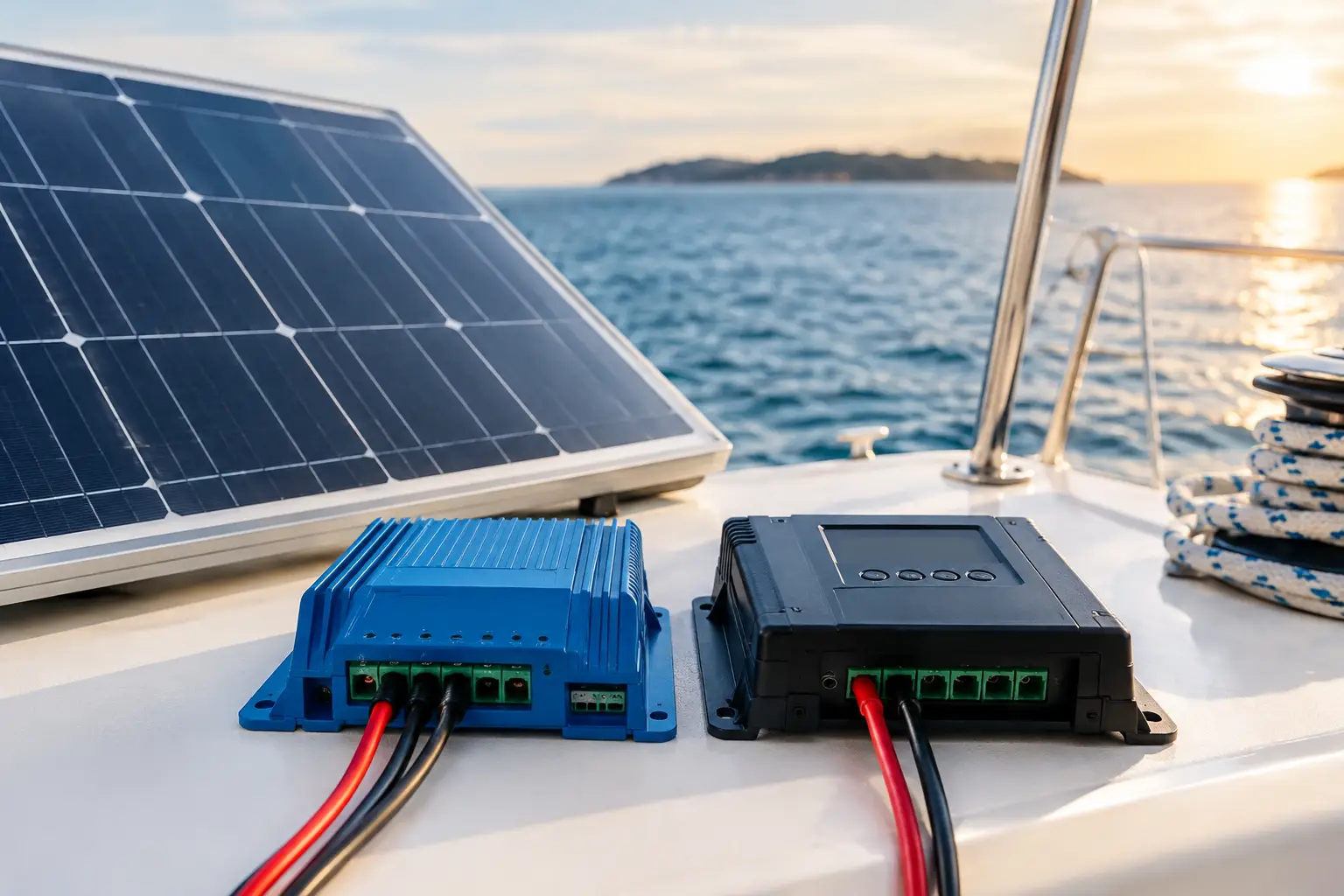
A solar panel may seem like a simple addition on the cabin roof, hardtop, or bimini, but a vessel's true autonomy depends on the entire chain of components. The question of MPPT or PWM regulator is not just a choice between a more expensive or cheaper box. It is a decision that affects available energy, the condition of the service battery bank, duration of consumer operation at anchor, and system reliability under real sea conditions.
On a vessel, solar production rarely occurs under ideal conditions. The mast, antennas, radars, tender crane, sails, and superstructures create variable shading. Panel temperature rises, cable runs can be long, and batteries are not always at the same state of charge. Therefore, the regulator is not chosen solely based on the panel's rated power but on a comprehensive system assessment.
What a Solar Regulator Does on a Vessel
The regulator manages the energy transfer from the solar panel to the batteries. Its task is to ensure the battery receives the appropriate voltage and current at each charging stage, without overcharging or unnecessary loss of available solar energy.
In a well-designed marine system, the regulator must be compatible with the battery bank voltage, battery type, panel characteristics, conductor gauge and length, and existing charging sources. The alternator, shore charger, DC-DC charger, and solar regulator should operate with compatible parameters. If each source follows a different charging logic, the battery won’t necessarily be better maintained just because there are multiple energy sources.
For lead-acid batteries, this means properly adjusted bulk, absorption, and float charging phases. For LiFePO4 batteries, allowed charging voltages, communication with the BMS if applicable, thermal protection, and regulator behavior when charging is interrupted are particularly important. Sodium-ion systems also have specific requirements to verify per battery manufacturer specifications.
MPPT or PWM Regulator: Key Difference
A PWM regulator, or Pulse Width Modulation regulator, during charging effectively pulls the panel’s operating voltage toward the current battery voltage. It is simple, reliable, and can be a good solution when the panel and battery system are properly matched.
An MPPT regulator actively finds the panel’s maximum power point. It converts the higher panel voltage to a voltage suitable for battery charging, increasing the available current at the output. Thus, it can utilize the panel more efficiently, especially when its optimal operating voltage significantly exceeds the battery bank voltage.
A common example is vessels with a 12-volt service bank and panels operating around 30 V or higher. A PWM regulator in such a setup leaves a significant portion of the panel’s potential unused because the panel operates near the battery voltage. An MPPT regulator uses that higher voltage more efficiently and typically delivers noticeably more energy, especially at lower panel temperatures and good sunlight conditions.
However, this does not mean MPPT is automatically the right choice for every vessel. For smaller panels, short cable runs, and nominally matched 12 V panels on simple lead battery banks, a quality PWM can be technically justified and economically sensible. The energy gain difference may not justify the higher cost and system complexity.
When MPPT Regulator Has a Clear Advantage
MPPT regulators are most often recommended when the solar system must significantly contribute to autonomy rather than merely maintain the battery during vessel inactivity. This is especially relevant for sailboats and catamarans at anchor, motorboats with higher consumption in living areas, and vessels with LiFePO4 banks and larger solar panel capacities.
MPPT advantages are noticeable when using higher voltage panels, when there is a voltage difference between panels and battery bank, when cable lengths are longer, or when the system includes multiple panels. Higher panel voltage can reduce conductor current and ease voltage drop limitations, provided wires, fuses, switches, and regulator are properly dimensioned.
MPPT is often the better choice for 24 V or 48 V systems, especially on larger yachts or vessels with inverters, larger battery banks, and demanding consumers. However, the regulator's nominal voltage alone is insufficient; one must check maximum permissible input voltage, panel open-circuit voltage at low temperatures, maximum output current, and actual installation conditions.
Still Valid Applications for PWM Regulators
PWM regulators are not obsolete solutions to discard without system review. Their advantages are simple design, lower cost, and predictable performance on small, properly matched systems.
They may be suitable for a smaller panel maintaining the starter battery, a vessel mostly docked in marina, or a simple 12 V installation with a panel designed explicitly for PWM charging. In such cases, the priority is reliable battery maintenance with reasonable system complexity, rather than maximizing energy yield of every sun hour.
Errors occur when a PWM regulator is connected to a higher voltage panel simply because the connectors fit. The system may operate but won’t necessarily deliver the energy the owner expects. On vessels with compressor refrigerators, navigation electronics, autopilot, communication equipment, and continuous device charging, this loss becomes apparent quickly.
Shading Is Not Solved by Regulator Choice Alone
At sea, it is often assumed MPPT automatically solves shading problems. Reality is more complex. Partial shading of a panel section can significantly reduce output, depending on the cell layout, bypass diodes, panel connection type, and shading source position during the day.
If two panels are shaded differently, their series connection may limit entire string production. Parallel connection can in some cases be more tolerant to such issues but increases current and imposes different cable sizing and protection requirements. In complex arrangements, using separate MPPT regulators for panel groups may be justified.
Before selection, it is necessary to assess panel placement options, typical anchoring modes, whether the boom or mast shade panels, and if tents or biminis create constant shading in summer. A well-designed smaller system often delivers more useful energy than a larger system installed without shading analysis.
Technical Checks Before Installation
Regulator selection starts with reviewing the existing electrical system. We check battery capacity and condition, actual daily consumption, available panel mounting area, cable routes, and existing charging sources. Then we determine expected production—not just the nominal wattage on the panel label.
Special attention is required for:
- maximum panel open-circuit voltage, including low temperature correction
- maximum regulator input power and output current
- charging profile compatibility with lead-acid, LiFePO4, or sodium-ion batteries
- fuses, switches, conductor gauge, and mechanical protection
- ventilation, regulator location, and protection from moisture, salt, and overheating
- system monitoring and integration with existing battery monitors or vessel networks
A regulator installed in a closed, hot space without proper ventilation may reduce output exactly when solar yield is highest. Similarly, an inappropriately selected fuse or undersized cable are not trivial issues—they affect installation safety, energy losses, and reliable diagnostics.
Installation and Configuration Determine Results
A solar regulator must not be an isolated component added to an existing installation without review. With modern battery systems, charging priorities, voltage limits, potential load management, and system behavior when the BMS disconnects the battery must be defined.
After installation, configuration follows, with voltage and current measurements, polarity checks, protection tests, and commissioning under real load. If the regulator offers monitoring via display or app, data must be correctly interpreted. An instantaneous power of 30 W is not a fault indication if the battery is nearly full, the panel partially shaded, or the regulator is in float charging phase.
UnLucky handles technical compatibility checks, equipment selection, design, installation, and integration with existing electrical networks for vessel solar systems. We also perform diagnostics if a system produces less energy than expected or charges batteries improperly.
If you are considering MPPT or PWM regulators, send an inquiry with vessel details, batteries, existing panels, and main consumers. The correct solution does not begin with assumptions but with an assessment of real conditions onboard. Because Luck Has Nothing to Do With It.