


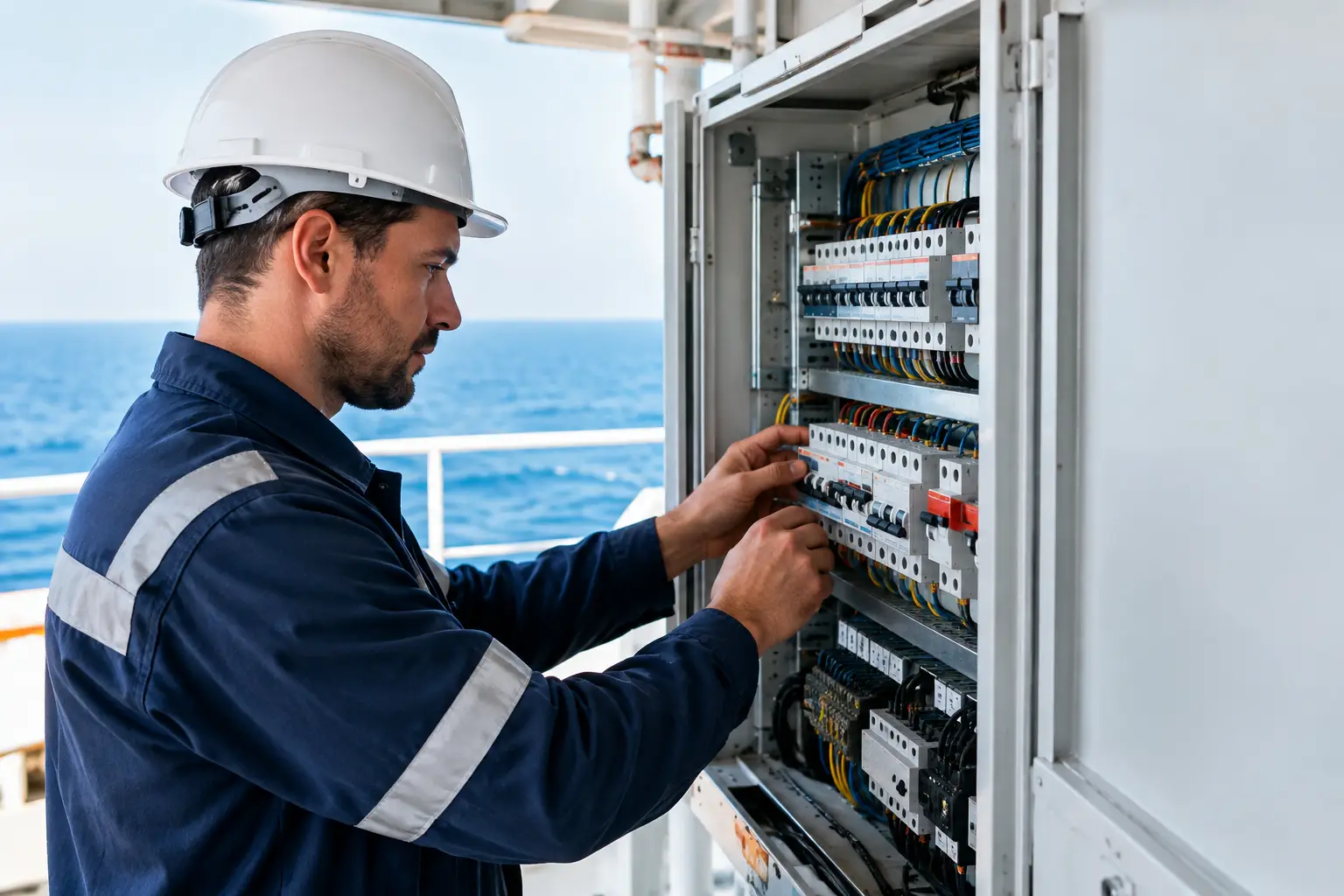
An old ship's electrical distribution panel rarely fails all at once. Issues typically manifest as overheated breakers, unclear fuse labeling, voltage drops upon consumer activation, or circuits upgraded over years without clear documentation. Therefore, modernization of the ship's distribution panel is not a cosmetic cabin job but a task focusing on safety, reliability, and the controllability of your vessel’s electrical system.
The distribution panel is the central point for electrical power distribution. It connects sources such as shore power connection, generator, inverter, chargers, and battery banks to navigation equipment, lighting, pumps, refrigerators, winches, and other consumers. When this point is not properly designed, protected, and labeled, fault diagnostics slow down, and risks of overload and poor connections increase.
When Modernizing the Ship’s Distribution Panel Becomes Necessary
The age of the distribution panel alone is not sufficient reason for replacement. A well-executed system can reliably operate for years if components are appropriate, connections inspected, and loads remain within designed limits. In practice, the need for modernization often arises after changes in vessel usage or addition of new systems.
Installing a larger inverter, LiFePO4 batteries, solar controllers, watermakers, bow thrusters, new navigation electronics, or electric winches changes the vessel’s energy profile. A new consumer must not simply be connected to the first free fuse. It is essential to check conductor cross-section, rated protection current, voltage drop, busbar capacity, condition of main breakers, and how sources and consumers integrate into existing system logic.
Signs requiring technical inspection include frequent tripping of protection, corrosion at connections, panel overheating, unlabeled wiring, incorrect fuse ratings, and improvised connections. It is equally important to act when the crew can no longer quickly identify which breaker powers which system. In emergencies, every minute spent searching for the correct circuit is an unnecessary operational risk.
Checks Before Modernizing the Distribution Panel
Quality modernization does not begin with selecting a new panel. It begins with inspecting actual conditions aboard. Documentation is helpful but often fails to reflect subsequent modifications, especially on older vessels. Therefore, physical verification of wiring, connectors, protective elements, and actual loads is required.
Energy Sources and Load Distribution
The first step is identifying all AC and DC sources and their interconnections. Shore power, generator, and inverter must be integrated to prevent undesired parallel feeding and feedback energy flow toward sources. For DC installations, starting and service batteries, chargers, DC-DC converters, solar regulators, alternators, and potential energy management systems are checked.
Vessels with new battery technologies deserve special attention. A LiFePO4 system offers higher usable capacity and better autonomy but requires properly dimensioned protection, an appropriate Battery Management System (BMS), correct charging, and clearly defined procedures in case of alarms or battery disconnection. The distribution panel must follow this architecture rather than hinder safe operation.
Conductor Protection and System Selectivity
A fuse or circuit breaker does not protect a device merely by being located near it. Their fundamental task is to protect the conductor from currents it cannot safely carry. Protection ratings are not determined by estimation, nor is a larger fuse installed just to prevent nuisance trips. Conductor cross-section, length, installation method, ambient temperature, and expected load are all considered.
System selectivity is also critical. For a localized fault, only the affected circuit’s protection should trip, rather than shutting down entire vessel sections. This is vital for navigation devices, bilge pumps, communication equipment, and maneuvering systems. Properly arranged circuits facilitate problem isolation without losing crucial functions.
Busbars, Connections, and Physical Installation
The distribution panel often reveals effects of years of upgrades: multiple terminals on one connection, insufficiently secured conductors, inadequate busbars, or connections lacking proper contact protection. Such setups may seem operational but generate heat and losses under higher loads.
During modernization, busbar load capacity, quality of crimped connections, conductor labeling, mechanical strain relief, and protection against moisture and corrosion are verified. The panel must remain service-accessible yet protected from accidental touch and environments typical aboard vessels. An orderly layout is not about aesthetics; it enables rapid inspection, precise diagnostics, and safer crew operation.
Choosing the Right Solution for Your Vessel
There is no universal distribution panel suitable for every yacht, sailboat, or work vessel. A smaller sailboat spending most of its time in marinas has different needs than a catamaran cruising autonomously for extended periods; similarly, a charter vessel has different priorities than a private yacht with professional crew.
For simpler systems, reasonable solutions may include replacing worn panels, reorganizing existing circuits, new protection, and clear labeling. Extensive refits often justify designing a new DC and AC distribution, isolating critical consumers, installing voltage and current monitoring, and preparing reserves for future upgrades.
Reserved capacity does not mean unnecessary oversizing but planning space, busbars, and circuit distribution so subsequent systems can be installed without improvisation. If you plan a solar system, larger battery capacity, or inverter in the future, this should be considered when designing the distribution panel, even if equipment will be installed later.
Installation and Integration are More Important than the Panel Itself
A quality panel cannot compensate for incorrectly sized conductors, poor connections, or uncoordinated relations between batteries, chargers, and inverter. Hence, distribution panel modernization must encompass the whole: technical compatibility inspection, design, component selection, installation, configuration, and operational testing under real loads.
During commissioning, polarities, voltage drops, protection operation, individual circuit loads, and power transfer between sources are verified. AC systems’ protective devices and proper source management are also tested. DC systems see realistic load tests, especially for consumers with high starting currents.
Completing the job with updated documentation and clear labeling is equally crucial. Owners, captains, or service technicians must understand circuit layouts, main disconnection points, and basic power logic. This reduces diagnostic time and facilitates preventive maintenance throughout the season.
Preventive Maintenance After Modernization
A modernized distribution panel is not a system to be forgotten after installation. Periodic inspection of connections, signs of heating, corrosion, and mechanical damage helps detect problems before they affect vessel availability. Especially after winter, major engine room work, or additions of new consumers, verification of correct electrical loading remains essential.
UnLucky approaches such projects through existing condition assessment, technical consulting, design, installation and integration, commissioning, and ongoing technical support. The scope, component selections, and timelines are determined by your vessel’s actual configuration, not by pre-packaged solutions.
If the distribution panel shows signs of overload, if you plan an energy upgrade or simply want to know the state of your electrical distribution, send an inquiry for a technical inspection. At sea, reliability is never left to chance. Because Luck Has Nothing to Do With It.