
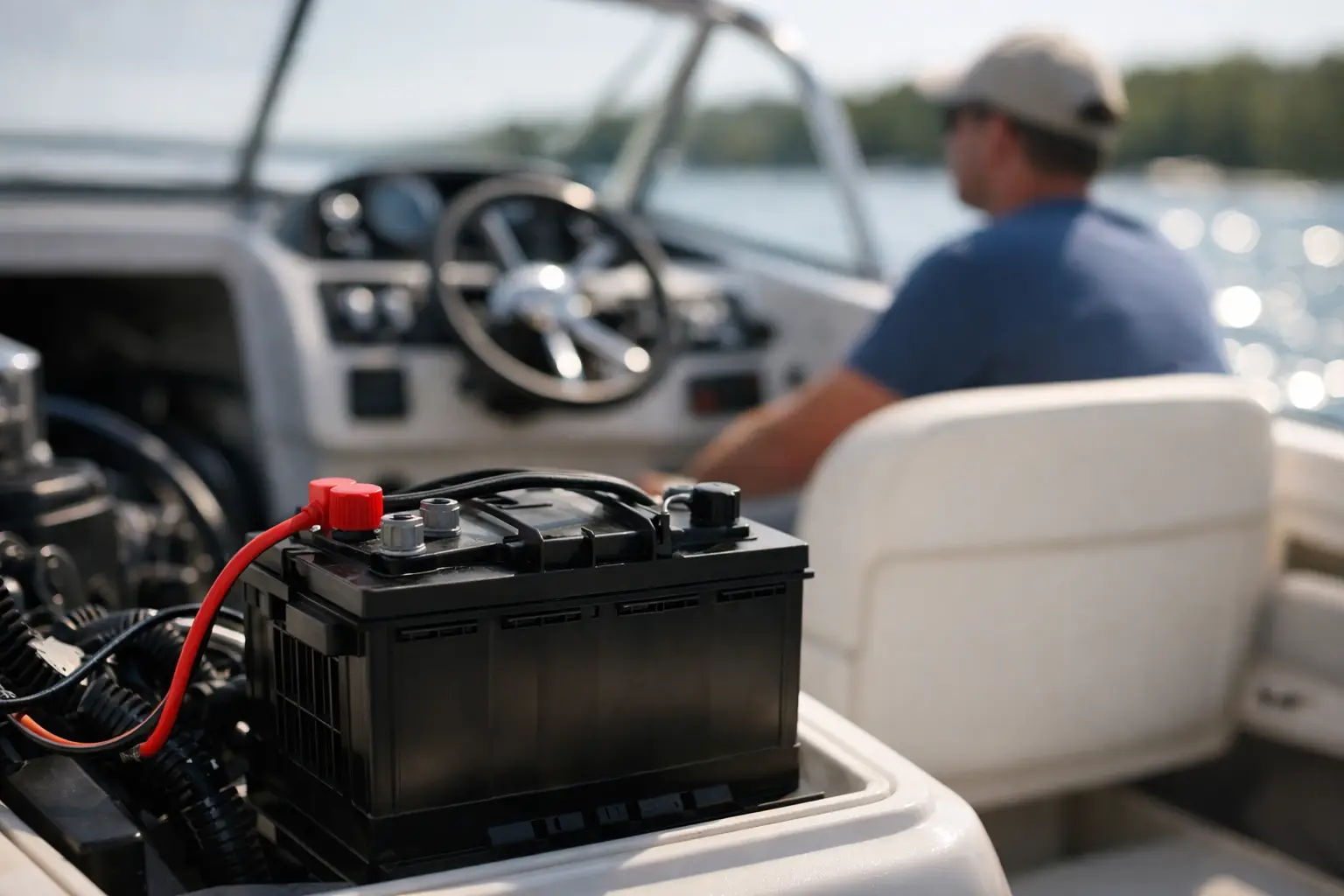
A battery that reliably starts the engine in the marina is not necessarily dependable for an overnight at anchor, maneuvering in an unfamiliar harbor, or operating essential systems without shore power connection. Therefore, the question of how long a boat battery lasts does not have a single answer. Its actual lifespan depends on battery type, depth of discharge, charging quality, temperature, vessel usage, and the condition of the entire electrical system.
For vessels, it is especially important to distinguish calendar age from actual availability. A battery may be only a few years old but seriously degraded due to long periods of partial discharge during storage, improper charger profiles, or repeated deep discharges. Conversely, a properly integrated battery system can reliably last significantly longer than the expected average.
Battery Lifespan According to Technology
Lead-acid batteries, including classic flooded, AGM, and GEL types, commonly last between three and seven years in marine applications. This wide range exists because the declared cycle count applies only at a certain depth of discharge and under specified charging conditions. A starter battery primarily used for short engine starts may outlast a service battery of the same capacity that daily powers a refrigerator, anchor light, navigation, and inverter.
AGM batteries are often a good choice when higher peak currents, lower maintenance, and installation in spaces where regularly checking electrolyte levels is impractical are required. However, AGM batteries are not resistant to chronic undercharging. If the alternator, solar regulator, or shore charger fails to complete the charge cycle as per manufacturer specification, capacity can significantly decrease before the expected lifespan ends.
GEL batteries handle cycling well but require precisely limited charging voltages. A charger set to an inappropriate AGM or classic lead profile can permanently damage them. On older vessels, simply replacing the battery is insufficient—it is necessary to check the compatibility of the existing charger, alternator, and solar regulator.
LiFePO4 batteries in a properly designed system typically achieve 2,000 to 5,000 or more useful cycles, which often means eight to fifteen years of service in practice. This is not an automatic lifespan guarantee. The outcome depends on cell and BMS quality, low temperature charging protection, charge and discharge currents, and proper integration with the alternator, chargers, and consumers.
Sodium-ion batteries are an interesting newer category with certain safety and temperature behavior advantages, but their actual selection for a specific vessel should be based on available technical data, system requirements, and service support. Technology should not be replaced just because it is newer. The system is selected according to the actual navigation profile and existing installation.
Why Battery Lifespan on Vessels Is Often Shorter
The most common cause of premature failure is not a manufacturing defect but prolonged adverse operating conditions. For lead-acid batteries, leaving them at partial charge is particularly harmful. Sulfation gradually reduces the active plate surface, making the battery appear fully charged by voltage but lacking necessary capacity under load.
Deep discharges further accelerate wear. A service bank regularly discharged to 50% capacity can perform acceptably for years, while the same battery often discharged near full depletion loses much of its cycle life. For lead-acid batteries, it is recommended to plan consumption conservatively and not count nominal capacity as fully available.
Inadequate charging is an equally serious problem. An undersized charger may not restore used energy between voyages. Too high voltage or incorrect absorption phase duration can cause overheating, electrolyte loss, or accelerated aging. For lithium systems, issues can include excessive currents from the alternator, mismatched BMS protection, or charging outside allowed temperature ranges.
In the Adriatic, additional influences are high summer temperatures, humidity, salt, and long periods of inactivity off-season. Connection corrosion increases contact resistance, and poor main cable contacts may resemble battery failure. Therefore, diagnostics must include cables, fuses, busbars, grounds, connectors, and charging sources—not just battery terminal voltage.
Starter and Service Banks Have Different Tasks
A starter battery is designed for very high current over a short time. Its priority is not deep cycle discharging. Regularly powering a refrigerator, autopilot, lighting, or bow thruster through it shortens its lifespan and reduces starting reliability.
A service bank must be sized according to actual daily consumption and expected autonomy. A sailboat spending several days at anchor has a different profile from a motorboat that docks at a shore power every evening. Charter vessels have an additional factor: user consumption and habits may be unpredictable, requiring safety capacity and clear protection against excessive discharge.
Separate starter and service systems, properly executed parallel charging connections, and controlled parallel operation in emergencies increase vessel availability. Attention must be paid to the type of charging sources. Alternator, solar regulator, shore charger, generator, and DC-DC charger must have coordinated settings, especially when integrating a LiFePO4 service bank with an existing lead starter battery.
Signs It Is Time for Inspection or Replacement
Voltage drop alone is insufficient as a criterion but is a useful signal. A fully charged lead-acid battery may show correct open-circuit voltage yet drop sharply under engine start or inverter load, indicating increased internal resistance and reduced available capacity.
Inspection is justified if the engine cranks slowly, the bow thruster loses power, the refrigerator frequently shuts off due to low voltage, the charger runs long without stabilizing, or the battery unusually heats up. For flooded lead batteries, signs can include low electrolyte level, deformed case, or visible corrosion around terminals. Swollen battery, sulfur smell, or heat require immediate action and shutdown following safety procedures.
The most useful check includes resting voltage measurement, load testing, capacity testing where applicable, and charging control from all sources. For lithium batteries, BMS status, cell balancing, recorded alarms, and actual currents should be read. A voltmeter alone cannot provide a complete picture of the battery system condition.
How to Extend the Lifespan of a Boat Battery
Preventive maintenance begins with monitoring, not waiting for the vessel to lose power. A battery monitor with a properly installed shunt provides more useful data on ampere-hours consumed and current than occasional voltage readings. Still, the monitor must be configured to the actual capacity and occasionally checked because state of charge estimations may deviate as the battery ages.
Maintain lead-acid batteries as close to full charge as possible, avoid deep discharges, and verify the charger profile precisely matches the battery chemistry. During winter storage, do not assume continuous connection to the charger is always ideal. Depending on the charger model, marina conditions, and battery type, appropriate approaches may involve maintenance charging with regular checks or periodic charging per manufacturer recommendations.
For LiFePO4 systems, design and integration are key. Protect the alternator from adverse loads, ensure proper interrupts and fuses, check charging logic, and plan responses when the BMS cuts off charge or discharge. A professionally executed system is not just a battery but a set of mutually compatible components.
When Replacement Becomes a Technical Project
If replacing one lead battery in a bank that has operated together for several years, the new battery is often limited by the condition of the older ones. Mixing different capacities, technologies, or wear levels within the same parallel bank is generally not a good long-term solution. In such cases, the entire bank and its charging method should be evaluated.
Switching to LiFePO4 is not a "old out, new in" replacement. Technical compatibility checks, consumption analysis, cable and fuse sizing, charger configuration, and post-installation testing are required. This especially applies to vessels with larger inverters, powerful alternators, generators, bow thrusters, or electric winches.
If you are uncertain about the real capacity of your vessel’s battery system and its reliable delivery, request diagnostics before purchasing a replacement battery. UnLucky can inspect the existing installation, measure relevant parameters, suggest compatible solutions, and perform installation, configuration, and operation verification. Reliability at sea is not based on assuming the battery will last - Because Luck Has Nothing to Do With It.