


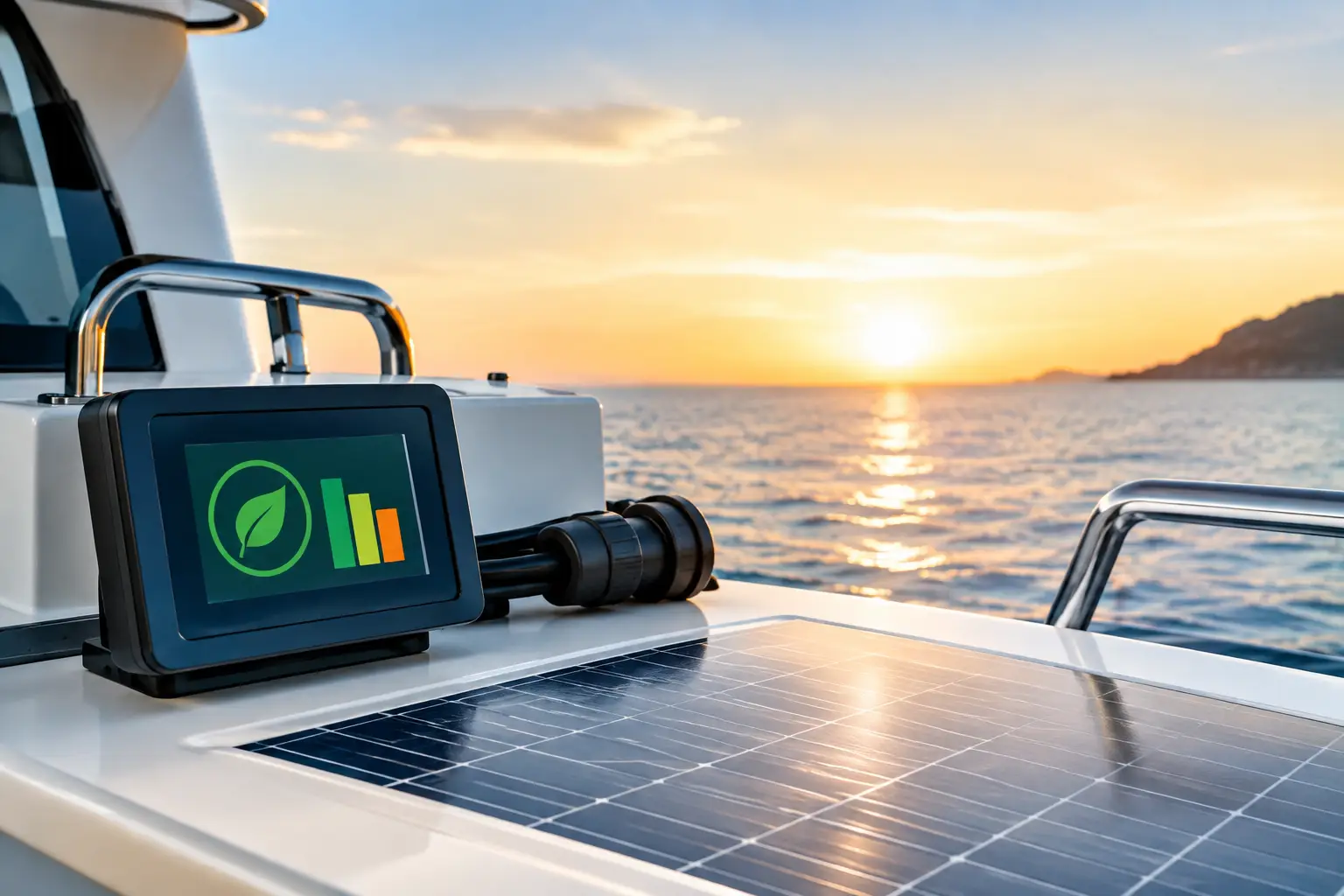
At anchor, far from the marina, electricity consumption ceases to be an abstract figure. The refrigerator must operate, navigation and communication must remain available, and batteries must not fall below a safe charge level. Therefore, the question of how to reduce a boat’s electricity consumption is not about comfort or sacrifice, but about autonomy, safety, and control over the energy system.
The most common mistake is looking for one large consumer to switch off. In practice, the problem is more often a combination of constant smaller loads, batteries with reduced real capacity, inefficient charging, and an installation without reliable monitoring. The solution begins with measuring the actual state rather than estimating by feel.
How to Reduce Boat Electricity Consumption by Measuring
Before any change, it is necessary to know how much your vessel truly consumes. A boat battery monitor with a properly installed shunt will show current draw, total consumption in ampere-hours, state of charge, and time to discharge at the current load. Without this data, the owner sees only voltage, which alone often does not provide enough information—especially with LiFePO4 batteries whose voltage curve remains flat over much of the capacity.
Measurements should be conducted in real conditions: during the night at anchor, while preparing meals, operating the autopilot, with the refrigerator running, and typical navigation devices on. This establishes the base consumption, i.e., the load that remains active even when the crew does not use obvious consumers.
Special attention should be paid to devices that run continuously or cyclically. Refrigerators, freezers, fans, network equipment, alarms, bilge pumps, inverters in standby mode, and monitoring systems can consume more energy over 24 hours than short-term operation of larger devices. If base consumption is unusually high, diagnostics of individual circuits are needed rather than random fuse disconnections.
The Largest Consumers Are Not Always Obvious
On vessels with inverters, a common issue is a device that remains permanently on powering only a few small AC loads. The inverter then consumes energy in idle mode, and additional energy is lost converting from DC to AC. Where possible, smaller equipment such as phone chargers, network devices, lighting, or certain pumps should be powered by appropriate DC solutions. This is not a universal rule—a quality inverter is necessary for many devices and part of a properly designed system—but its operation must correspond to actual demand.
Refrigerators and freezers are often the largest continuous consumers on smaller and medium-sized vessels. High cabin temperature, damaged seals, poor compressor ventilation, frozen evaporators, or inadequate insulation prolong their operating cycle. Before replacing the device, conditions should be checked. Improving ventilation and servicing the refrigeration system sometimes yield greater effect than purchasing new equipment.
Water pumps may also consume significantly more than expected if the system has micro-leaks, improperly set pressure switches, or pressure loss at connections. A pump switching on occasionally without opening the tap is not a minor issue to postpone until the next service. It consumes energy unnecessarily, wears components, and may indicate a problem in the water supply system.
Electric kettles, coffee makers, hair dryers, air conditioning, and watermakers may require high peak power. It is not realistic to simply treat them as consumers to exclude. Instead, operational timing should be planned: when the engine is charging the batteries, when shore power is available, or when solar production covers part of the current load. Managing operating time is often more effective than usage limitations.
Reduce Losses in the Installation
Energy efficiency depends not only on devices. Corroded connectors, undersized conductor cross-sections, poorly executed joints, inappropriate fuses, and voltage drops increase losses and generate heat. On a 12-volt system, even relatively small voltage drops can affect sensitive equipment, pump motor operation, or charger performance.
The main cables between the battery bank, inverter, charger, distribution busbars, and large DC consumers should be especially checked. The inspection includes conductor cross-section, route length, terminal quality, connection tightness, corrosion protection, and fuse rating matching the load and cable. Such inspection is not cosmetic—it reduces losses, increases reliability, and decreases risks of overheating.
Older vessels often have new devices added over the years without comprehensive system review. The result can be multiple parallel wiring, unclear circuit labeling, and consumers connected directly to the battery. Technical compatibility checks and distribution reorganization are then more reasonable steps than adding another power source to existing weaknesses.
The Battery Must Suit the Usage Pattern
The battery itself does not reduce consumption but determines how safely the system can handle load and charging. Lead-acid batteries gradually lose available capacity, and frequent deep discharges further shorten their service life. A vessel may then have a battery bank that looks sufficient on paper but does not provide needed autonomy in reality.
LiFePO4 systems can offer larger usable capacity, stable voltage, and faster acceptance of charging—but only when properly designed. Appropriate BMS, protections, chargers, alternator charging, temperature conditions, and configuration taking into account critical boat consumers are necessary. Incorrect replacement of lead-acid banks with lithium batteries can cause problems with the alternator, chargers, and existing distribution.
Sodium-ion batteries can be interesting for certain applications, especially when safety requirements and operation at lower temperatures are important. However, chemistry choice is not the starting point for the project. The starting point is the vessel's energy profile, available space, charging sources, peak loads, and expected usage regime.
Charge Smarter, Not Just More
A solar system can significantly extend autonomy at anchor, but only if panels, controller, and battery system are aligned. Panel position, mast shadow, antennas, season, vessel orientation, and actual daily consumption determine results. Solar coverage of refrigerator consumption during sunny days is worth more than a system chosen solely by panel rated power.
The alternator is the next important energy source, but prolonged charging of a large battery bank can thermally stress it. When upgrading the system, alternator capacity, regulation, wiring, and protection must be checked. DC-DC chargers or external regulators may be appropriate solutions, but the choice depends on the engine, battery, and existing installation.
Shore chargers must have appropriate charging profiles for battery chemistry. Equally important is verifying whether the generator operates under favorable load conditions. Short generator running solely for charging may be inefficient; sometimes synchronizing battery charging with operation of larger AC consumers is better if consistent with system specifications and vessel usage.
Crew Habits and System Automation
Rational consumption does not mean the crew has to constantly monitor every ampere. A well-configured system can display clear data, warn of low charge state, and separate non-critical consumers from vital circuits. Navigation equipment, communication, bilge pumps, and safety systems must have predictable power. Comfort consumers can be scheduled according to available energy.
Simple routines help: switching off the inverter when not needed, avoiding devices in cabins remaining in standby, and operating large consumers only when an appropriate power source is available. The captain or responsible person must have an overview of priorities, not just the current battery percentage.
If you notice batteries discharging faster than before, chargers overheating, the inverter indicating undervoltage, or devices resetting occasionally, do not wait for complete failure. Timely diagnostics can reveal battery degradation, poor connections, unexpected consumers, or misconfigured setups.
To reduce consumption and increase autonomy, observe your vessel as a whole: consumers, batteries, charging sources, installation, and actual navigation regime. UnLucky can perform system inspection, measure loads, suggest compatible components, and carry out installation, integration, configuration, and commissioning. Submit an inquiry with basic vessel and usage data—because safety and autonomy do not depend on luck. Because Luck Has Nothing to Do With It.