
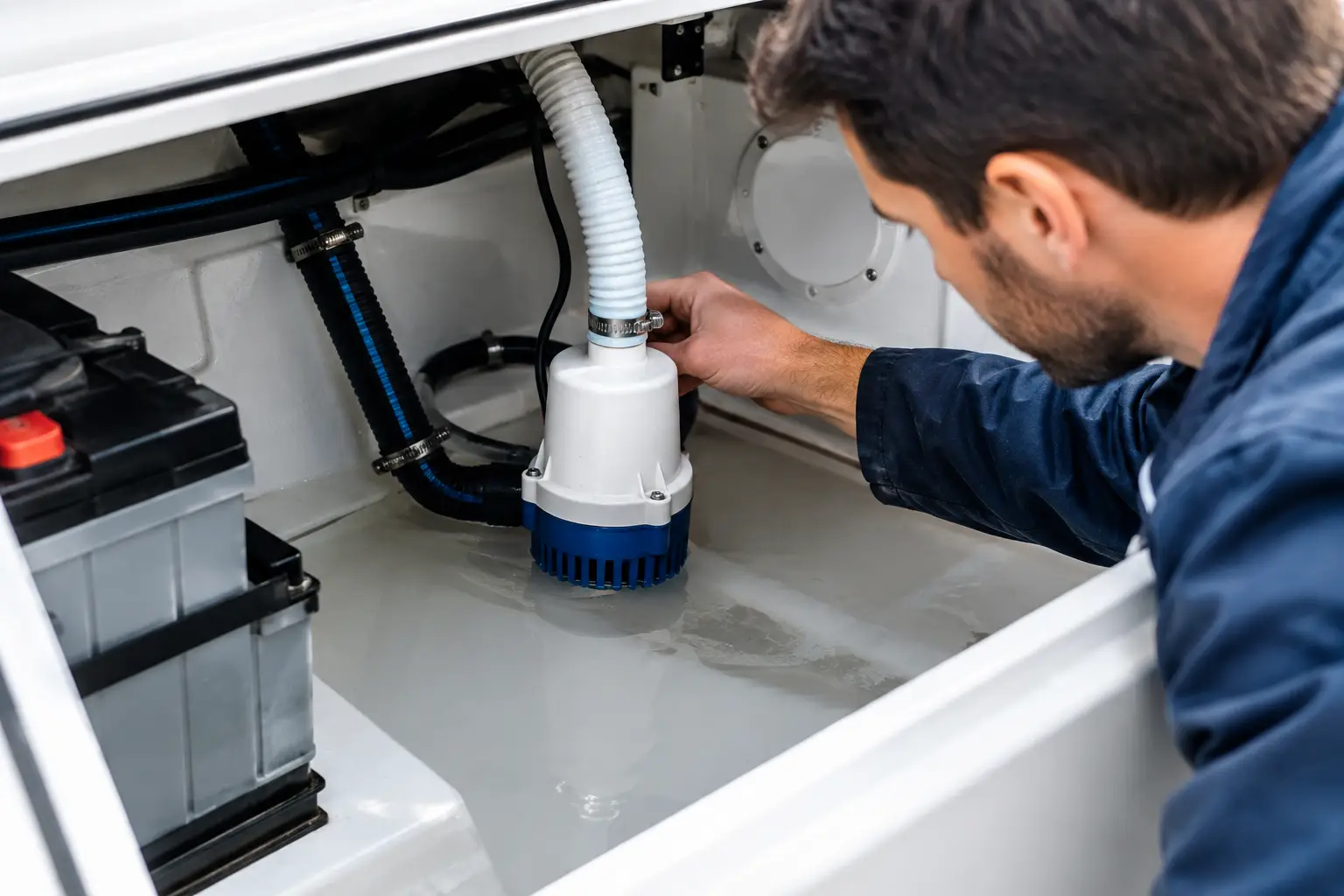
The bilge pump rarely attracts attention while functioning properly. However, when water appears in the bilge, and the pump does not activate or fails to expel water from the vessel, the consequences can be serious. Thus, the question how to check the bilge pump is not a routine technical detail, but part of the basic preparation of the vessel before departure, extended stays at the berth, and the season.
The bilge system is not designed to protect against major sea ingress after a casualty. Its task is to remove usual amounts of water from condensation, rainwater, minor leaks, water systems, or engine compartments. Still, timely detection of unusual water ingress often provides the crew with valuable reaction time. Therefore, the pump must be accessible, properly powered, clean, and checked under actual operating conditions.
Determine System Configuration Before Testing
Most vessels have at least one electric bilge pump with automatic activation via a float switch or built-in sensor. Larger vessels often have multiple pumps distributed across watertight compartments, dedicated engine compartment pumps, and a manual diaphragm pump as a backup solution.
Before testing, locate the pump, float, fuse or automatic switch, control panel, and outlet through the vessel's hull. If you cannot reliably trace the entire path from intake to discharge, do not assume the system works just because you hear the pump motor. The pump may run, yet water can remain in the bilge due to clogged intakes, kinked hoses, or faulty check valves.
On modern vessels, bilge pumps may be integrated with monitoring systems, high-water alarms, or remote notifications. Such integration improves oversight but does not replace physical inspection of the pump, float, and piping.
Step-by-Step Procedure to Check the Bilge Pump
First, ensure safe access to the bilge. Turn off unnecessary consumers, remove objects that might fall into the pump area, and use adequate lighting. In the engine space, watch for hot components, moving parts, and any traces of fuel or oil. If the bilge is contaminated with petroleum derivatives, do not pump the contents overboard.
1. Inspect the Bilge, Intake, and Pump Housing
Remove hair, fibers, insulation fragments, sediments, plastic ties, and other debris around the intake strainer. Automatic bilge pumps are sensitive to dirt that obstructs flow or blocks the rotor. Even a small foreign object can reduce pump capacity when its full performance is needed.
Check if the pump is firmly mounted and positioned at the lowest practical point of the bilge. If mounted too high or the float is set too high, a significant volume of water will always remain in the bilge. Conversely, a float set too low can cause frequent activation due to minimal condensation or vessel movement at the berth.
Examine the housing for cracks, corrosion at connectors, signs of overheating, or damaged cables. Cracked insulation and oxidized terminals are especially common problems in damp spaces where faults may appear intermittently rather than continuously.
2. Test Manual Activation via Control Panel
Switch the pump to manual mode on the control panel and listen for smooth motor operation. Then check whether water is discharging through the designated outlet on the vessel's side. The motor sound alone is insufficient proof - the rotor may spin without actual flow.
For a functional test, add a small amount of clean water into the bilge, enough to submerge the pump intake. Observe how quickly the pump removes water and whether it leaves an unusual amount after stopping. Do not allow the pump to run dry for extended periods unless explicitly permitted by the manufacturer.
A weak or irregular jet at the discharge may indicate partial clogging, worn rotor, low voltage, leaking hose, or excessive resistance in the installation. If the pump runs slower than before, do not attribute the problem solely to equipment age before measuring voltage and inspecting piping.
3. Verify Automatic Activation of the Float or Sensor
Test automatic operation separately from manual. For a separate float, lift it manually and check if the pump activates immediately. For an electronic sensor, gradually add water until activation level is reached. The pump must start without knocking on the housing, cable movement, or repeated attempts.
The float often jams due to deposits, loose cable, or objects in the bilge. Also, verify it returns freely to the lower position and deactivates the pump after the water level drops. A pump that runs continuously can drain service batteries, especially when the vessel is not connected to shore power.
If your vessel is equipped with a high-water alarm, test it separately as well. The alarm should be set above the activation level of the main automatic pump. Its purpose is not to initiate routine pumping but to alert the crew that water volume exceeds expectations or that the primary system is not functioning efficiently enough.
4. Inspect Hose, Outlet, and Check Valve
Follow the discharge hose from the pump to the hull fitting. The hose must not be pinched, cracked, loosely connected, or arranged with unnecessary high loops. Every additional elevation and constriction reduces the actual pump flow.
The outlet connection should be properly designed concerning its position relative to the waterline and to prevent backflow. Details depend on vessel type, pump position, hose diameter, and applicable regulations. An improperly designed outlet can create a bigger problem than a faulty pump itself.
A check valve can prevent water returning to the bilge but introduces additional resistance and is prone to fouling. It is not a universal solution for every installation. If water returns after the pump stops, it is necessary to determine whether only the hose volume returns or if there is an issue with outlet position, valve, or overall system design.
Check Electrical Power Under Load
The bilge pump may start running unloaded but lose power when lifting water through the hose. Therefore, it is necessary to verify the fuse, switch, connections, and wiring condition, as well as voltage at pump terminals while it is actually running.
Corrosion on terminals, poor connections, undersized wiring, or bad ground paths can cause voltage drop. The result is slower operation, reduced flow, and motor overheating. For automatic pumps, pay special attention to continuous power supply. If this feed is connected behind the main battery switch, the pump might lose power exactly when leaving the vessel.
Circuit protection must be properly sized and located as close as possible to the power source. Do not install a larger fuse just because the existing one occasionally blows. A blown fuse is a symptom requiring cause diagnostics - possible pump blockage, damaged wiring, water intrusion in the motor, or incorrect system configuration.
When Basic Checks Are Not Enough
Intermittent activation without visible cause, persistent bilge water, frequent battery discharge, or unusual smell of overheated insulation warrant a more thorough inspection. The same applies if the vessel has been stationary for a long time, exposed to heavy rain, impact from waves, installation work, or changes in battery and charging system configuration.
During refit or pump replacement, selecting a model based solely on rated capacity is insufficient. Actual lift height, hose diameter and length, voltage system, current consumption, float position, service accessibility, and compatibility with existing alarms and monitoring systems must be checked. A larger pump is not automatically a better choice if the rest of the installation limits flow or overloads the electrical circuit.
UnLucky can perform bilge system diagnostics, inspect electrical installations and component compatibility, and propose solutions tailored to the vessel's actual condition. After selection follow professional installation and integration, automatic operation configuration, commissioning, and load testing.
If you notice irregularities during testing, send an inquiry with vessel type, system voltage, pump position, and observed symptoms. The bilge pump is no place for assumptions - Because Luck Has Nothing to Do With It.