


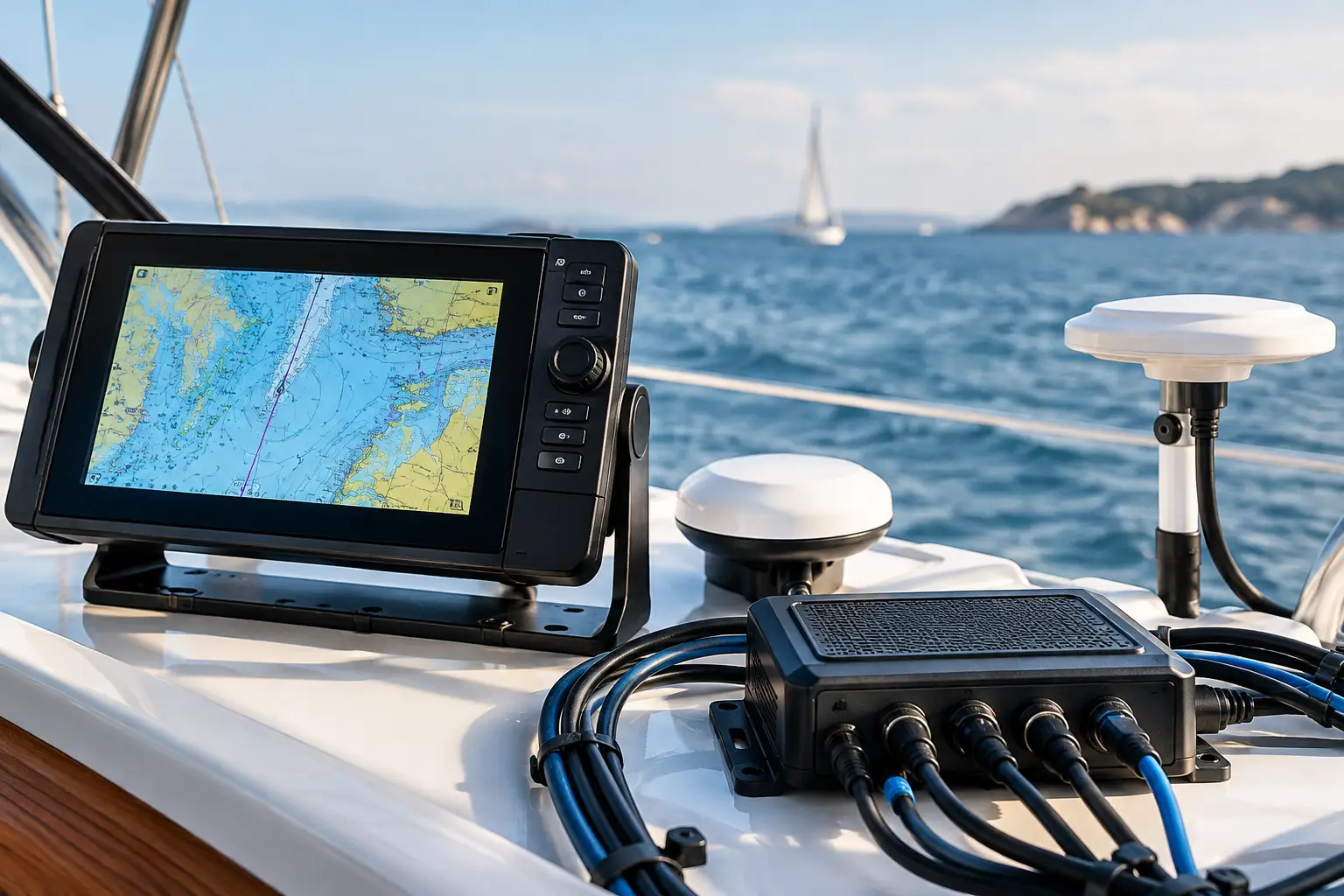
A navigation display that does not show depth data, an autopilot not receiving course from GPS, or a VHF device without AIS targets often are not faults of individual devices. In many cases, the cause is an improperly designed, connected, or configured communication network. Therefore, programming an NMEA network is not merely a matter of a few menu settings. It involves understanding topology, data sources, device priority, and the actual needs of your vessel.
On yachts, sailboats, or workboats, the NMEA network links navigation, engine instruments, sensors, VHF, AIS, radars, autopilot, battery monitoring, and other systems. When integration is done correctly, the crew sees consistent data and devices cooperate. When it is not, consequences can be confusing: duplicate GPS positions, unstable heading, false alarms, or missing data when you need it the most.
What does programming an NMEA network actually mean?
The term "programming" might suggest writing code. For most marine systems, this is not the case. Programming an NMEA network usually involves planning communication, physical installation, adjusting data sources and destinations, and verifying operation after commissioning.
Two standards are most common. NMEA 0183 is an older serial communication method where devices are connected via separate wires for data send and receive. NMEA 2000 uses a shared bus with a backbone cable, T-connectors, terminating resistors, and drop cables to individual devices. Manufacturer-specific networks often physically or logically use NMEA 2000 principles but may have unique connectors, restrictions, or configuration procedures.
This difference dictates the entire approach. For NMEA 0183, message compatibility, baud rate, and wire direction are essential. For NMEA 2000, proper topology execution, network power supply, load control, and defining the main data source are critical.
Start from function, not cable
Before buying adapters or connecting existing connectors, define what the system must perform. For example, the autopilot may require GPS position, COG, SOG, magnetic or true heading, wind data, and a route from the plotter device. An AIS receiver must send targets to a compatible display, while a VHF with DSC usually needs a reliable GNSS position.
Equally important is identifying which device produces each data type. A vessel may have GPS integrated in the plotter, a separate GNSS antenna, an AIS transponder with internal GPS, and a satellite communication device also sending position. If all simultaneously broadcast the same data without clear priority, the display might select an incorrect source or constantly switch sources.
Create a list of devices, their interfaces, and data they send or need to receive. In practice, this includes device models, software versions, existing cables, free ports, and possible converters between NMEA 0183, NMEA 2000, Ethernet networks or other protocols. Only then can a technical compatibility check be performed.
Define one authoritative source for each data type
It is not always necessary to have only one physical sensor, but the network must have a clearly defined priority. For position, this might be an external GNSS antenna; for heading, a precise compass with tilt correction; for depth, an appropriate transducer; and for engine data, a gateway reading the engine communication system.
The choice depends on equipment and usage. A sailboat relying on autopilot for longer passages has different requirements than a smaller powerboat navigating mostly coastal routes. In vessels with multiple control stations, ensure each display receives the same selected sources but does not unnecessarily duplicate messages back into the network.
Correct NMEA 2000 topology is the foundation of configuration
An NMEA 2000 network is not a series of devices connected arbitrarily. It is built around a backbone cable with exactly two terminating resistors at each end. Each device connects via a T-connector and a separate drop cable. Power is introduced at a designated location, protected by an appropriate fuse and installed according to the network equipment manufacturer's specifications.
A common mistake is adding a third terminating resistor, omitting one resistor, or connecting devices in an informal star topology. The network might seem to work but communication interruptions can occur with vibration, voltage drops, or when adding new devices. Such a system is not reliable.
Check the total backbone length, drop cable lengths, cable gauge, and total device load. On larger vessels, it is especially important where the network is powered and whether voltage drops occur towards remote parts of the installation. An NMEA network may have correct data connections but operate unstably due to poor power supply or connector corrosion.
Device and data converter configuration
After physical installation comes configuration of each device. On multifunction displays, typically sources for GPS, heading, depth, speed through water, wind, and engine data are selected. The autopilot then links to the selected heading and navigation sources, along with its compass and drive calibration procedures.
For NMEA 0183 systems, the baud rate must be verified—often 4,800 or 38,400 bps for AIS—and message formats sent by devices checked. It is insufficient that both devices are labeled NMEA 0183. One may send sentences the other does not use or only from a specific output. Also check if the port is set as input, output, or combined channel, and verify wire polarity.
Converters between standards deserve special attention. They cannot always transfer every message and data in both directions. A quality solution requires filtering unnecessary messages, mapping required data, and controlling to prevent data loops. Data loops can overload the network or cause illogical instrument displays.
Do not skip updates and calibration
Compatibility is not just a matter of connectors. Device software versions can affect recognition of network data, support for certain messages, or behavior in automatic source selection. Updates should be done methodically, with stable power and following specific model instructions. Updating multiple critical devices just before departure without time for testing is not advisable.
Calibration is a separate task. The compass, tilt sensor, speed log, tanks, and engine sensors do not become accurate simply by connecting to the network. If input data is incorrect, the network will only efficiently distribute it to all vessel displays.
How to verify NMEA network functionality
Commissioning does not end when a device appears on the network list. Actual data must be checked in real conditions. First, review the network device list and voltage diagnostics, then confirm source selections on each display. Functional tests follow: position and time, depth, heading, engine data, AIS targets, VHF position, and communication with the autopilot, depending on installed equipment.
A connection test alone is not sufficient for all functions. The autopilot and compass should be tested at sea, under different headings and loads. If data intermittently disappears, diagnostics should include connector inspection, voltage measurement, network termination check, cable condition in wet zones, and analysis of device messages.
Preventive maintenance involves periodic inspection of connectors, moisture protection, mechanical cable strain relief, and network changes after adding new equipment. Each added device can alter load, data sources, or logic of the entire system.
When expert review is necessary
A simple network with few compatible devices can be manageable, but more complex systems rarely resolve by trial and error. Expert review is especially recommended when combining multiple manufacturers, linking NMEA 0183 and NMEA 2000, installing autopilots, integrating engine data, or troubleshooting intermittent faults that cannot be reproduced in the marina.
UnLucky approaches NMEA integration through reviewing the current state, designing topology, technical compatibility checks, installation and configuration, then commissioning and diagnostics. This addresses not only the current symptom but builds a system understandable for maintenance and ready for future expansions.
If unsure about missing data, conflicting sources, or how to safely add new equipment, send an inquiry with your device list and problem description. A good NMEA network does not rely on luck but on proven topology, clear configuration, and control before departure. Because Luck Has Nothing to Do With It.