
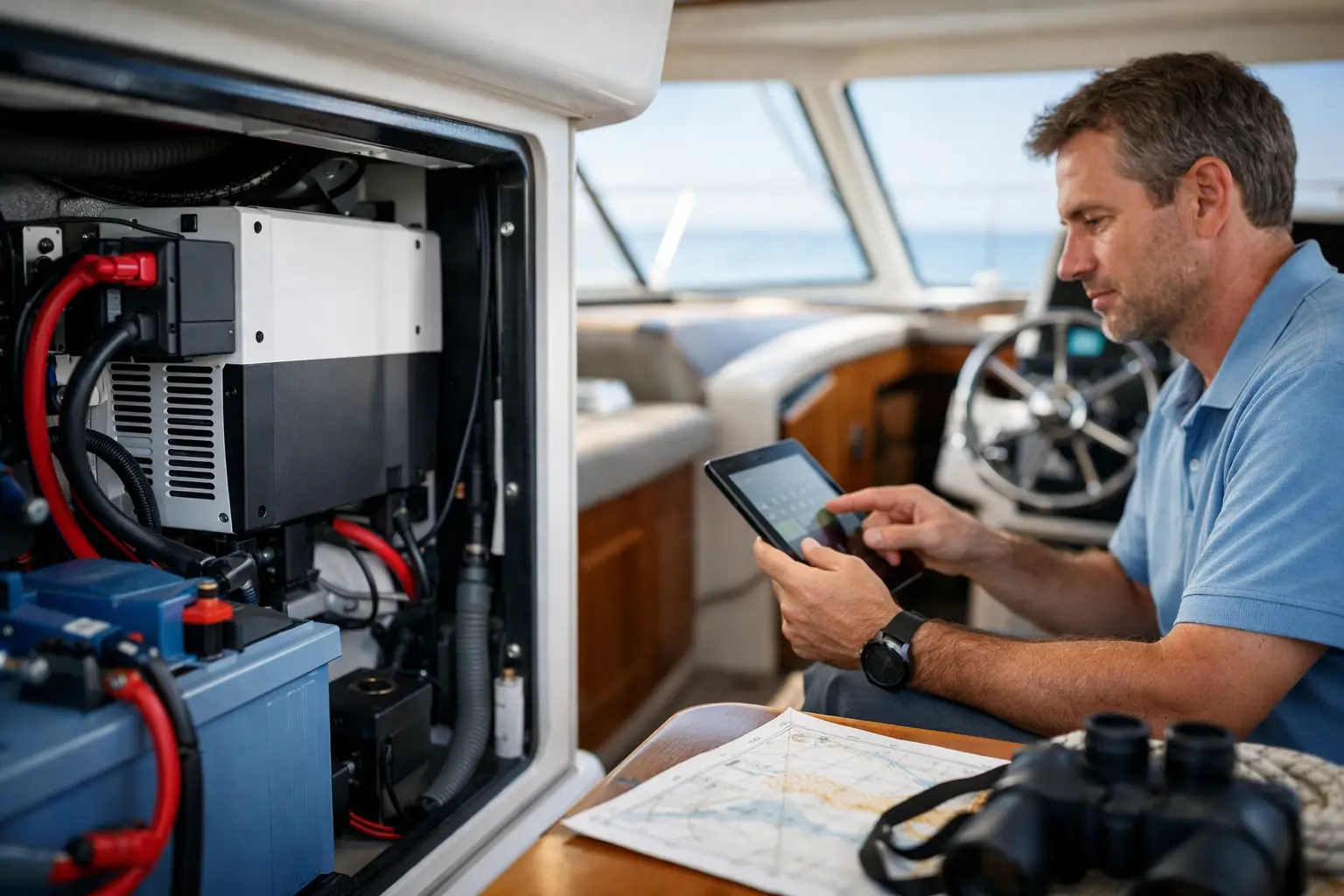
When your coffee machine, power tool charger, or air conditioning stops working at anchor, the cause is not necessarily a device failure. Often, the problem is an inverter that is undersized, incorrectly installed, or not compatible with the battery system. The question how to choose a marine inverter is therefore not just about nominal wattage, but about designing the entire energy system on your vessel.
An inverter converts direct current voltage from batteries, usually 12 V, 24 V, or 48 V, into alternating current voltage of 230 V. This allows operation of household and professional AC consumers when the vessel is not connected to shore power or the generator is off. However, every watt the inverter delivers at 230 V must come from the batteries, through cables, fuses, connectors, and protective devices. It is precisely in this chain that limitations arise which are not visible from the specification of a single device.
How to Choose a Marine Inverter Based on Actual Consumption
The first step is not selecting a model, but listing the consumers you actually want to use without shore power. Distinguish between devices that operate intermittently, such as kettles, microwave ovens, or power tools, and devices that run for long or continuous periods, such as refrigerators, communication equipment, televisions, network devices, and some medical devices.
The nominal power of the inverter must cover the simultaneous load, not the sum of all devices on board. If during breakfast you expect to run a coffee machine of 1,400 W and a kettle of 1,800 W, the inverter must reliably handle at least 3,200 W continuous load, with reasonable reserve. In practice, other consumers that may not be obvious, like chargers, refrigerator or circulation pumps, must also be considered.
Peak, i.e., starting power, is equally important. Compressors, pumps, electric motors, and some tools draw multiple times the current listed as running power when starting. An inverter that covers continuous consumption on paper may shut down due to such surge protection. Therefore, for motorized consumers, selection is not based only on the device label wattage, but on actual startup behavior.
Inverter Power Is Not the Same as Autonomy
A 3,000 W inverter does not mean that the battery system can supply a 3,000 W load for a long time. On a 12 V system, such load, considering conversion losses, can draw approximately 280 A or more from the batteries. This requires batteries of appropriate capacity and allowable discharge current, very short and properly dimensioned DC cables, and quality connections.
To estimate autonomy, energy in watt-hours must be considered, not just capacity in ampere-hours. A 400 Ah battery at 12 V nominal contains about 4.8 kWh of energy, but available energy depends on battery chemistry, allowable depth of discharge, temperature, system age, and load. For lead-acid batteries, the usable capacity for regular discharge is significantly less than for a properly designed LiFePO4 system.
If you plan to power larger consumers, consider whether it makes sense to keep the existing system at 12 V. Systems at 24 V and 48 V operate at lower currents at the same power, which facilitates cable sizing and reduces losses. However, this is not a universal solution as compatibility with the engine, chargers, bow thruster, windlass, and existing DC consumers must be checked.
Pure Sine Wave for Sensitive Marine Equipment
For most vessels, an inverter with a pure sine wave output is recommended. Such output is closer in quality to shore power and more suitable for sensitive electronics, chargers, audio equipment, control systems, refrigerators, and devices with electric motors.
Modified sine wave inverters may be acceptable for simple resistive loads but can cause buzzing, overheating, lower performance, or irregularities with electronic equipment. On yachts, sailboats, or charter vessels where the 230 V network often powers multiple different devices, saving on output voltage shape is rarely justified.
Check also voltage regulation quality, permitted overload, cooling method, and standby power consumption. An inverter that constantly consumes a significant amount of energy can unnecessarily drain batteries overnight, especially if it is on just for a few small consumers. Economy modes may help, but verify whether the device reliably detects low loads.
Standalone Inverter or Inverter/Charger
A standalone inverter converts battery energy into 230 V and is suitable when battery charging is already handled by a separate charger, alternator, solar regulator, or generator. Such a solution may be justified for simpler systems or partial upgrades of existing installations.
An inverter/charger combines an inverter, a powerful AC battery charger, and management of transferring loads between shore power, generator, and battery supply. With proper integration, it can automatically switch consumers to an available source, limit input current according to marina connection capacity, and prioritize battery charging or AC consumers depending on configuration.
For vessels frequently changing berths, anchored, or using generators, an inverter/charger usually offers clearer system management. However, it requires careful AC distribution design, backfeed protection, grounding, residual current device, and neutral conductor planning. Incorrect source automatic transfer can create serious safety issues and complicate later system diagnostics.
Batteries, BMS, and Charging Must Be Coordinated
For LiFePO4 batteries, the inverter is not selected independently of the Battery Management System (BMS). The BMS must be able to continuously withstand the expected discharge current and short-term peak currents. If the inverter triggers BMS protection under higher loads, the entire DC system may lose power. Consequences depend on the installation design—from outlet shutdowns to interruption of critical devices that should not share the same bus.
The charging method must also be verified. Shore chargers, alternators, solar regulators, and generators must have properly set charging profiles, temperature conditions, and current limits. For lithium systems, alternator protection and charge management are specially designed to prevent overload of the engine drive system.
Sodium-ion batteries have different characteristics from LiFePO4 batteries, including voltage curves and manufacturer charging recommendations. Therefore, inverter/charger settings, low voltage disconnects, and communication with the BMS must not be copied from other projects without technical compatibility verification.
Installation Determines Reliability as Much as the Device
A large 12 V inverter can draw currents comparable to serious propulsion consumers. DC cable cross-section, length, fuses, switches, busbars, and cable lugs must be sized according to actual load and installation conditions. Every poor connection creates resistance, heating, and voltage drop. The inverter may then report low voltage even though batteries are nominally not empty.
Installation must allow ventilation, accessibility, moisture protection, and service access. The inverter must not be placed in spaces with potential flammable vapors nor rely on existing wiring without checking their cross-section, condition, and protection. AC and DC installations must be clearly marked, neatly routed, and separated where necessary.
Special attention is required for load management. Not all circuits on the vessel are intended to operate from the inverter. Air conditioners, water heaters, induction cooktops, and high-capacity chargers can rapidly deplete the battery system. In some projects, it is more sensible to power only selected sub-distributions with the inverter, while heavy loads remain available only on shore power or generator.
Selection Starts with a Technical Vessel Inspection
Correct selection involves inspection of existing batteries, chargers, alternators, solar production, generators, main DC distribution, and AC distribution panel. Only then can it be determined if a standalone inverter, inverter/charger, battery system upgrade, stronger alternator, or different consumer division is needed.
At UnLucky, we approach the inverter as part of an energy system, not as a standalone device. Technical compatibility check, design, installation and integration, parameter configuration, and commissioning reduce the risk of unexpected shutdowns and accelerate future diagnostics.
If you plan greater energy autonomy or replace an existing inverter, send an inquiry with vessel data, batteries, available charging sources, and consumers you plan to use. Reliable operation at anchor does not depend on luck but on a properly designed system. Because Luck Has Nothing to Do With It.