


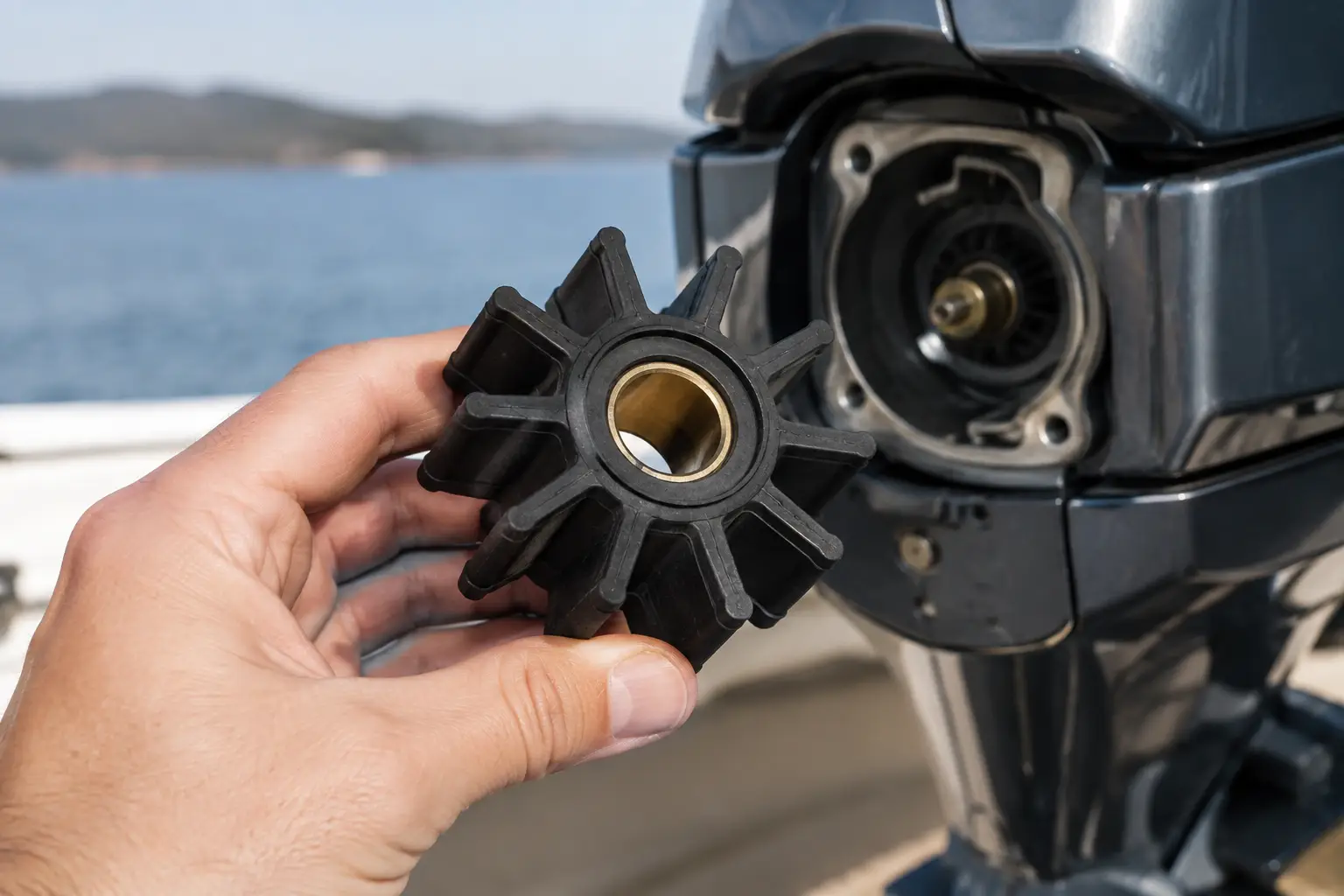
The impeller may seem like a small consumable part, but its failure often stops the vessel at the most inconvenient moment. The question when to replace the marine engine impeller is not solely based on operating hours. The answer depends on the manufacturer's recommendation, the rubber's age, vessel usage, the condition of the seawater intake line, and whether the engine has ever operated without sufficient water supply.
In a marine engine, the impeller drives the raw seawater pump. This water passes through the cooler, heat exchanger, exhaust system, and other components depending on the propulsion design. When the impeller loses elasticity, cracks, or loses blades, flow decreases. Consequences may include high-temperature alarms, exhaust steam, damage to the exhaust hose, engine overheating, and loss of navigation.
Preventive replacement is simpler and considerably more cost-effective than interventions after overheating. However, replacement without inspecting the remainder of the cooling circuit is not a complete service. The impeller is part of a system, not an isolated rubber piece.
When to Replace the Marine Engine Impeller According to Interval
As a basic rule, follow the engine or pump manufacturer's service interval. For many recreational marine engines, the recommendation is replacement once a year or after a certain number of operating hours, often between 200 and 500 hours. However, this range is not universal and specific engine documentation always takes precedence.
For vessels that remain idle most of the year, the annual interval is especially reasonable. Impeller rubber ages even when the engine is not running. Blades can remain bent in the same position for months, so upon first startup, they no longer fit properly against the pump housing. On charter vessels, workboats, or yachts with high hours, replacement is planned according to operating hours and the service schedule, often multiple times during a season.
If the impeller was changed a few months ago, it does not automatically mean it is still functional. Starting the engine with a closed seawater intake valve or clogged intake can damage it very quickly. A pump without water has no lubrication or cooling that seawater flow normally provides. A few dozen seconds of dry running can be enough for blades to deform, seize, or crack.
Signs That Replacement Should Not Be Delayed
The clearest sign of a problem is elevated engine temperature, especially under higher loads or rpm. However, do not wait for an alarm. Reduced or irregular water flow at the exhaust, weaker jet at the control outlet in engines that have it, and the unusual smell of heated rubber are reasons for immediate inspection.
During impeller inspection, look for cracks at blade roots, permanently bent blades, worn edges, separated rubber pieces, and loss of elasticity. A superficially intact impeller is not necessarily functional if its blades are hard or do not return to the initial position. Also, inspect the inside of the cover and pump housing. Deep wear traces can reduce the effectiveness of a new unit, so replacing the impeller alone will not solve flow problems.
Special attention is required for impellers missing blades. Pieces often do not remain inside the pump. They can end up in hoses, oil coolers, heat exchangers, or other cooling circuit parts. Installing a new impeller without locating all fragments might temporarily restore flow, but retained pieces can later again restrict cooling.
What Else to Check Before Concluding the Impeller Is at Fault
Overheating is not always due to the impeller. Therefore, quality diagnostics of the cooling system begins by checking the entire seawater path—from the hull intake to discharge.
Check if the seawater intake valve is fully open, ensure intake basket and filter are clean, and verify filter cover does not admit air. Even a small air leak at the pump's suction side can reduce water intake capacity. Inspect hoses, clamps, pump cover seals, and belt condition if the pump is belt-driven.
On engines with heat exchangers, consider scaling, deposits, and contamination in channels. For vessels that stay long in harbors or operate in silt and seaweed-rich areas, clogged intake or cooler is not uncommon. If temperature only rises at full load, partial flow restriction invisible at idle may be the cause.
It is important to distinguish the raw water pump from the engine's closed coolant circuit. The impeller is usually part of the seawater circuit. Problems with thermostat, coolant, temperature sensor, or engine circulation pump may present similar symptoms but require different procedures.
Proper Replacement: Small Part, Precise Procedure
Impeller replacement is performed with the engine off, seawater intake valve closed, and secured pump access. For professionally maintained vessels, the procedure is recorded in service documentation along with engine hours, date, condition of removed parts, and any notes on the pump housing.
Before installing a new impeller, verify the exact pump model compatibility. Similar diameter or identical blade count are insufficient criteria. Important are blade width, shaft diameter, hub shape, material, and intended use. An unsuitable impeller may physically fit but will not provide proper flow or service life.
Blades are oriented according to pump rotation during assembly, using lubricant recommended by the manufacturer. Improper lubricant can damage rubber or contaminate the system. The cover is assembled with the correct gasket or O-ring, and screws tightened evenly. Over-tightening can deform the cover or damage threads in the pump housing.
After opening the system, check for leaks and actual flow while the engine runs. The fact that the engine did not immediately overheat is not sufficient proof of correctness. The engine should warm to operating temperature, and the cooling circuit verified at various RPMs based on safe vessel operating conditions.
Spare Impeller Onboard Is Not a Substitute for Maintenance
It is advisable to carry a suitable spare impeller, cover gasket, and basic tools aboard, especially for longer voyages or vessels operating far from service infrastructure. This is reasonable preparation but does not mean every replacement should be done without prior system inspection.
If the impeller failed before the scheduled interval, it is necessary to determine why. Did the engine run dry? Was the seawater intake clogged? Is there air leakage? Is the pump housing worn? Without answers to these questions, a new part may also fail prematurely.
For vessels with multiple engines, generators, air conditioning, watermakers, or other seawater-utilizing systems, maintenance should be planned as inspection of all relevant pumps and intakes. Not all impellers require the same interval, but system-based inspections reduce the chance that one neglected consumable disrupts operation of a crucial device.
Preventive Maintenance for a Safer Season
The best time to plan replacement is usually before the season or as part of the regular annual engine service. At this time, there is enough opportunity to inspect the pump, procure the exact parts, clean filters, and check the entire cooling circuit. Intervention during the season makes sense when operating hours, observed condition or symptoms require it, but should not be the only maintenance plan.
If you are unsure when the impeller was last replaced, treat its service status as unknown. Documentation review and technical inspection are safer than appearance-based judgment or assuming the previous owner performed all maintenance on time.
For your vessel, we can organize cooling system inspection, diagnostics of reduced flow causes, selection of compatible impeller, and service intervention with post-installation operation check. Send an inquiry with engine data, operating hours, and observed symptoms so work scope can be defined based on actual system condition.
A reliable engine does not rely on a small rubber part lasting another season. It relies on the correct interval, technical inspection, and procedures without improvisation. Because Luck Has Nothing to Do With It.