


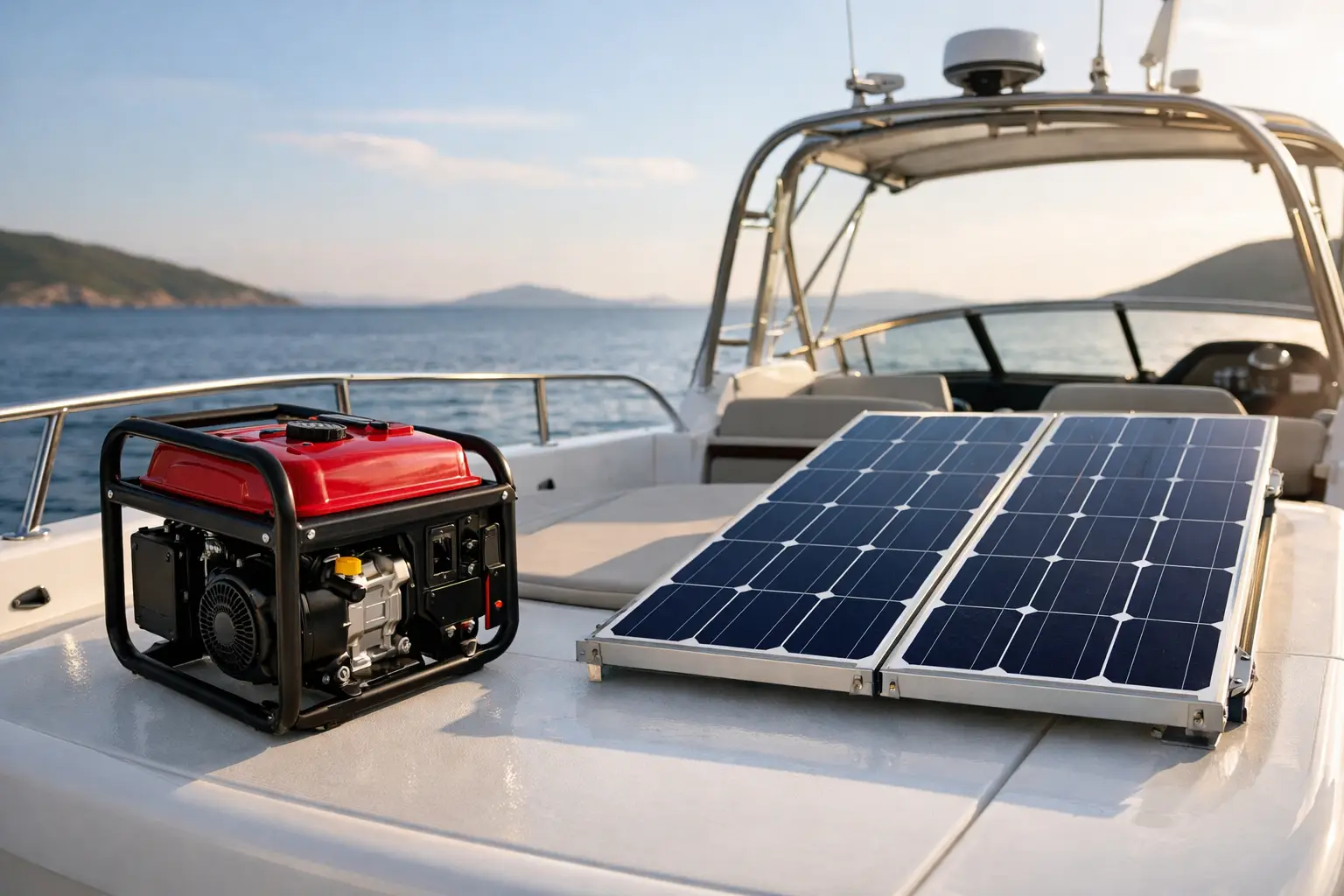
When a vessel remains anchored for several days, the question is not only whether you have enough electrical energy, but also what you will have to accept because of it: noise, fuel consumption, service intervals, engine room space, or consumption limits. The generator or solar system is not a choice between old and new solutions. These are two energy sources with fundamentally different characteristics, and on many vessels, the best results are achieved through a properly designed combination of both systems.
An incorrect decision often becomes evident only during the season. A generator operating under too low load consumes unnecessary fuel; solar panels cannot keep up with air conditioning or watermaker operations; batteries charge too slowly, and existing installations lack appropriate protection and capacity. Therefore, the decision should not be based solely on the declared power of equipment but on the actual energy balance of your vessel.
Generator or Solar System: Key Difference
A marine generator produces electrical energy on demand, regardless of the time of day or weather conditions. It can power large AC consumers, charge the battery system with high power, and ensure continuous operation when the vessel is at anchor, in a harbor without shore power, or during longer passages.
The solar system produces energy when sunlight is available. It operates quietly, without fuel consumption, and without the regular mechanical servicing required by diesel generators. Its greatest value lies in continuously covering the basic daily consumption and maintaining batteries, especially on sailing yachts, catamarans, and motor vessels that frequently stay at anchor.
The difference lies in the power profile. The generator provides high power for a limited operating time. Solar provides lower, variable power throughout the day. The battery system links these two sources and determines how comfortable and reliable autonomy will be in practice.
When a Generator Has a Clear Advantage
A generator is justified when a vessel has consumers whose power far exceeds the real daily production of solar panels. Air conditioning, larger watermakers, electric kitchen equipment, washing machines, dryers, large refrigerators and freezers, hydraulic systems, and intensive charging of a large battery bank create a consumption profile that solar alone often cannot cover.
On crewed yachts, the generator often serves an operational function. It allows a predictable energy production schedule, continuous operation of hotel systems, and power supply when consumers are active at night or during cloudy days. For charter operators, this can be important for guest comfort, but also for clear control of battery status between guest shifts.
However, a generator is not an automatic solution for every need. Running a diesel generator at very low load can be inefficient and detrimental for the engine in the long run. It also requires fuel, ventilation, exhaust systems, cooling, vibration control, regular servicing, and quality integration with the AC distribution and chargers. A poorly sized or poorly maintained generator can cause more operational issues than it solves.
Sizing According to Actual Consumers
The generator power is not determined simply by summing the power of all devices on the vessel. It is necessary to establish which devices operate simultaneously, their starting currents, operation duration, and whether some consumers can be staggered. Special attention should be given to air conditioning, compressors, induction cooktops, pumps, and high-capacity chargers.
An oversized generator unnecessarily occupies space, increases weight, installation costs, and maintenance expenses. An undersized generator can be overloaded, struggle with peak loads, and limit vessel functionality. Technical checks include the existing electrical distribution, automatic source switching, grounding, galvanic isolation, and protection against overloads and current leakage.
When Solar Systems Deliver the Greatest Value
Solar systems are especially effective when your vessel has a stable daily consumption: refrigerators, navigation electronics, communication equipment, lighting, autopilot, pumps, charging small devices, and occasional inverter use. In such a regime, panels can significantly reduce the need to run the generator or main engines just to charge batteries.
On a sailing yacht spending multiple summer days outside the marina, a well-executed solar system can maintain service batteries at a favorable charge state and reduce noise and fuel consumption. Catamarans often have more flat surface area available for panels, but even then, the layout needs careful planning due to shading from masts, bimini constructions, radars, antennas, and awnings.
Solar has limitations that must be accepted without embellishment. Production decreases with cloud cover, high panel temperatures, unfavorable sun angles, and partial shading. A single shadow over part of the panels can significantly affect production, depending on module and regulator design. Winter production on the Adriatic is also not comparable to summer expectations.
Panels Are Not the Whole System
Solar panels are the visible part of the installation, but reliability depends on all components. An MPPT regulator must match the voltage and current of the panel array and the battery chemistry and capacity. Cable sizes, fuses, disconnects, glands, and mounts must be chosen for the marine environment and installed so they are inspectable and serviceable.
For LiFePO4 batteries, integration demands additional discipline. Charging from solar, alternator, shore charger, and generator must be configured according to BMS parameters, temperature limits, and allowable charging currents. The solar regulator should not be viewed as a standalone device simply connected to the battery but as part of a comprehensive energy system.
Batteries and Inverter Determine Actual Autonomy
Without an appropriate battery capacity, neither the generator nor the solar system will deliver expected results. Batteries cover nighttime consumption, handle short-term peak demands, and enable the generator to operate in meaningful cycles instead of starting for every minor consumer.
Capacity is not determined only by nominal ampere-hours. One needs to estimate daily consumption in watt-hours, desired autonomy, allowed depth of discharge, operating temperature, available space, and weight. In upgrading older vessels, it is necessary to verify if existing chargers, alternators, busbars, and cables can safely carry higher currents enabled by lithium batteries.
The inverter is equally important if you want to use 230 V devices without starting the generator. Its continuous and peak power, output voltage quality, standby consumption, and integration with shore charging and source switching must match the vessel's usage. A high-capacity inverter without sufficient battery reserve will only accelerate system discharge.
The Most Common Solution Is a Hybrid System
For vessels with larger energy consumption, the most rational solution is often not either a generator or solar system alone but a system in which each source performs the task for which it is best suited. Solar maintains basic consumption and replenishes batteries during the day. The battery system silently covers evening and nighttime consumption. The generator turns on for large consumers, fast charging, or periods when solar production is insufficient.
This approach can reduce generator operating hours, fuel consumption, and service frequency without sacrificing the functionality required by a larger vessel. However, a hybrid system must have clear control logic. Properly set source priorities, voltage and current monitoring, protections, quality charging, and understandable data displays for crew or owners are necessary.
What to Inspect Before Investment
Before selecting equipment, it is essential to capture the actual state of the electrical system. This includes battery capacity and condition, charging sources, consumers on DC and AC sides, existing cable routes, distribution panels, protective elements, available space, and ventilation possibilities. When installing solar panels, the roof, bimini, or hardtop structure must be checked, as well as wind load, water drainage, and the impact of panels on access to deck equipment.
Equally important is defining usage patterns. A vessel that leaves the marina only on weekends has a completely different energy profile from a yacht spending weeks at anchor, a charter catamaran in full summer regime, or a motorboat spending most of the time in marinas with shore power connection.
At UnLucky, selection is preceded by inspection, energy analysis, and technical compatibility check. This is followed by design, installation and integration, charger and regulator configuration, commissioning, and testing under real load. This process prevents a quality component from becoming a weak point due to improper installation or unsuitable settings.
If you plan to upgrade your energy system, send an inquiry with vessel data, existing batteries, charging sources, and consumers you intend to use at anchor. Based on the real consumption profile, it can be determined whether your vessel needs solar, a generator, or a carefully sized combination. Because Luck Has Nothing to Do With It.