


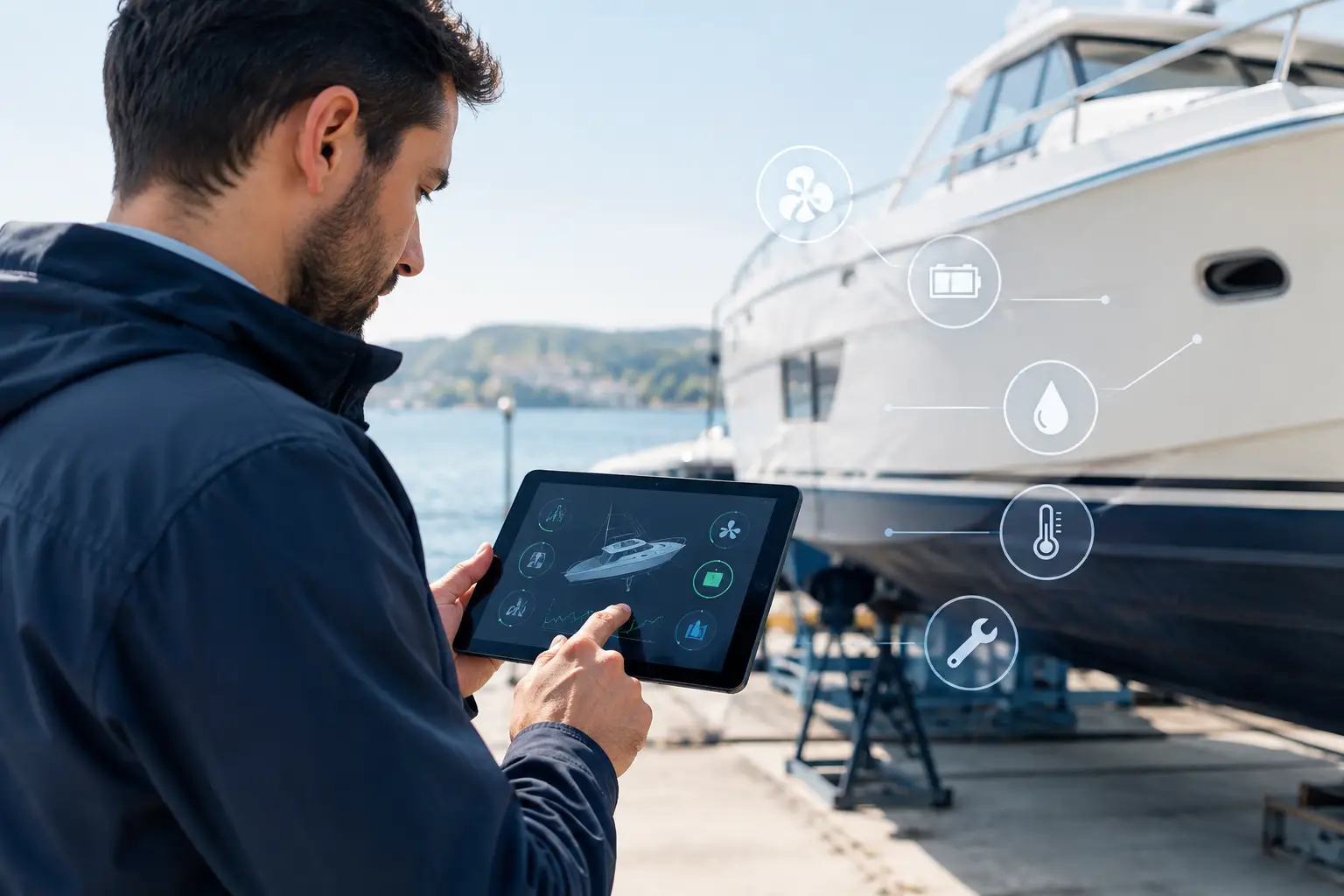
Failures often do not start with an alarm. They begin with a rise in temperature in the electrical cabinet, unusual cycles of the bilge pump, voltage drops under load, or chargers operating longer in a certain mode. Digital maintenance helps recognize such deviations before they escalate into navigation interruption, loss of autonomy, or complex service interventions.
For the owner, captain, or yacht manager, the value is not in another onboard display. The value lies in reliable data that shows the true condition of the system, in a clear service plan, and in decisions made based on measurements rather than assumptions. On a vessel where navigation, electrical power, water, and communication are interconnected, this is a critical difference.
What Digital Vessel Maintenance Really Means
Digital maintenance is not just remote monitoring or an app that sends notifications. It is an organized process of data collection, technical verification, and planning work based on the vessel's actual condition. The system can monitor battery bank voltages, charging and discharging currents, temperature, tank levels, generator operation, pump status, water consumption, vessel position, or the operation of individual devices.
However, data alone is not a diagnosis. A voltage of 12.5 V can be acceptable or concerning depending on battery chemistry, load, temperature, rest time, and measurement method. Similarly, a high-temperature alarm could result from actual overload or a poorly placed sensor. Therefore, digital monitoring must be linked to technical understanding of the installation.
In a well-designed system, every measurement serves a purpose: confirming system operation, alerting on deviations, or providing a basis for preventive service. The goal is not to collect as much data as possible, but to obtain data that facilitates correct decisions.
Why Data Matters When the Vessel Is Not Sailing
Many damages occur while the vessel is moored in the marina. An unnoticed consumer can drain the service battery bank. A faulty charger can shorten battery life over time. Water leaks, stuck pumps, or loss of shore power can remain undetected until the crew returns.
Digital monitoring allows checking whether the vessel is connected to shore power, if batteries are charging within expected parameters, if consumption is increasing, or if an important alarm has been activated. This especially helps owners who are not always on board, charter operators with multiple units, and professional crews needing a clear status without visiting every vessel.
Still, remote access is not a substitute for regular physical inspections. A camera will not show every connector corrosion, and a level sensor cannot assess hoses, clamps, or mechanical parts of pumps. Good practice combines digital logs with installation inspection, cleaning, load measurements, and functional system checks.
From Alarm to Useful Service Decision
A good alarm must be set early enough to warn of a problem but not too sensitive to cause constant false alerts. If the crew receives daily notifications that require no action, important alarms may gradually be ignored.
Alarm thresholds are therefore defined based on the specific vessel. For battery systems, battery chemistry, capacity, BMS, alternators, solar regulators, chargers, and actual consumption profiles are considered. For water systems, pressure, pump operation frequency, tank condition, and presence of a watermaker are important. For generators and propulsion systems, hours of operation, temperature, load, and service history matter.
Once an alarm is confirmed, priority assessment follows. It matters whether the information pertains to the next scheduled service, a fault requiring intervention before departure, or a safety deviation demanding immediate action. Such categorization reduces unnecessary trips but does not diminish real risk.
Systems Worth Connecting
The scope of digital maintenance depends on vessel size, usage type, installation age, and expected autonomy level. On a smaller sailing yacht, priorities might be monitoring service batteries, solar production, bilge pumps, and vessel position. On a motor yacht or catamaran, monitoring may cover multiple energy sources, generators, air conditioning units, tanks, navigation networks, water systems, and critical consumers.
Priority is usually given to systems whose failure could endanger safety, availability, or cause significant damage. These include electrical installations and battery banks, shore and alternator charging, bilge pumps, navigation and communication equipment, water systems, and equipment operating without permanent crew supervision.
LiFePO4 batteries, for example, offer useful autonomy but require correct design of the entire energy system. BMS data, charge state, temperatures, and charger communication must be interpreted in the installation context. Installing new battery chemistry without checking alternators, protections, conductor cross-sections, and charging settings is not digital maintenance—it is creating new risk with a better display.
The Foundation Is a Proper Installation, Not the Application
A digital monitoring system can be only as good as the quality of data sources and the vessel’s electrical installation. Poor connections, unclear wiring labels, inappropriate fuses, or unconnected devices limit any subsequent digitalization.
Before integration, existing conditions must be reviewed: layout of sources and consumers, battery capacity and condition, circuit protection, communication protocols, network data availability, and physical conditions where equipment operates. Special attention is needed for older vessels, partially refitted vessels, and those with systems installed over several years by different contractors.
After inspection, what to measure, which devices to use, sensor placement, and data presentation are defined. Then follow installation and integration, configuration, alarm verification, and commissioning. The final phase is not a formality: key states must be simulated and confirming the system sends clear information to the right person.
Compatibility and Cybersecurity
Vessel electronics often connect devices of different ages and manufacturers. Not all protocols are equally open, nor can every device reliably share data with the monitoring system. Technical compatibility checks before purchase prevent situations where installed equipment works standalone but does not provide expected data.
If the system features remote access, access protection methods should be considered. Passwords, user permissions, updates, and separation of critical networks from guest devices are not details to address later. Connectivity provides useful capabilities but demands discipline in configuration and maintenance.
Preventive Maintenance Gains a Concrete Schedule
The greatest advantage of the digital approach is not constant data watching, but better work scheduling. Instead of planning service solely by calendar or after failure, decisions can be linked to operating hours, loads, trends, and recorded deviations.
This does not mean factory maintenance intervals should be ignored. Engine service, safety equipment, deck equipment, and other components still have prescribed requirements. Digital data helps determine where earlier actions are needed, what to check further, and how to avoid multiple minor issues merging into a costly downtime during the season.
For charter operators, this may mean improved preparation between guest shifts. For a private owner, it increases the likelihood the vessel will be operational upon arrival. For the captain and crew, it means clearer records, faster communication with service, and less time spent searching causes without prior data.
When Is the Right Time to Introduce Digital Maintenance
The best time is during refit, battery system replacement, electrical installation renewal, or new navigation equipment installation. Then monitoring can be anticipated as part of the project, with proper wiring, protections, network infrastructure, and documentation.
However, integration is also possible on existing vessels starting with a realistic inspection. It makes no sense to digitalize everything at once if the priority is actually reliable shore charging, bilge pump monitoring, or resolving unknown battery drains. Project phases are determined by risk, budget, and vessel usage.
UnLucky approaches such projects through condition assessment, technical compatibility checks, equipment selection, installation and integration, configuration, and commissioning. Following this, digital data becomes a useful basis for system diagnostics and preventive maintenance, not just another underutilized screen function.
If you want to determine which monitoring would bring real value to your vessel, send an inquiry with basic vessel data, existing systems, and usage patterns. Properly implemented digital maintenance does not rely on luck—it relies on verified data, expert execution, and timely response. Because Luck Has Nothing to Do With It.