
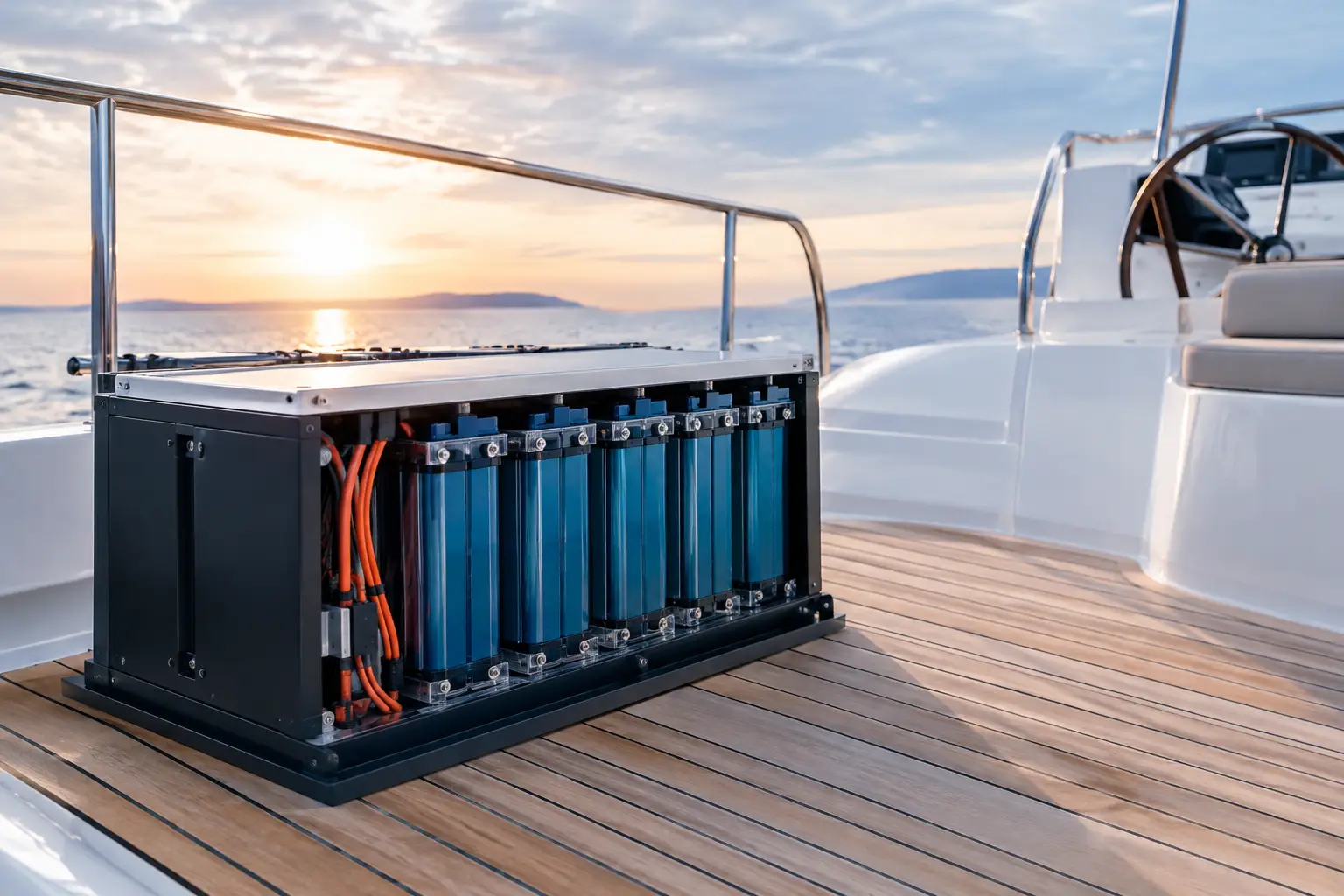
When a vessel in a calm bay runs out of sufficient energy for refrigerators, navigation, communication, or anchor handling, the problem seldom starts that day. It most often originates earlier — when selecting a battery without verifying actual consumption, when connecting new equipment to an existing installation, or due to charging not adapted to the battery chemistry. Therefore, the future of marine batteries is not simply about larger capacity. It involves a comprehensive energy system that must reliably operate under conditions of vibration, heat, humidity, corrosion, and changing vessel usage patterns.
For owners, captains, and charter operators, the change is already visible. Consumption on vessels is increasing: there is more navigation electronics, communication devices, cooling systems, inverters, stabilization systems, and auxiliary consumers. Simultaneously, longer anchorage stays, reduced generator operation, and greater energy independence are expected. This imposes higher demands on batteries, chargers, alternators, solar systems, cable installations, and monitoring systems.
The Future of Marine Batteries Is Not Just About Larger Capacity
Traditional lead-acid batteries still have their application, especially where existing systems are simple, consumption moderate, and budgets limited. However, their usable capacity, mass, charging speed, and cycle life often prove insufficient for modern vessels with greater energy demands.
LiFePO4 batteries have already changed expectations for service battery banks. Compared to comparable lead systems, they offer significantly higher usable energy, lower weight, more stable voltage during discharge, and faster acceptance of charging. This can mean more time at anchor, reduced generator runtime, and better availability of consumers.
However, LiFePO4 is not an automatic “remove old, install new” replacement. Batteries with built-in BMS manage their own protection but cannot alone resolve interactions with alternators, existing chargers, inverters, battery separators, or sensitive consumers. If the BMS interrupts current during charging under alternator load, consequences can be costly. Hence, the project must include proper charge management, alternator protection, appropriate DC-DC chargers where needed, and clearly defined system operation logic.
Sodium-ion batteries represent a technology worth monitoring. Their advantage lies in reducing dependence on lithium and certain critical raw materials, and in some applications they offer good thermal stability and acceptable behavior at lower temperatures. However, their availability, energy density, selection of compatible equipment, and long-term service support are not yet on par with the most widespread LiFePO4 solutions. For some vessels, they may become a very interesting option, but the decision should be based on concrete system specifications rather than market announcements.
What Actually Determines Vessel Autonomy
Capacity expressed in ampere-hours is an important figure, but alone it is insufficient. To estimate autonomy, daily consumption in watt-hours must be calculated, system voltage considered, true depth of discharge accounted for, inverter losses factored in, and expected charging sources evaluated. A 400 Ah battery may be more than sufficient for a weekend sailing yacht with moderate consumption, yet inadequate for a motorboat with large refrigerators, radar, inverter air conditioning, and constantly active hotel consumers.
It is important to distinguish the service bank from start batteries and batteries for critical consumers. Engine start, bow thruster, winches, navigation, and communication devices do not share the same load profile or risk tolerance. On certain vessels, it is justified to separate critical circuits, provide backup power sources, or enable manual bridging under controlled conditions. Such solutions are not unnecessary complexity when designed according to the actual vessel usage.
Monitoring is as important as energy storage. A quality battery monitor does not only display instantaneous voltage. It tracks charging and discharging current, calculates consumed ampere-hours, estimates state of charge, and can warn against unusual consumption or insufficient charging. Integrated monitoring provides owners and crew with data for decision-making and offers service technicians a clearer basis for system diagnostics.
Charging Is the Crucial Point of Every Upgrade
A battery bank can achieve its potential only if charging is properly designed. Shore chargers must have appropriate profiles for the selected battery chemistry. Solar regulators must be dimensioned according to panels and system voltage. Alternators must charge batteries without overheating, overloading, or risk of sudden current interruption.
In LiFePO4 systems, it is often necessary to isolate the alternator from the service bank via DC-DC chargers or to use an external alternator regulator, depending on configuration. The solution depends on alternator power, battery capacity, cable length, existing distribution, and navigation profile. A vessel spending most time in a marina has different priorities than one which stays weeks off-grid.
Solar systems can significantly extend autonomy, especially during summer sailing in the Adriatic. However, panels are not a substitute for calculation. Their actual output depends on available surface area, shading by masts and additions, mounting angle, panel temperature, and daily consumption profile. Professional integration includes verification of conductor cross-sections, fuses, surge protectors, and routing methods of installation through the vessel.
Weight, Safety, and Service Accessibility
The lower mass of lithium batteries can change weight distribution on a sailing yacht and free valuable space in the engine room or storage compartments. However, simply placing the battery where it physically fits is insufficient. It is necessary to ensure firm mechanical fastening, moisture protection, appropriate ventilation where prescribed, access to service components, and protection from possible mechanical damage.
System safety depends on details often overlooked: correctly sized fuses close to energy sources, quality terminals and connections, appropriate conductor cross-section, main switches, proper grounding, and clearly labeled circuits. Special attention requires coordination of BMS, contactors, fuses, and monitoring systems. A quality component cannot compensate for faulty installation.
Future development will bring smarter BMSs, more detailed remote diagnostics, and better integration of batteries with marine monitoring systems. This is beneficial only if data is meaningful and configuration understandable to the crew. A system sending ten warnings per day without clear priority and response procedure does not enhance safety – it creates information saturation.
How to Plan Battery System Upgrades
The first step is not selecting brand or battery chemistry, but a technical survey of existing conditions. The battery bank, chargers, alternators, distribution panels, cable installations, protections, consumers, and available space must be reviewed. Then, the usage profile is defined: how many days the vessel needs to operate without shore connection, which consumers are critical, whether there is a generator, plans for solar systems or electric propulsion, and the owners’ and crew’s expectations.
Based on this data, a solution is developed linking batteries with the rest of the system. This includes compatible equipment selection, design, installation and integration, charger and monitoring configuration, protection testing, and commissioning. Subsequently, documentation of the implemented state and preventive maintenance follow. On more complex vessels, it is useful to explain system normal operation, limitations, and procedures upon warnings to the crew.
UnLucky approaches battery systems as part of the vessel's entire electrical infrastructure, not as an isolated component replacement. If you are planning LiFePO4, sodium-ion, solar systems, or modernizing existing charging, send an inquiry for assessment and technical evaluation. Reliability at sea is not accidental. Because Luck Has Nothing to Do With It.