


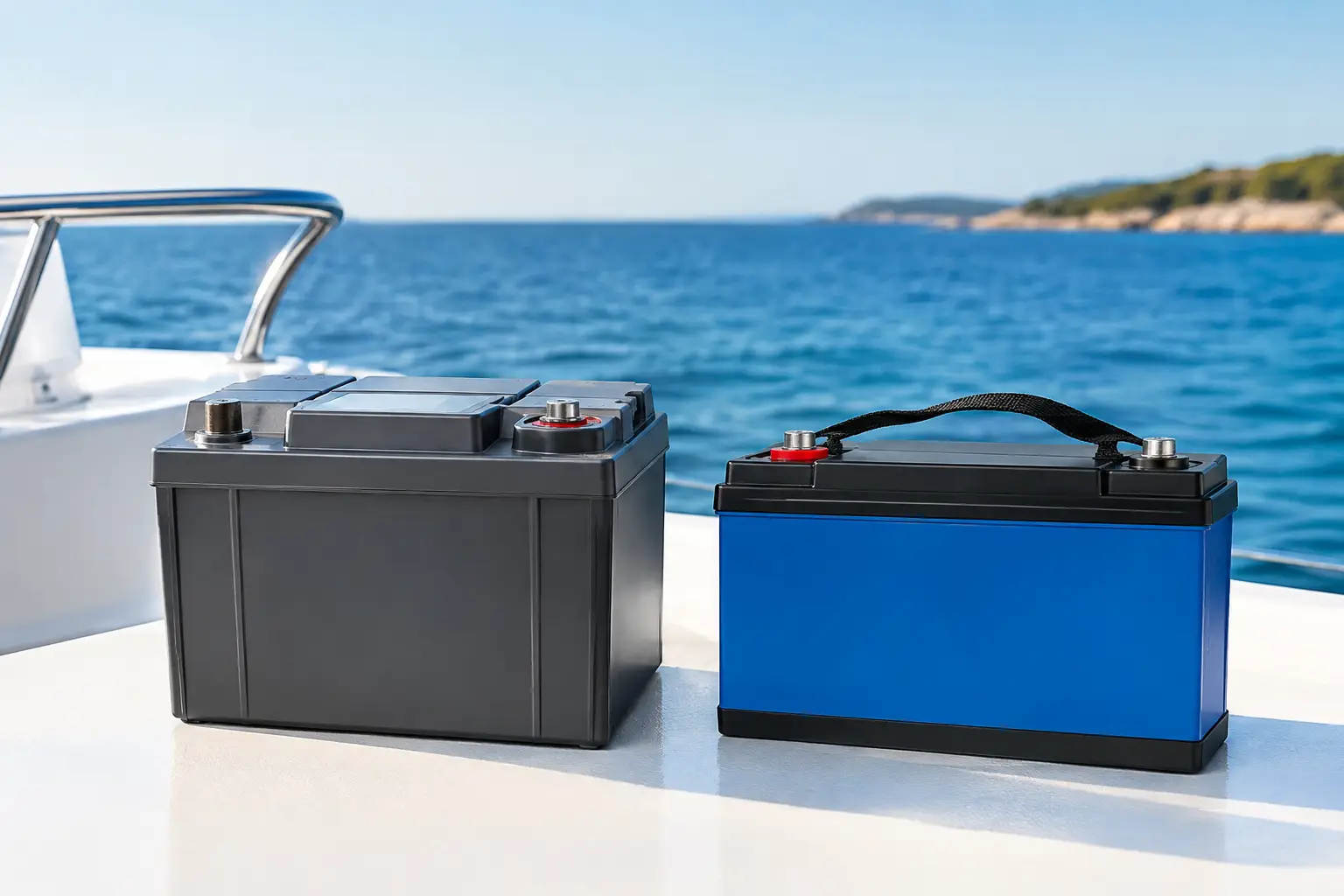
The battery system on a vessel rarely fails at a convenient time. Issues most commonly arise while anchored without shore power, during nighttime navigation, when starting the bow thruster, or when refrigerators, navigation, autopilot, and inverter operate simultaneously. The question of AGM or LiFePO4 batteries is thus not merely about price or label capacity. It is a decision impacting autonomy, availability of electrical energy, charging method, and reliability of the entire marine system.
AGM batteries still hold a justified place on many vessels. LiFePO4 technology can provide significantly greater usable capacity, lower weight, and longer service life, but only if chargers, alternators, protections, cables, and system monitoring are properly selected and integrated. Replacing a battery without technical verification often transfers the problem from one component to the entire system.
AGM or LiFePO4 Batteries: The Difference Visible at Sea
AGM is a lead-acid battery design in which the electrolyte is bound in glass wool. It is sealed, requires no water topping, and tolerates short-term high loads well. Therefore, AGM batteries are often used as engine starting batteries and as service batteries on vessels with moderate consumption.
LiFePO4, or lithium iron phosphate batteries, belong to lithium chemistries but differ from other lithium types by greater thermal stability and a long cycle life. For marine service banks, this is the most commonly relevant lithium technology in practice. With a quality BMS - Battery Management System - it provides very precise monitoring of voltage, current, temperature, and individual cell status.
The most important operational difference is usable capacity. It is not recommended to regularly deeply discharge AGM batteries. For long service life, design usually accounts for approximately 50% of nominal capacity. LiFePO4 batteries can typically safely provide a much larger portion of their rated capacity, often 80 to 90%, depending on manufacturer parameters and BMS settings.
This means that a LiFePO4 service bank of smaller nominal capacity can, in actual use, offer equal or greater autonomy than a larger AGM bank. However, this advantage is worthless if the battery cannot be properly charged or if low-temperature protection interrupts charging at an unforeseen moment.
Capacity Is Not the Only Selection Criterion
Before comparing ampere-hours, it is necessary to determine your vessel’s actual daily consumption. Refrigerators, freezers, autopilot, radars, communication equipment, instruments, lighting, pumps, watermaker, and inverter can have completely different consumption profiles. It is insufficient to sum declared device power; it is necessary to know how long each consumer operates, at which voltage, and under what peak loads.
For sailboats anchored for several days, the service bank must support long-lasting autonomy and effectively accept energy from solar panels, alternators, or generators. For motorboats spending most of their time in marinas, priorities may differ: reliable engine starting, short periods without shore connection, and simpler maintenance.
Weight is also a practical criterion. A LiFePO4 bank of comparable usable capacity can be significantly lighter than an AGM variant. On sailboats, this may affect weight distribution, trim, and available space. On larger motor vessels, benefits may relate more to additional capacity in existing battery space than weight savings alone.
AGM Makes Sense When the System Is Simple and Well-Dimensioned
AGM batteries can be a reasonable choice if the existing charging system is correct, consumption moderate, and batteries regularly charged to full capacity. Their advantage is simpler compatibility with many older alternators, shore chargers, and solar panel regulators.
They are also often a practical choice for diesel engine starting batteries, where short-term high current loads are more important than deep cycling. In professional vessels or charter fleets—where usage and maintenance must be strictly controlled—AGM solutions can be warranted when predictable and simple replacement within an existing system concept is sought.
AGM technology limitations become apparent with frequent deep discharges. As the battery discharges, voltage drops, and the user often only realizes the insufficient available capacity too late. Leaving the bank partially charged regularly causes sulfation that further shortens its service life.
LiFePO4 Is Justified When You Need Autonomy and High Cycle Count
LiFePO4 batteries particularly excel on vessels with higher daily consumption and frequent stays outside the marina. High charging efficiency means more energy from solar panels, generators, or alternators is stored in the battery. Charging is usually faster, and voltage during discharge more stable than with lead-acid batteries.
More stable voltage can improve the operation of sensitive consumers, especially systems that increase current or protectively shut down at lower voltage. Inverters, refrigerators, water pumps, and communication equipment often operate more predictably when the service bank voltage does not drop sharply under load.
However, LiFePO4 is not a simple “remove the old and connect the new” replacement. The BMS can disconnect the battery if it detects overvoltage, undervoltage, excessive current, or unfavorable temperature. If this occurs without a properly designed protection system, consequences may include critical consumer power loss or overloading other components beyond intended limits.
Charging Is Key to Successful Integration
When switching to LiFePO4, each charging source must be reviewed. The shore charger must support the appropriate charging profile and allow voltage adjustment according to battery specifications. The solar regulator must be configured correctly, including absorption and float voltage limits.
The alternator requires special attention. LiFePO4 batteries can accept high current for extended periods, which benefits fast charging but may overload a standard alternator. Depending on engine design and existing installation, a DC-DC charger, external alternator regulator, alternator temperature sensor, or charging current limitation may be necessary.
Operation of generators, inverter-chargers, and any parallel power sources should also be checked. If the vessel has separate starting and service batteries, their connection method must prevent unwanted starting battery discharge and allow controlled charging from all sources. A classic battery combiner relay is not always suitable for mixing lead-acid starting and LiFePO4 service banks.
Safety, BMS, and Protection of Critical Consumers
A quality LiFePO4 battery is not just a set of cells in a case. The BMS must be properly sized for continuous and peak currents of consumers, especially if the system includes an inverter, bow thruster, winch, or electric propulsion. Design must consider not only rated device power but actual starting current, cable length, conductor cross-section, fuses, and voltage drop.
Charging protection at low temperatures is especially important. LiFePO4 cells must not be charged below the temperature limit specified by the manufacturer. Vessels wintering in colder regions or sailing outside summer seasons need temperature monitoring, battery compartment heating, or procedures preventing inappropriate charging.
Important navigation and communication devices should not be powered in a way that a BMS shutdown leaves them without power. Depending on the vessel, it may be necessary to isolate critical circuits, keep a separate starting battery, or design backup power. Technical compatibility checking here is not an administrative step but a part of vessel safety.
How to Make a Decision for Your Vessel
If your vessel has low consumption, is often connected to shore power, and the existing charging system is proper, AGM may be a rational and reliable solution. If you require multi-day autonomy, use solar panels, have larger service consumers, or want to reduce battery bank weight, LiFePO4 often justifies greater initial investment.
The right decision does not come from simply comparing price per battery. It is necessary to compare usable capacity, expected number of cycles, adaptation cost for charging, installation condition, and actual vessel usage. Sometimes the best approach is to retain the AGM starting bank and configure the service system with LiFePO4 batteries. In other cases, a gradual system modernization after consumption measurement and diagnostics of existing components is safer.
UnLucky conducts inspections of the existing battery system, charging sources, protective elements, and consumption profiles before selection. Based on this, it is possible to design the battery bank, choose compatible chargers and regulators, carry out installation and integration, and perform configuration and commissioning.
Send an inquiry with vessel data, existing batteries, chargers, and main consumers. A well-designed battery system does not rely on luck - Because Luck Has Nothing to Do With It.