


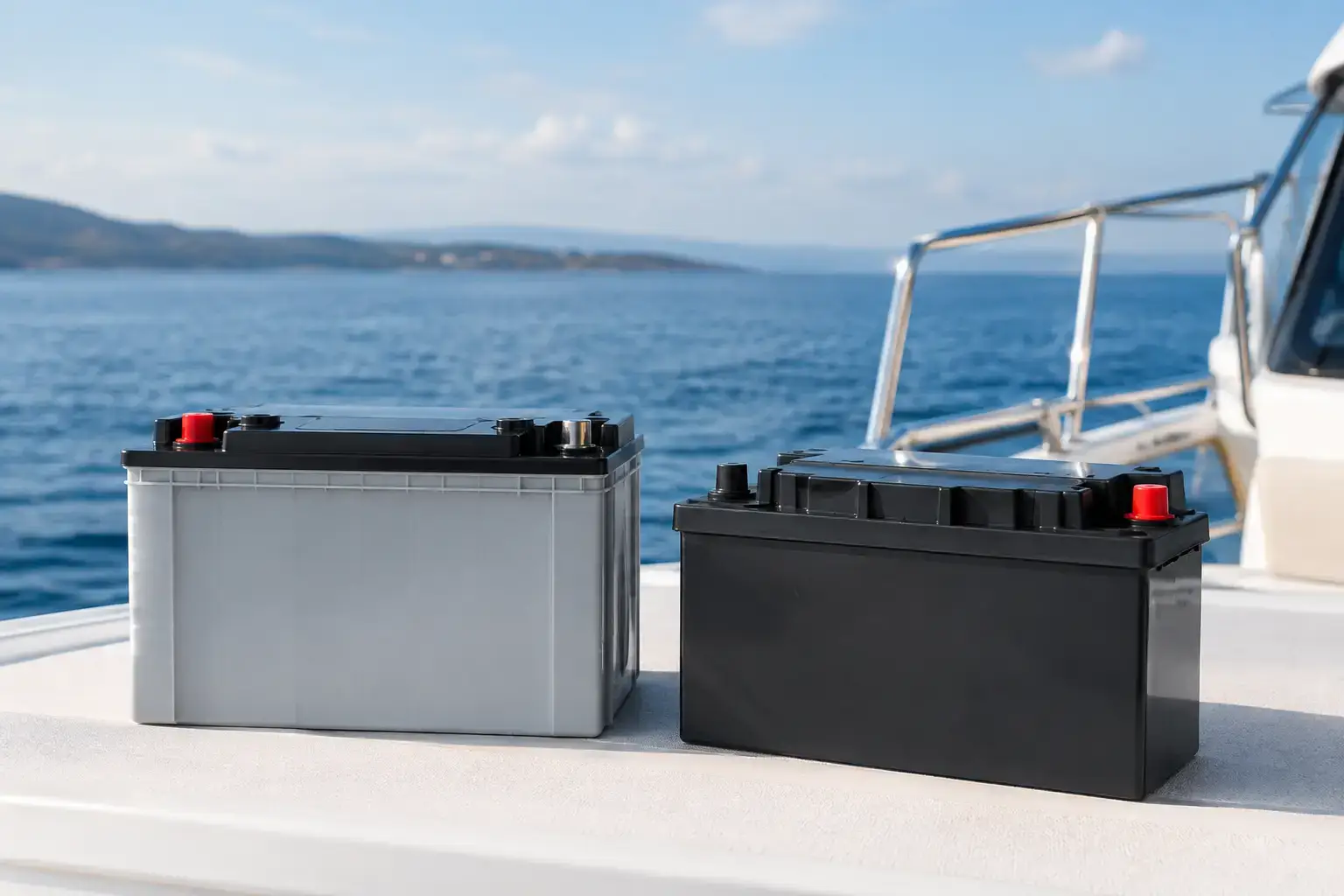
A battery may seem like a simple component in a marine system until the refrigerator shuts off overnight, the bow thruster loses power, or the engine fails to start after anchoring. The question of AGM or gel batteries is therefore not merely about declared price or available storage space. The answer depends on your vessel's actual consumption, charging method, operating mode, and condition of the existing installation.
Both technologies belong to sealed lead-acid VRLA batteries. They do not require regular addition of distilled water, are more resistant to electrolyte spillage than traditional open batteries, and are suitable for many marine applications. However, AGM and gel batteries do not tolerate the same operating conditions equally well. Choosing the wrong type or improperly setting the charger can significantly shorten their service life.
AGM or Gel Batteries: Key Difference
In an AGM battery, the electrolyte is absorbed in a glass fiber separator. This design allows for low internal resistance, enabling AGM batteries to deliver high current in a short time. Therefore, they are often chosen for engine starting, bow thrusters, winches, and combined systems where both starting capacity and moderate cyclic use are required.
In a gel battery, the electrolyte is bound in a gel. They are generally better suited for slower and deeper discharges in service banks, such as for lighting, pumps, refrigerators, instruments, and other continuous consumers. However, gel batteries are more sensitive to overvoltage during charging and typically accept charging at a slower rate than comparable AGM batteries.
This basic distinction does not replace checking the specifications of a particular model. Some AGM models are primarily designed for cyclic use, others for engine starting. The same applies to gel types. Markings on the casing alone are insufficient for a correct decision without insight into capacity, allowable discharge current, recommended charging profile, and actual battery function on the vessel.
When is an AGM Battery a Justified Choice?
An AGM battery makes sense when the system requires higher instantaneous currents, rapid acceptance of charging, and good resistance to typical vibrations on the vessel. It is often installed as a starter battery for the engine, but also as a service battery on vessels with sufficiently powerful alternators, shore chargers, or solar regulators properly set for the AGM profile.
For vessel owners, this can be a practical solution if limited charging time is available between voyages. AGM batteries usually accept higher charging currents more efficiently than gel batteries, provided the charger is adequately sized and cables, fuses, and connectors are implemented without unnecessary voltage losses.
However, AGM is not a battery that should be regularly discharged fully. For lead-acid batteries, deep and frequent discharges accelerate capacity loss. Reliable operation of a service bank requires planning consumption so that the battery does not regularly operate at the limit of allowed discharge. Capacity expressed in ampere-hours should be considered together with expected daily usage and available charging sources, not as an isolated figure.
When are Gel Batteries a Better Choice?
Gel batteries can be a very good solution for service systems with moderate, long-term discharge and predictable charging. They are suitable for vessels where the battery bank powers consumers during multi-day anchorage, provided charging is designed according to their requirements.
Their advantage is evident when cyclic use is important, and consumers do not require very high surge currents. But precisely for this reason, gel batteries are not automatically the best choice for every service system. If the alternator, charger, or solar regulator use a profile with too high absorption voltage, gas can form, and permanent damage to the gel structure may occur. Such damage often cannot be repaired by service intervention.
Therefore, gel batteries must not be chosen under the assumption that all sealed batteries are mutually interchangeable. It is necessary to check the settings of each charging source on the vessel, including alternator, shore charger, solar regulator, generator, and any DC-DC charger.
Charging is More Important than Chemistry
The highest-quality battery will not achieve its expected lifespan if the charging system is incorrectly set. On many vessels, a new battery bank is found connected to an old charger with a generic profile or to an alternator without proper regulation. The result can be chronic undercharging, overcharging, or charging at a voltage lost due to undersized or corroded cables.
AGM batteries generally tolerate a higher absorption voltage than gel batteries, but exact values are specified by the battery manufacturer. Temperature further changes the charging requirements. A battery located in a warm engine room should not be treated the same as a battery in a cooler, ventilated space. Chargers with temperature sensors and proper compensation can significantly reduce the risk of improper charging.
Special caution is necessary regarding the equalization voltage function. The procedure used for some open lead-acid batteries is usually not suitable for AGM or gel models unless explicitly allowed by the manufacturer. Activating the wrong charger profile can shorten the entire bank's lifespan in a single charging cycle.
What to Check Before Replacing a Battery Bank
Before deciding, it is necessary to determine the function of each battery. Starter battery, service bank, generator battery, bow thruster, or safety consumers do not necessarily have the same requirements. Mixing different technologies is possible only if charging circuits are properly separated and each circuit receives the appropriate profile.
When assessing an existing system, several related elements are checked:
- actual daily consumption and expected autonomy time at anchor
- battery bank capacity at relevant discharge rate, not just nominal Ah value
- power and profile of shore charger, alternator, solar regulator, and other sources
- cable cross-sections, voltage drop, connection condition, main fuse, and distribution components
- available space, load capacity, ventilation, and safe access for service
- age and condition of existing batteries, especially if only one new battery is planned to be added.
In the same series or parallel battery bank, batteries should be of the same technology, capacity, age, and preferably the same model. Connecting a new battery alongside an old weak battery often leads to uneven operation. The new battery then takes the larger share of the load, while the old limits charging and the overall system capacity.
Battery Condition Monitoring Changes System Management
Voltage alone is not a reliable indicator of the actual state of charge, especially while the battery is charging or powering larger consumers. A quality battery monitor that measures charging and discharging current provides a more informative picture of consumption, remaining capacity, and battery bank condition.
Such monitoring is particularly useful on yachts and charter vessels where multiple users operate the system and consumption habits are not always consistent. It can alert to unusual discharges, consumers left active, or charging that does not reach expected levels. Preventive maintenance thus becomes a concrete process, not just an assessment of whether the engine will start tomorrow.
AGM, Gel, or Another Technology?
For some vessels, the answer will be neither AGM nor gel batteries. If higher available capacity, lower weight, frequent cyclic discharge, and faster charging are required, a LiFePO4 system may be a technically justified solution. However, such an upgrade requires a detailed check of the alternator, protections, BMS, charger, wiring, and the entire energy concept. It is not a matter of replacing a battery of the same format.
AGM and gel batteries still have a clear role on many vessels, especially when the existing installation, usage profile, and budget justify lead-acid technology. A good decision is not the one with the highest declared ampere-hours but the one that suits the entire system and can be reliably maintained.
Before replacing batteries, we recommend a technical check of the compatibility of charging, consumers, and the existing installation. UnLucky can perform system diagnostics, propose a suitable configuration, carry out installation and integration, and verify system operation at commissioning. Send an inquiry with data about your vessel, existing batteries, and usage method – because reliability at sea is not left to luck. Because Luck Has Nothing to Do With It.