
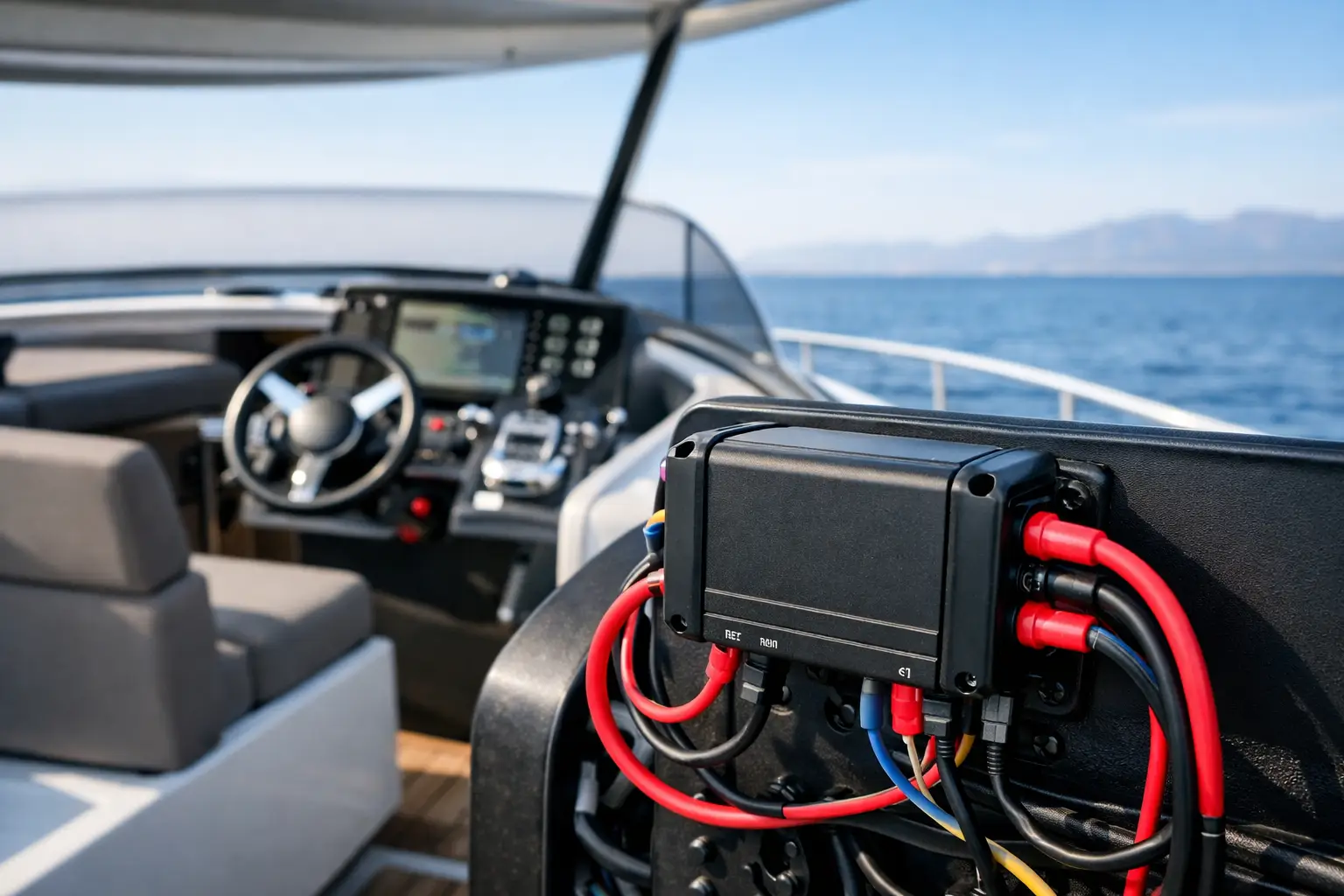
When the engine is running but service batteries charge too slowly, unpredictably, or the alternator overheats excessively, the problem is often not the battery itself. The seven advantages of a DC-DC charger demonstrate why this device is an essential part of a properly designed vessel power system, especially when upgrading to LiFePO4 batteries, larger consumers, and extended anchorage stays.
A DC-DC charger takes energy from the starter battery or alternator and delivers it to the service battery bank according to a predefined charging profile. Unlike simple relay-based battery bank connections, it controls voltage, current, and charging phases. This solves problems often revealed only after system failure: insufficiently charged batteries, overheated alternator, voltage drop on long cables, or battery chemistry mismatch.
Seven Advantages of DC-DC Chargers for Your Vessel
1. Correct Charging Profile for Service Batteries
Each battery technology has specific requirements. Lead-acid, AGM, gel, LiFePO4, and sodium-ion batteries do not accept charging identically nor at the same voltages. A DC-DC charger can be configured according to the battery manufacturer's recommendations, including absorption voltage, maintenance voltage, and allowable charging current.
This is especially relevant when the starter battery remains lead-acid, and the service bank upgrades to LiFePO4. Parallel connection of such banks without controlled charging can lead to incorrect operation modes. The DC-DC charger electrically isolates their functions and supplies the service bank with the charging it truly needs.
2. Alternator Load Control
Lithium batteries can accept high current for extended periods. This is their advantage but can become a serious thermal load for a standard marine alternator. If the LiFePO4 service bank is connected without limitation, the alternator may operate near maximum power longer than its cooling and design allow.
The DC-DC charger limits the input current to a designed value. This keeps the alternator load within realistic limits, provided that conductor cross-sections, fuses, engine room ventilation, and drive belts are also checked. The charger is not a replacement for a properly sized alternator but is a key tool in managing its load.
3. Stable Charging Despite Voltage Drop in Installation
On larger vessels, the alternator, starter battery, and service bank are often physically distant. Long cables, insufficient cross-section, corroded connectors, or existing distribution can cause voltage drops. The battery then does not receive the voltage needed for full charging, even though the engine instrument shows the alternator is operating normally.
A quality DC-DC charger converts the available input voltage into a stable output voltage suitable for the service bank. This does not mean poor cabling should be left in place. On the contrary, technical inspection of cables and connections remains mandatory. The advantage is the charger reduces system sensitivity to normal voltage variations during engine operation.
4. Separation of Starter and Service Functions
The starter battery has one priority: reliable engine starting. The service bank powers navigation, refrigeration, communication equipment, pumps, lighting, inverter, and other consumers. When banks are connected only via a classic relay, their behavior depends on the instantaneous voltage and condition of both batteries.
The DC-DC charger allows a clearer separation between energy sources and consumers. Engine starting remains protected, while the service bank is charged in a controlled manner after the system recognizes appropriate operating conditions. Certain installations also use engine run signals or smart voltage recognition, depending on alternator type and existing electrical architecture.
5. More Efficient Use of Engine Running Time
Engine hours are a limited resource, especially when the engine is started solely to charge batteries at anchor. The DC-DC charger allows you to direct the available alternator power predictably to the service bank within the chosen current limits. This can significantly improve energy recovery during sailing or brief generator operation.
However, higher charger power is not automatically better. Chargers rated at 50 A, 70 A, or 100 A must correspond to battery capacity, continuous alternator power, engine running duration, and actual consumption profile. An undersized charger will underutilize available energy, and an oversized one may unnecessarily load the alternator and installation.
6. Improved System Monitoring and Diagnostics
Modern DC-DC chargers often provide monitoring of input and output voltages, charging current, temperature, and status of individual operating phases. Combined with battery monitors and vessel system supervision, the captain or crew gains a clearer picture of energy sources and consumption.
This has practical value during diagnostics. If the service bank does not reach expected capacity, it is possible to check if the charger is operating, if the engine signal is activated, if voltage drop occurs at the input, or if there is a problem with the battery and its BMS. Without such data, faults are often sought by trial and error—a method unsuitable for marine service procedures.
7. Safer Integration with BMS and Other Sources
In LiFePO4 systems, the BMS may disconnect charging due to overvoltage, undervoltage, or battery temperature extremes. If the alternator is directly connected to a bank that suddenly disconnects, unwanted voltage spikes may occur. A properly integrated DC-DC charger, along with appropriate alternator control and protection devices, reduces this risk.
Its role becomes even more important when the vessel uses multiple energy sources: solar regulators, shore chargers, generators, inverter-chargers, or electric propulsion. Each source must have a defined function and properly set voltages. The energy system is not a collection of separate devices but a whole in which one incorrect setting can affect all other components.
What to Check Before Selecting a DC-DC Charger
Selection starts with reviewing the current state, not the nominal charger power. It is necessary to determine the alternator type and power, starter and service battery capacity and chemistry, expected daily consumption, component locations, and the cross-section and condition of existing cables. Checking alternator control methods is also vital, as smart alternators on newer engines may operate with variable voltage.
Protection elements are equally important. The charger must have properly sized fuses on input and output, suitable conductors, secure connections, adequate ventilation, and a service-accessible position. For lithium systems, charger parameters must be coordinated with the BMS, temperature sensors, and allowable charging current of the battery bank.
Installation Is Part of the Solution, Not a Final Formality
Installing a DC-DC charger is not merely connecting a few cables. It requires technical compatibility checks, protection design, correct cable routing, charging profile configuration, and load testing. After commissioning, voltages, currents, alternator temperature, and system behavior under real operating conditions must be verified.
UnLucky approaches such tasks comprehensively: inspecting existing installation, selecting compatible equipment, installation and integration, configuration, and diagnostics after commissioning. If you plan a new service bank, solar system, or want to solve unpredictable charging during navigation, send an inquiry with basic details about your vessel and existing power system. Charging reliability is not left to chance - Because Luck Has Nothing to Do With It.