
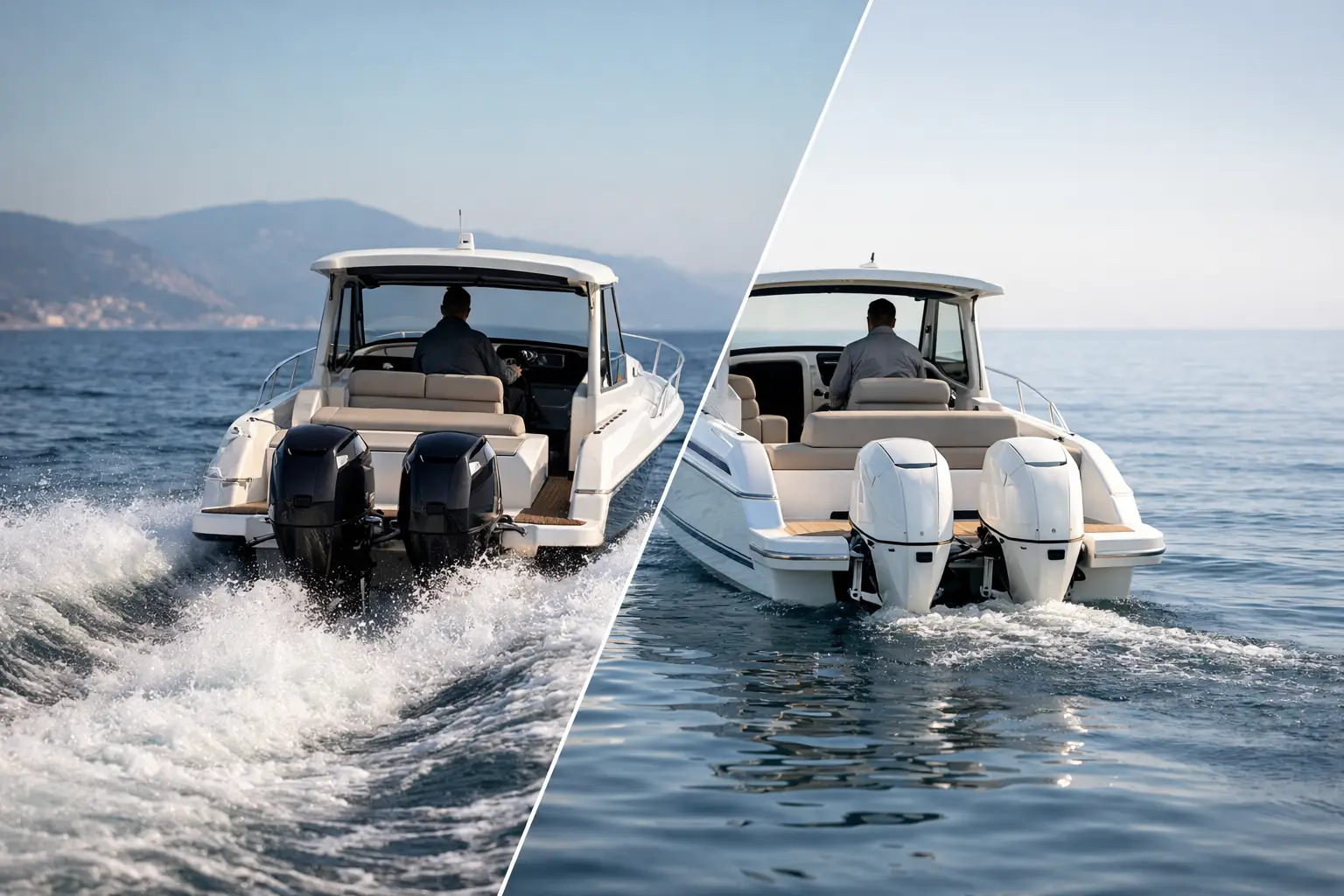
An electric propulsion system is not automatically the better choice, just as a diesel or petrol engine is not always more practical. The crucial factor in the Fuel VS Electric decision is not current popularity, but how you actually use your vessel: how far you travel, at what speed, how often you dock, and how much energy other onboard systems require simultaneously.
For a day boat that regularly recharges batteries in its home port, electric propulsion can greatly simplify operation and reduce noise. For a motor yacht undertaking long passages, operating under load and requiring predictable range without relying on infrastructure, conventional fuel still holds a significant technical advantage. The correct decision begins with analyzing the navigation profile, rather than selecting an engine from a catalog.
Fuel VS Electric: A Matter of Energy, Not Just Engines
The main difference between fuel and batteries is the energy density stored. Liquid fuel carries significantly more energy per kilogram and liter than today's marine battery systems. Therefore, a fuel tank sized for multi-day passages is spatially and mass-efficient compared to a battery pack needed for equivalent autonomy.
Electric propulsion, on the other hand, converts energy into thrust with very high efficiency and delivers instant torque. There is no idling, no engine oil changes, less vibration, and fewer moving parts in the drive system. However, an efficient electric motor does not eliminate the need for energy. If batteries are not properly sized, if charging isn't available, or if the vessel is exposed to unfavorable conditions, limitations emerge rapidly.
Thus, comparisons must consider the entire system: propeller, reduction gear or direct drive, battery capacity, BMS, chargers, shore power, solar sources, generator if present, and actual consumption at different speeds. The motor is only one part of the equation.
When Electric Propulsion Makes Sense
Electric propulsion is particularly justified on vessels with predictable and shorter routes. Examples include tenders, day boats, smaller workboats in marinas, sailing yachts that primarily use the engine for maneuvering and short excursions, and vessels on inland waters where noise and emissions are especially restrictive factors.
The greatest benefit is if the vessel can regularly recharge between uses. Overnight shore charging changes the entire calculation. The battery system then does not have to be designed for multi-day autonomy but rather for a clearly defined daily cycle. In such scenarios, electric propulsion can be quiet, clean, and operationally simple.
An electric system can also be a good choice in a sailing yacht refit, but only after assessing hull resistance, expected engine speed, and available space for batteries. A sailing yacht requiring several minutes of engine use to exit a marina has very different requirements than one frequently running the engine for hours during calm summer conditions.
Solar panels can extend house consumption autonomy and contribute to charging, but rarely fully cover the energy needed for serious propulsion. On decks with limited surface area, the solar system should be viewed as part of the energy balance, not as a replacement for charging infrastructure or a sufficiently large battery pack.
Where Fuel Retains an Advantage
Diesel and petrol systems retain their advantage when long range, quick refueling, and availability in diverse ports are necessary. Refueling tanks is fast, and additional autonomy comes with relatively little mass increase. This is important for motor yachts, fishing vessels, commercial operations, charter fleets with varying routes, and navigation in areas without reliable coastal electrical grids.
Traditional propulsion requires regular maintenance: fuel system, filters, impeller, cooling system, exhaust, oils, belts, and service intervals. Proper preventive maintenance reduces downtime risk but does not remove the complexity of internal combustion systems.
Fuel also does not cover all energy needs onboard. A modern yacht can have significant electrical loads: navigation, radar, communications, stabilization, refrigeration, winches, bow thrusters, watermakers, and air conditioning. The propulsion engine may be diesel-powered while the house system concurrently requires rigorously designed battery, charging, and distribution systems.
Range Should Not Be Assessed by Rated Power Alone
A common mistake is comparing electric and diesel engines solely by rated kilowatts or horsepower. Two engines with identical declared power may not deliver the same result on the water. Propeller diameter and pitch, transmission, vessel mass, underwater hull condition, load, and cruising speed directly impact required power.
Hull resistance does not increase linearly with speed. For displacement and semi-displacement vessels, an additional knot can demand disproportionately more energy. An electric vessel with comfortable range at economical speed may consume its available capacity rapidly at higher speeds. Therefore, range calculations must reflect real operating modes, not ideal values from promotional materials.
Technical evaluation should include at least average and peak consumptions, usable battery capacity, safety margins, expected capacity loss over time, and available charging power. LiFePO4 batteries are often suitable for marine applications due to cycle durability, stability, and usable capacity, but require properly designed BMS, fuses, conductor sizes, ventilation where needed, and coordination with chargers and alternators.
Charging Is Not a Project Detail
A high-capacity battery without an appropriate charging method merely transfers the problem from sea to dock. Before installation, it's necessary to verify the shore power connection capacity at the home marina, existing AC system condition, possibility for three-phase charging, protective devices, cable routes, and actual infrastructure limits.
For example, a battery pack may technically support fast charging but the vessel may lack a suitable charger, the marina may not have the required connection, or the existing installation might not be designed for continuous high loads. Installing a more powerful charger without checking wiring, connectors, protection, and load management is not an upgrade — it is a new risk source.
For vessels occasionally lacking shore power, roles for alternators, generators, solar panels, and possible DC-DC charging must be defined. A hybrid approach may sometimes be more rational than full conversion to electric propulsion: diesel engine or generator maintains autonomy, while the battery system handles silent operation modes, maneuvering, or overnight consumption.
Safety Depends on System Integration
Fuel safety relies on proper tanks, lines, ventilation, filtration, fire protection, and regular inspections. Electric propulsion has different risks but they are not lower if the system is implemented without professional oversight. High-voltage DC systems require correct circuit separation, short circuit protection, insulation monitoring where applicable, clear labeling, quality connectors, and defined emergency shutdown procedures.
It is especially important that battery, BMS, motor controller, chargers, and monitoring system communicate according to parameters dictated by the design. Mismatched components can cause power limitations, improper charging, unexpected shutdowns, or shortened battery system lifespan. Compatibility cannot be assumed simply because devices share the same voltage.
After installation, configuration, load measurements, protection verification, and commissioning follow. Only then can one confirm system behavior under real conditions, including maneuvering, load changes, and simultaneous operation of multiple consumers.
Cost Should Be Considered Over Entire Service Life
Electric propulsion often entails higher initial costs due to batteries, control electronics, charging equipment, and installation adaptations. On the other hand, it can reduce some maintenance and energy expenses, especially with frequent use on short routes and convenient dock charging.
Fuel systems may have lower initial investment or an already functional setup, but ongoing expenses for fuel, regular maintenance, consumables, and future overhauls must be considered. No option is universally cheaper. The key is to compare costs based on your annual operational hours, expected vessel lifespan, and service availability in your cruising area.
If planning a new propulsion system, refit, or battery system upgrade, send an inquiry with vessel data, existing installation, and usage profile. UnLucky can perform technical checks, design integration, select compatible components, and perform installation with commissioning. Because Luck Has Nothing to Do With It.