
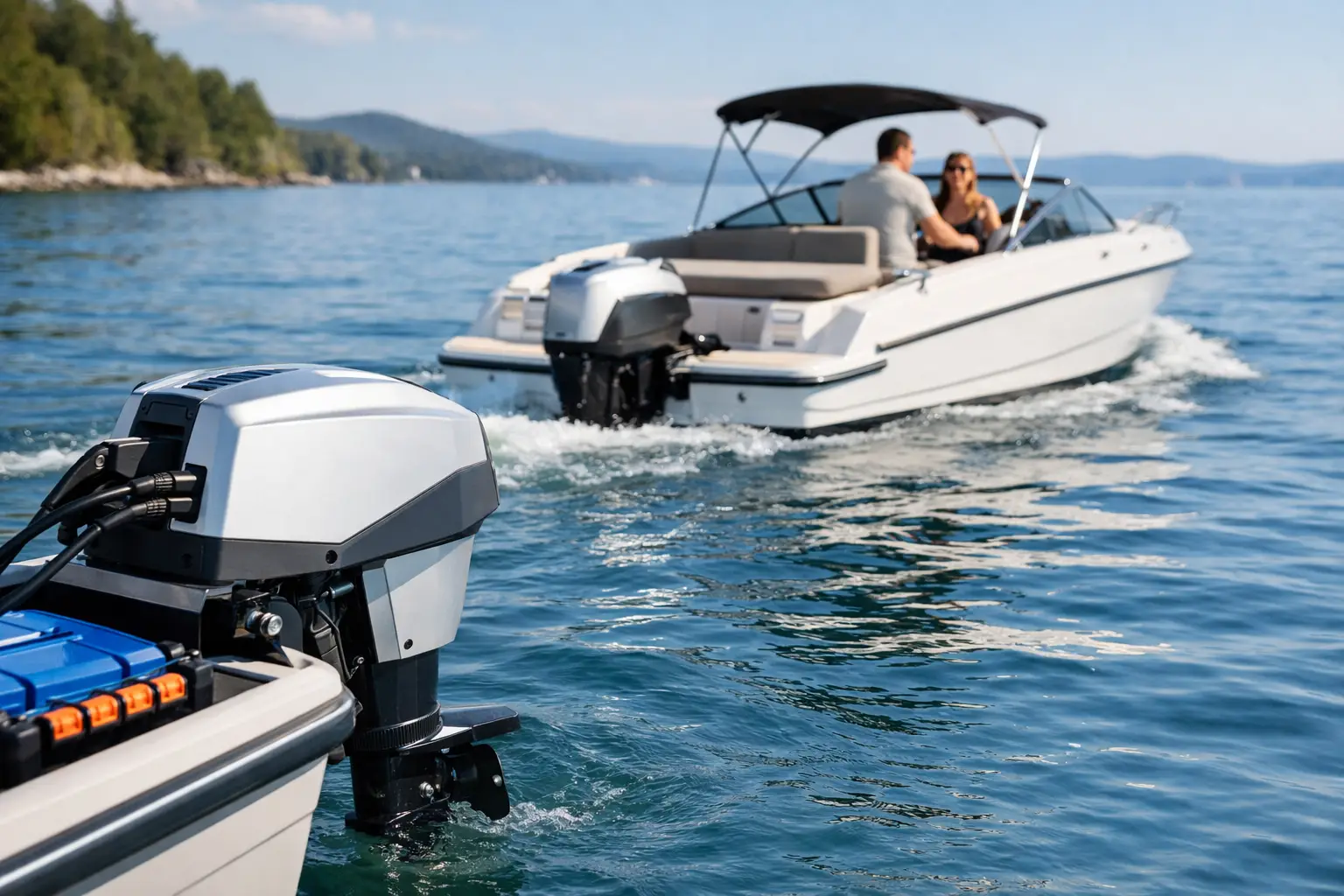
Silent departure from the marina and the instantaneous torque of the electric motor are clearly attractive. However, electric propulsion for boats is not a "old motor out, new motor in" replacement. It is an energy system that must be designed according to the vessel's displacement, hull, sailing style, desired range, available space, and existing electrical installation.
Incorrectly sized systems may perform adequately on a short test run but will reveal limitations when confronted with wind, waves, current, a loaded vessel, or the need for a safe return to port. Therefore, the decision for electric propulsion begins with a technical assessment, not merely selecting a motor by its rated power.
When electric propulsion makes sense
Electric propulsion is particularly logical for day boats, tenders, smaller sailboats, workboats on short routes, and vessels that spend most of their time in coastal waters or marinas. The benefits are concrete: no exhaust emissions at the place of operation, reduced vibration and noise, and easier routine maintenance compared to diesel or gasoline engines.
On sailboats, electric motors can be a very effective solution for leaving and returning to the harbor, especially when energy is supplemented from shore power, solar systems, or regeneration during sailing if the propulsion setup supports it. For slower displacement hulls, the power needed to maintain moderate speed is often acceptable. However, increasing speed beyond hull speed requires disproportionately more energy.
For planing powerboats that must maintain planing speed for a long time, the situation differs. Required power and battery capacity quickly increase, as do mass, cost, and charging requirements. Electrification of such vessels can be feasible but must have a clearly defined usage profile. There is no universal solution.
Technical assessment before choosing the system
The first step is to determine what your vessel actually needs to accomplish between charges. This is not the same as asking how many kilometers or nautical miles you want to cover under ideal conditions. Relevant factors include average and maximum required speed, engine operating time, number of passengers and load, typical weather conditions, and energy safety margins.
Motor power is not the same as autonomy
The motor's rated power, expressed in kilowatts, indicates how much propulsion power the system can deliver. The battery system capacity, given in kilowatt-hours, determines how long it can supply that power. If the motor consumes 5 kW at cruising speed, a 20 kWh usable battery theoretically allows roughly four hours of operation. In practice, reserves, electronic losses, battery condition, temperature, and variable loading at sea must be considered.
It is insufficient to design a system for calm waters and a brand new battery. One must define an operational scenario in which the vessel can safely maneuver, hold course against wind or current, and reach a safe berth without relying on optimistic calculations.
Hull, propeller, and transmission determine real results
An electric motor can deliver high torque at low RPM, but this does not remove the need for proper propeller selection. Diameter, pitch, number of blades, and material must suit the hull, transmission, and motor speed range. A propeller designed for a diesel engine is not necessarily suitable automatically for electric propulsion.
In some refit projects, the existing shaft and mechanical transmission are retained. In others, direct drive or a new shaft system is justified. Each option affects component layout, noise, efficiency, service accessibility, and the scope of shipyard work. Technical compatibility checks before ordering prevent costly modifications during installation.
Batteries and charging form the core of the system
The propulsion is the visible part of the project, but the battery system determines the electric vessel's practical value. For propulsion applications, LiFePO4 batteries are often considered due to their cycle durability, safety characteristics, and ability to deliver high currents. Chemistry selection alone is insufficient. Capacity, continuous and peak discharge currents, BMS, operating voltage, communication with the propulsion system, and installation conditions must be verified.
The battery pack must be mechanically securely mounted, moisture-protected, and properly ventilated according to the chosen equipment’s requirements. Cables, fuses, main switches, contactors, and short-circuit protection are sized based on actual system currents, not on the assumption that all DC conductors are equal. At higher propulsion battery voltages, insulation monitoring, proper labeling, and a clear emergency shutdown procedure are additionally important.
Charging must be regarded as seriously as consumption. Shore power may be the basic energy source, but charger power must match the available connection and marina stay duration. Solar systems can significantly support hotel loads and extend autonomy but rarely cover energy for substantial propulsion alone. When using a generator, realistically assess whether a hybrid concept offers advantages over classic propulsion.
Integration with existing onboard systems
Electric propulsion for boats must operate alongside navigation, battery monitoring, chargers, DC and AC distribution, and hotel consumers. It is especially important to separate the propulsion battery bank from the service bank where the design demands, with clearly defined charging methods and consumption priorities.
System monitoring should provide the captain or owner with understandable data: state of charge, current consumption, estimated remaining runtime, battery temperature, charge status, and any active alarms. Data without proper configuration can create a false sense of security. For example, range estimates must be based on actual current consumption, not just nominal battery capacity.
Installation includes practical matters often overlooked: location of the main disconnect, serviceability without dismantling other components, protection of cable entries, and accessibility of all connections for inspection. Quality installation is not just neat at handover. It must remain clear and reliable after seasons of vibration, moisture, and regular use.
Real limitations are not drawbacks, but design data
Electric propulsion does not eliminate the need for route planning. Range changes with speed, sea state, load, and temperature. Charging in marinas depends on infrastructure availability, connection power, and time spent. For vessels making long routes or requiring high speed without reliable charging, conventional or hybrid concepts may remain a more rational choice.
Therefore, the assessment should be conducted before selecting equipment. A good design does not promise what physics and available energy cannot deliver. It defines system boundaries and ensures they are acceptable for how you actually use the vessel.
From design to commissioning
A quality project begins with inspection of the vessel and existing installations. After analyzing the sailing profile, available space, weight, and energy requirements, a proposal of compatible components is prepared. This is followed by system design, installation, and integration of motor, batteries, charging, protection, and monitoring.
After physical installation, configuration, measurements, protective function checks, and commissioning are necessary. Trial sailing serves to verify loads, consumption, temperature, and propulsion behavior under real conditions. Only then does the system gain the expected value: predictable operation, clear data, and the possibility of preventive maintenance.
If you are considering electric propulsion for a new vessel or refit of an existing one, send an inquiry with basic vessel data and usage profile. UnLucky can carry out a technical assessment, propose a feasible system, and undertake installation, configuration, and post-commissioning support. Because Luck Has Nothing to Do With It.